Developers proposing to undertake public utility works in/on/over a State-controlled road: supplementary information requirements for Road Corridor Permit applications#
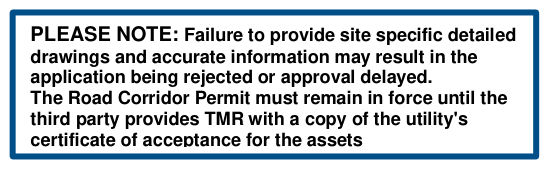
This document outlines the supplementary material required for a Road Corridor Permit (RCP) application by a developer, where the developer proposes to undertake public utility installations to form part of the future public utility network in the State-controlled road corridor. The Department of Transport and Main Roads (TMR), recommends that a public utility works agreement be issued by TMR to the relevant public utility provider prior to the developer applying for a RCP. This order of approvals is more likely to lead to a suitable location for the infrastructure in a state-controlled road and the developer receiving a RCP for the infrastructure. Once the public utility provider has received a works agreement and reference number from TMR, the public utility should provide the TMR reference number to the developer. The developer can then apply for a RCP, making sure to include the reference number with the application. TMR requires the supplementary information and the TMR reference number for the works agreement with the public utility provider to effectively assess the road corridor permit application by a developer. A complete application is beneficial to both the applicant and TMR to ensure the assessment of an application can be undertaken in a timely manner.
What you need to provide#
The following information should be provided to TMR with a completed RCP application:
- 1.Public utility works agreement TMR reference number.
- 2.Deed of Indemnity in favour of TMR.
- 3.Proof of Liability Insurance.
- 4.Authorisation from the public utility to undertake the specified works.
- 5.Description of the proposed works, including:
- a.The category/type of work being undertaken (that is, overhead or underground installation).
- b.The type of asset being installed/maintained (for example underground conduit, poles).
- c.The number of conduits/poles affected.
- d.Details of any additional requirements that may be required for the installation works (that is, proposed locations of compounds/site huts, additional land requirements for bore strings, exclusion zones, clearing requirements etc).
- e.Minimum technical information requirements (incorporating certified for construction drawings).
Technical information requirements#
In order to assure TMR the works comply with the Professional Engineers Act 2002 (Qld), the developer is required to supply Registered Professional Engineer, Queensland (RPEQ) 'certified for construction' drawings, detailing as a minimum:
- a)The type of service to be installed, including, but not limited to:
- size
- material proposed to be used
- enveloper size
- enveloper material
- pressure/kV
- cable type and size
- any associated infrastructure (for example, valves, pits, poles, manholes, thrust blocks).
- b)Locality plan including local streets, nearest cross roads, adjoining property ID number, and so on.
- c)Scaled plan view drawings identifying the service installation proposed and all existing assets owned by the public utility provider or the developer, with reference to cadastral (property) boundaries, footpaths and kerb lines and/or road edge lines so the suggested alignment is clearly described. This information is required to assist with identifying and confirming proposed alignments.
- d)All road crossing details including orientation, proposed installation method, load bearing capacity calculations, and so on.
- e)Typical sections identifying all trench reinstatement details including pavement reinstatement.
- f)All bore details including location of entry and exit points, depths, diameter, proposed pressurised grout/flowable material, enveloper size, enveloper type, and so on.
- g)Plans must be readable on A3 and should meet TMR Drafting and Design Presentation Standards.
Alternatively, the developer may submit the RPEQ 'certified for construction' drawings previously approved for the public utility works agreement, where these drawings meet the above Technical Information Requirements, and no changes have been made to the planned construction. If you have any questions or require assistance in completing the permit application, contact your nearest TMR office. To find out which office is your local office, call 132380 or go to www.tmr.qld.gov.au/About-us/Contact-us/In-person/Roads-offices.aspx