Special Event Traffic Marshal Scheme overview#
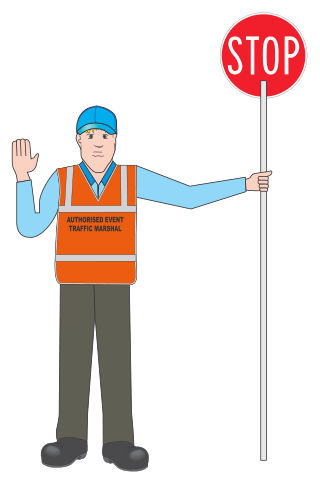
The Event Traffic Marshal (ETM) scheme enables volunteers to be engaged by event organisers to undertake basic traffic control tasks at permitted special events in Queensland. The scheme provides sporting, community and special interest groups with an alternative option in circumstances where accredited Traffic Controllers may not be required for basic and low risk duties. Event Traffic Marshals (ETMs) can have a very important role to ensure that special events proceed smoothly without disruption, and in reducing costs to community and sporting organisations to run events. ETMs may only undertake basic STOP/SLOW traffic control duties during a special event, if ETM locations are specified on the Traffic Guidance Scheme (TGS) for the event. ETMs must satisfy all pre-requisites described in the Event Traffic Marshal – Special Event Approved Procedure (ETM Approved Procedure), and control traffic in accordance with that procedure. An ETM’s authority to control traffic is only for the specific event (and period of time) stated on the Notice of Engagement issued by the Event Organiser (the Special Event Permit holder).
Why is traffic management needed for special events?#
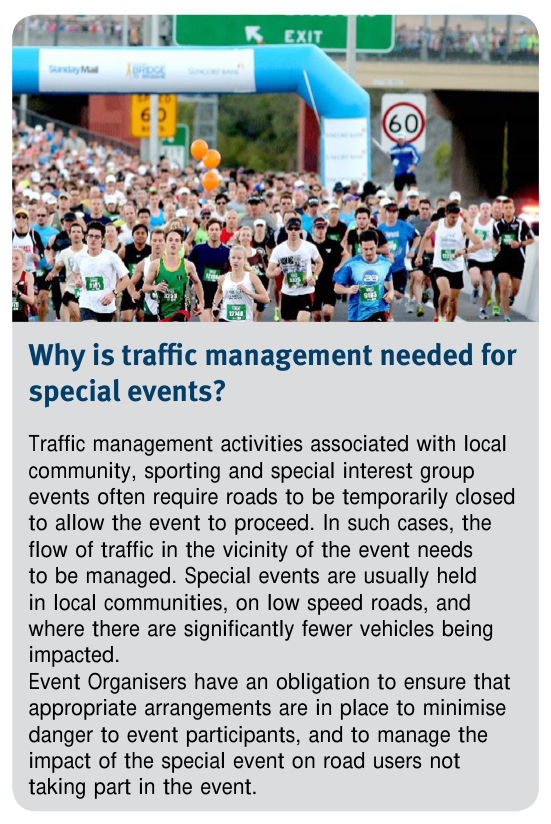
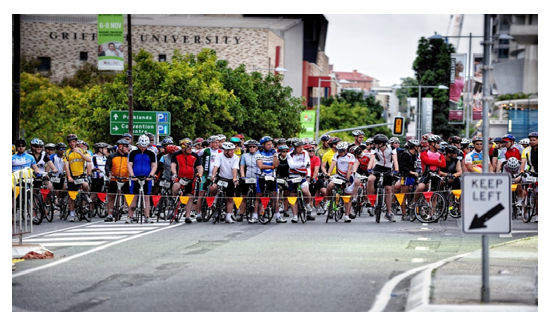
Traffic management activities associated with local community, sporting and special interest group events often require roads to be temporarily closed to allow the event to proceed. In such cases, the flow of traffic in the vicinity of the event needs to be managed. Special events are usually held in local communities, on low speed roads, and where there are significantly fewer vehicles being impacted. Event Organisers have an obligation to ensure that appropriate arrangements are in place to minimise danger to event participants, and to manage the impact of the special event on road users not taking part in the event.
Background to the ETM Scheme#
The scheme is administered by the Department of Transport and Main Roads. The department is responsible for setting the standards for traffic management to be applied across Queensland roads. The department also manages Queensland’s state-controlled road network. The scheme was introduced in August 2017 following consultation with community, industry and government stakeholders. The department received feedback from a number of Councils, community service organisations, Event Organisers and sporting associations about the prohibitive costs associated with traffic management at events, seeking a cost effective alternative to the use of traffic management service providers.
Following the release of a discussion paper in February 2017, the department received strong support for a volunteer-based ETM scheme. Volunteers traditionally contribute to events by providing a wide range of operational activities, such as setting-up of event signage; parking direction; and general guidance to spectators. Due to the ETM scheme, there is now an opportunity for event volunteers to expand their role in the implementation of the event by providing basic traffic control duties. Prior to the ETM scheme being introduced, volunteers could not provide assistance by legally controlling traffic to facilitate an event, unless they were accredited as traffic controllers by the department, or acting under the direction of Police Officers.
Benefits of scheme#
The immediate benefits to Event Organisers, and the broader community, is that event operating costs could be significantly minimised, thus making numerous sporting, social and cultural events viable to run and manage due to the substantially reduced cost of the traffic management component. The scheme is likely to be particularly useful for the following types of events:
- local street festivals and sporting events (such as fun runs) that have a minimal impact on roads and traffic flow and negligible impact on the non-event community
- local ANZAC Day marches and parades under police escort
- cycling events in regional areas that may cover larger distances, with ETMs assisting at minor side streets while accredited Traffic Controllers manage more complex locations.
Expected scheme benefits include:
- improved ability for Councils, community service organisations and sporting associations to stage special events
- increased opportunities for local communities to hold events that otherwise might not have been feasible additional business and tourism opportunities that hosting these events may introduce
- strengthened local communities - staging events using purely local volunteers, has the potential to build new skills for volunteers and other event staff
- improved opportunities for volunteers to support events in a safe and managed way
- increased work for Traffic Management Designers and accredited Traffic Controllers as a result of more events occurring.
Examples of ETM scheme requirements#
The ETM must:
- be a volunteer (not paid event staff) of at least 18 years of age
- have passed the online ETM Training Program to be eligible to be engaged as an ETM
- operate in an efficient and professional manner by undertaking duties in accordance with the ETM Approved Procedure
- be appropriately attired to control traffic at the event, by wearing a conforming orange fluorescent safety vest and enclosed shoes
- not perform traffic control duties while fatigued, or adversely affected by a substance or medication causing mental or physical impairment
- maintain a ‘zero percent’ blood/alcohol concentration while performing traffic control duties
- have a 15-minute break after two hours of traffic control duties
- carry their Notice of Engagement at all times while undertaking traffic control duties.
Accredited Traffic Controllers working with ETMs at events#
Some special events will involve both accredited Traffic Controllers and ETMs. This is likely where insufficient volunteers are available, or there is a combination of lower risk and higher risk road environments in the vicinity of the event. Unlike ETMs, accredited Traffic Controllers have authority to perform traffic control at locations that are higher risk environments, or involving more complex situations.
Accredited Traffic Controllers can undertake traffic control duties at any locations assigned to an ETM on the TGS. In such cases, the accredited Traffic Controller shall perform traffic control functions in accordance with the Traffic Controller Accreditation Scheme Approved Procedure (TCASAP), and not the ETM Approved Procedure.
What are the main differences between ETMs and accredited Traffic Controllers?#
ETMs and accredited Traffic Controllers are different in a number of ways:
- 1.The types of activities that they can undertake and the locations where they operate. Accredited Traffic Controllers are paid professionals who are competent to control traffic in a wide range of circumstances and road environments, whereas ETMs are authorised to control traffic in very limited circumstances relevant to just that event.
- 2.The type of authority they hold. Accredited Traffic Controllers hold a three-year regulatory authority (an industry licence) that is widely transportable in the industry, whereas ETMs are only authorized when engaged by event organisers and may only control traffic at the designated locations on the TGS for the duration of the event.
- 3.Training and other prerequisites. ETMs are required to undertake an online ETM Training Program. Prior to commencing duties, the volunteer must be checked by the event organiser as being suitable to perform the role. In contrast, accredited Traffic Controllers are subject to government pre-requisite checks; a rigorous assessment in a national competency for controlling traffic with a STOP/SLOW bat; and a requirement to have undertaken 20 hours of practical experience under close supervision, before being eligible for the authority as an industry professional.
- 4.Accountability. In the case of accredited Traffic Controllers, the traffic management company, worksite manager and the Traffic Controller are all accountable if traffic control is not performed properly and safely.
Event Organisers and ETMs have a duty of care, and must be road safety aware at all times.
In the case of ETMs, the individual is accountable to comply with the ETM Approved Procedure.
There is also an onus on the Event Organiser to be fully accountable for the selection, management, insurance and supervision of ETMs, and for placing them at locations specified in the approved Traffic Management Plan/TGS for the event. The event permit could be cancelled, or modified, if the Event Organiser fails in these important obligations.
Road users must not disobey a lawful direction or signal given by an ETM or a Traffic Controller using a STOP/SLOW bat. Accordingly, a Police Officer may issue a penalty infringement notice against a road user who has contravened an official traffic sign. The contravention is an offence against Section 74 of the Transport Operations (Road Use Management) Act 1995.