
4Operating procedure#
4.1Clothing#
ETMs are required to wear a compliant orange fluorescent safety vest as an outer garment at all times while conducting assigned traffic control duties.
Figure 4.1 shows an example of the safety vest to be used. The vest shall comply with:
- colour and fluorescence: Class F in Australian Standard AS/NZS 1906.4:2010 Retroreflective materials, and
- design and placement of retroreflective strips: Class R or RF in Australian Standard AS/NZS 4602:1999 High visibility safety garments.
The recommended text / stencilling is ‘EVENT TRAFFIC MARSHAL’ or ‘AUTHORISED EVENT TRAFFIC MARSHAL’. The text is optional.
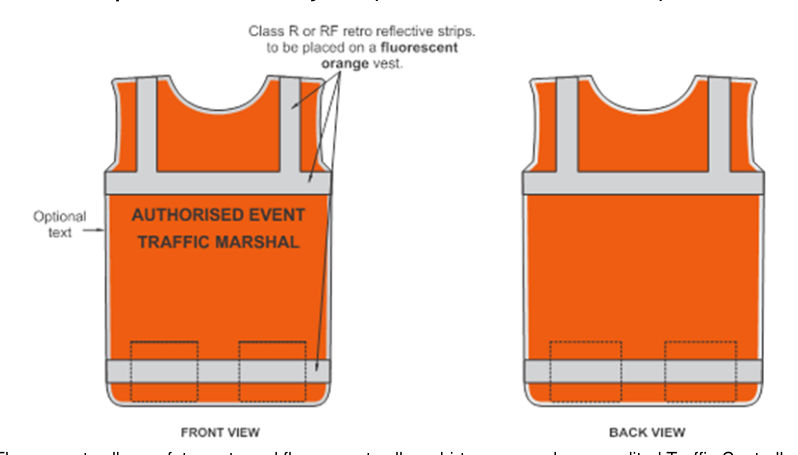
When undertaking STOP / SLOW duties, vest sides / buttons / VELCRO must be fastened.
In cases of rain, the orange fluorescent safety vest must be worn on the outside of weather protection garments such as rain coats.
In addition to wearing an orange fluorescent safety vest, an ETM should be suitably attired for the task and conditions. For example, the ETM is expected to wear:
- enclosed shoes
- long sleeve shirt and long pants
- sun protection during daylight hours (hat or cap, sunglasses, sunscreen and so on).
Hats or caps or other clothing worn by ETMs may have event logos or text indicating the event name.
4.2Equipment#
4.2.1STOP / SLOW Bat#
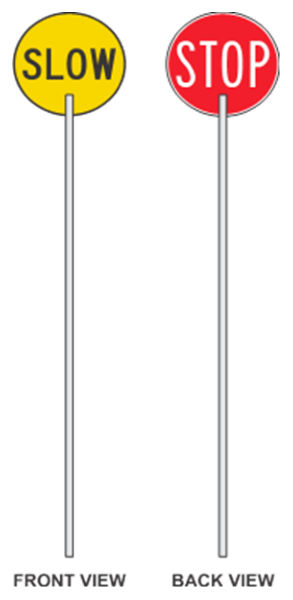
An ETM shall use a STOP / SLOW bat to control vehicular traffic. A STOP / SLOW bat measuring a minimum of 1.8 metres from the ground to the bottom of the STOP / SLOW sign (R6-8, R6-Q02 / T7-1) shall be used.
4.2.2Signs#
An ETM may only control traffic if a Traffic Controller Ahead / PREPARE TO STOP sign is installed. An example of this sign is shown at Figure 4.2.2.
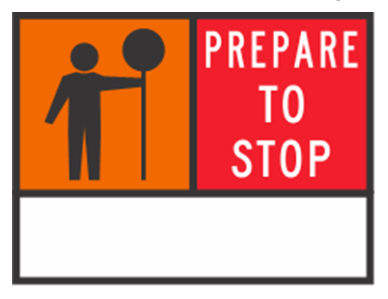
The event TGS may specify that an ETM is required to place the sign (or other official traffic signs) at locations shown on the event TGS. If a sign cannot be placed where specified, the sign should be placed nearby (within 10 metres) of the specified location in a safe area where there is a clear line of visibility to and beyond the sign.
ETMs should not place or modify any other official traffic signs (unless it is stated on the TGS that an ETM may do so).
4.3Operating instructions#
4.3.1Operational procedure for controlling vehicular traffic#
ETMs shall conduct their duties as follows:
- Only control one lane of traffic in one direction. If an ETM has been placed at a location that requires the ETM to control more than one traffic lane at a time, then the ETM shall contact the Event Organiser immediately. The ETM must not use 'shuttle flow' traffic control method – see definition at Table 5.
- Set up any signs and devices in locations instructed by the Event Organiser as specified on the TGS, and ensure that:
- the Traffic Controller Ahead / PREPARE TO STOP sign is erected correctly at the beginning of the shift
- the Traffic Controller Ahead / PREPARE TO STOP sign is removed or covered when duty is suspended throughout a shift or completed for the day.
- Position themselves in the location specified on the TGS, ensuring that:
- they have a clear line of sight to approaching vehicles and that there is enough distance for vehicles to stop safely
- they have a clear escape path to a safe section of the roadway, shoulder, footpath or median
- they are facing approaching traffic, but are outside of the projected travel path
- they are not hidden (for example, by vegetation or parked cars)
- they are not obstructing official traffic signs and devices.
- Undertake traffic control activities, giving definite and clear signals to approaching road users for the following actions (as per the procedures outlined following):
- changing from SLOW to STOP
- holding traffic
- changing from STOP to SLOW.
The following signals for traffic control are mandatory requirements for directing vehicular traffic.
4.3.2Changing from SLOW to STOP#
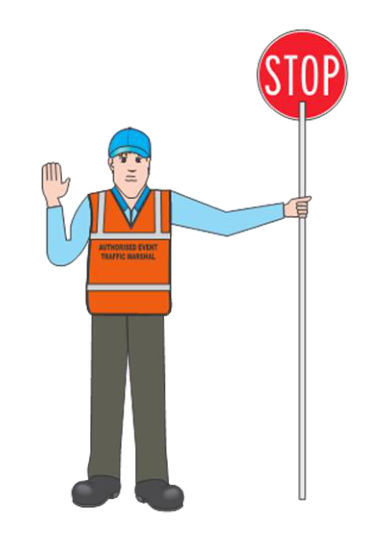
- While remaining outside the travel path (for example, on the road shoulder, closed lane(s) or footpath), the ETM shall face oncoming traffic.
- To stop vehicles, the ETM shall turn the bat to the STOP sign and raise his or her free hand into the STOP signal position with the palm towards the traffic (see Figure 4.3.2).
4.3.3Holding vehicles#
- The ETM is to continue facing the stationary vehicles and should, where possible, allow two to three vehicles to stop before stepping in front of the stationary lane of traffic.
- The ETM is to be positioned approximately 10 metres in front of the location where vehicles will be stopped.
- The ETM is to ensure that the bat's STOP sign continues to face the stationary traffic.
4.3.4Changing from STOP to SLOW#
- To allow the stopped traffic to proceed slowly, the ETM must wait until the event occurrence (that has required the stoppage of traffic) has finished and that it is safe to proceed (either by visual check or verbal confirmation from another ETM or an accredited Traffic Controller).)
- The ETM is to move to the side of the road (on shoulder, closed lane(s) or footpath) and clear of all traffic.
- The ETM is to recheck that there is no occurrence that requires the traffic to be held.
- The ETM is to turn and stand in a sideways position so all traffic can be visually monitored, then turn the bat so that the SLOW sign is facing the stopped traffic.
- With his or her free hand, the ETM is to give the TO GO signal (see Figure 4.3.4(a)).
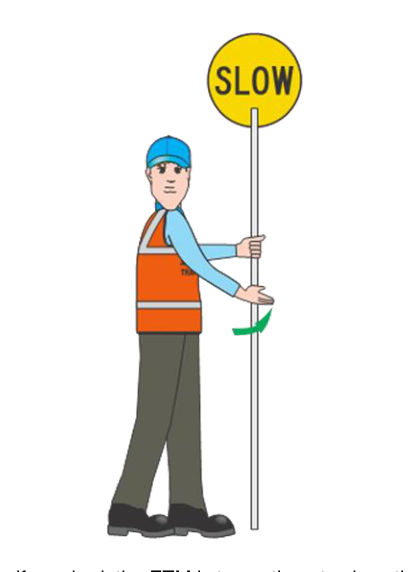
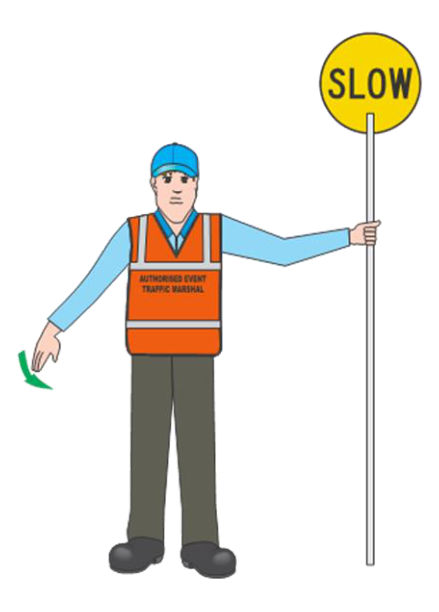
- To slow traffic further if required, the ETM is to continue to show the SLOW side of the bat facing the traffic, give the TO GO signal by moving his or her free arm up and down but not above shoulder level (see Figure 4.3.4(b)).
4.3.5Prohibitions#
While conducting their duties, ETMs shall not:
- control and direct vehicles in contravention of the event TMP and TGS (unless in an emergency)
- perform traffic control functions for complex traffic arrangements, such as:
- multiple lanes on multi-lane roads
- at signalised intersections
- at railway level crossings
- in high-risk environments
- control two (or more) lanes or directions of traffic simultaneously
- install or modify official traffic signs other than where specifically stated on the event TGS that an ETM may do so
- operate in a manner contrary to this Approved Procedure and the event permit conditions.
4.3.6Break periods#
- ETMs shall be relieved from their traffic control duty after not more than two hours for a period of rest of at least 15 minutes.
- An individual ETM should not undertake duties for more than two consecutive, two-hour periods per day (see Note following).
- The ETM shall remain at the traffic control station until directed by the Event Organiser, or representative, to leave or until relieved by another ETM or an accredited Traffic Controller.
The ETM may undertake additional traffic control shifts per day (that is, undertake traffic control duties for longer than four hours per day in total), providing the ETM is given a substantial break of at least one hour between shifts. Under no circumstances is an ETM to perform traffic control duties when tired or fatigued.
4.4Conclusion of duties#
At the conclusion of his or her shift, the ETM will:
- report details to the Event Organiser or the Event Organiser's representative, of incidents that occurred during the shift, unless those incidents have already been reported.
If not replaced by another ETM at the traffic control station, the ETM should undertake the following actions:
- ensure that it is safe to cease duty
- notify the Event Organiser or representative that the shift is concluding and that he or she is ceasing traffic control duties
- remove any temporary signs placed for the event (if traffic control is no longer required), and
- report back to the Event Organiser and return any equipment provided by the Event Organiser.
4.5Responding to incidents#
An incident is an occurrence that, in the opinion of the ETM, affects the operational safety of the public or the ETM. Examples include:
- accidents, or near misses, occurring in close proximity to the ETM’s location
- assaults or abusive / insulting / threatening language directed towards an ETM by road users
- unsafe or dangerous actions of other road users within proximity to the event
- road users disobeying a direction or signal given by an ETM.
An ETM should take action, in the following order, if an incident occurs within the designated control area:
- call 000 in the event of any medical emergency or life threatening situation
- notify the Event Organiser or their representative
- maintain effective traffic control if safe to do so, otherwise move to a position clear of danger.
4.6Event Traffic Marshal safety awareness#
Prior to commencing duty, the ETM shall undertake a personal safety risk assessment of the assigned location for the traffic control station. Due consideration shall be given to visibility, distance and any other visual obstructions that will adversely impact the ETM’s ability to undertake duties safely.
ETMs have a duty of care to ensure the safety of the public and themselves. ETMs are not obligated to fulfil their duty if they believe that they have been directed to operate at an unreasonable level of risk.
If an ETM has been incorrectly positioned at an unsafe location and cannot undertake ETM duties safely, he or she should immediately notify the Event Organiser or representative and cease any duty (if it is safe to do so).
ETMs should not abandon their traffic control stations if it will impact on the safety of event participants or stakeholders (unless there is an unreasonable level of risk) until the issue has been resolved.