1Scope and general#
1.3Terms and definitions#
1.3.3Shall#
Indicates that a statement is mandatory. Where certain requirements in the design or application of the device are described with the 'shall' stipulation, it is mandatory that, when an installation is made, these requirements be met.
1.3.4Should#
Indicates a recommendation. Where the word 'should' is used, it is considered to be recommended usage, but not mandatory. Any recommendation that is not applied must be based on sound traffic engineering judgement and documented.
1.3.6May#
Indicates the existence of an option. Where the word 'may' is used, it indicates that use of the device is conditional, or optional. Usually, no specific requirements for the design or application are intended.
1.3.7Registered Professional Engineer of Queensland#
A person who is registered as a Registered Professional Engineer of Queensland (RPEQ), under the Professional Engineers Act 2002 (Qld) with the Board of Professional Engineers of Queensland.
1.3.8Innovative treatments#
Innovative treatments that provide improved safety, efficiency, and/or value-for-money outcomes are encouraged. Such treatments may include:
- a) innovative use of current devices
- b) alternative device layouts using existing and/or improved devices, and/or
- c) new devices or practices.
New or improved devices, treatments, or practices require approval by the Department of Transport and Main Roads (see Clause 1.9 for guidance about variations to optimal treatments) prior to their use or adoption.
For trials of new or innovative traffic control devices, treatments, or practices, a submission in accordance with the requirements of the Queensland Manual of Uniform Traffic Control Devices (MUTCD) Part 1 Clause 1.13 shall be submitted to TrafficEngineering.Support@tmr.qld.gov.au.
1.4Responsibility and authority for installation#
Replace with Section 1.4 of the Queensland Manual of Uniform Traffic Control Devices Part 2.
1.6Sign design guidelines#
1.6.8Letter types#
Replace Item (e) with the following:
- (e)Cautionary legends, excluding TOLLS, associated with directions shall be black upper case letter on a yellow panel. Where a TOLL panel is required, refer to Transport and Main Roads' Traffic and Road Use Management manual Volume 3 Part 10 Signing and Pavement Marking for Toll Roads.
1.6.12Signing of dual names#
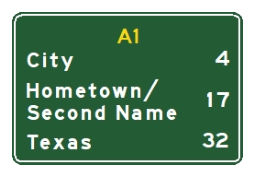
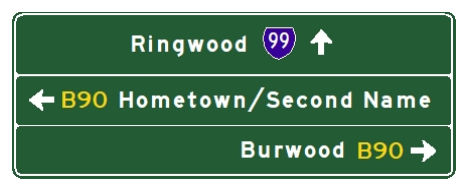
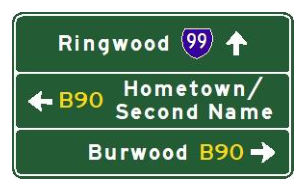
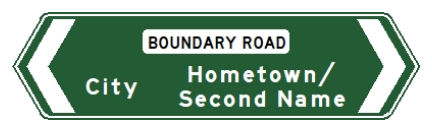
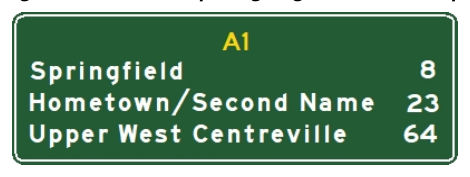
Gazetted dual named places and features listed in the Queensland Place Names Database (as shown separated by a solidus '/') shall be signed in full on directional signs in the order they appear in the database. A solidus shall be used to separate each name, with both names considered one destination. Capitalisation and punctuation of each name shall be as per the standard signing principles and requirements of this Manual (see Section 1.6).
Where the signing of dual names creates long lines of text, a line break may be included following the solidus and the shorter line of text shall be centred either above or below the longest line (except for reassurance signs, where both lines shall be left-justified and additional line spacing should be provided between adjacent destinations for visual separation). A maximum of two lines of text shall be used per dual named place or feature (see Figure 1.6.13 for examples).
1.6.13Signing of alternate names#
Where recently renamed places and features have alternate names listed in the Queensland Place Names Database (as shown in parentheses), the alternate name may be signed in accordance with Clause 1.6.12 to assist the travelling public with recognition of the new name.
Where the decision is made to sign an alternate name, a consistent approach should be applied to all applicable signs on a route. The signing of alternate names is considered a temporary measure to assist the travelling public with navigation. Alternate names should be covered up with a blank panel, once the new name is commonly recognised.
G4-1 · (a) Reassurance signs · G1-2 · (b) Advance direction signs · G2-4 · (c) Fingerboards (double chevron ended)
1.9Variation to treatments and Registered Professional Engineer of Queensland certification#
This Part of the Manual contains mandatory requirements (shall), recommendations (should) and options (may). The application of these mandatory requirements and recommendations is intended to provide the optimal level of safety and traffic efficiency. It is acknowledged that, in some instances, variations to these requirements and recommendations may be necessary and, as such, variations to these requirements and recommendations may be undertaken as follows:
- a)Where recommendations (should) are not adopted, a risk assessment shall be undertaken and certified by an RPEQ.
- b) Where mandatory requirements (shall) are not adopted, a risk assessment shall be undertaken and certified by an RPEQ.
- c) Where innovative treatments (see Clause 1.3.8) that are outside the scope of the Queensland MUTCD are proposed to be adopted, a risk assessment shall be undertaken and certified by an RPEQ.
- d) All proposed innovative treatments require approval by Transport and Main Roads prior to their use or adoption. Requests for approval of innovative treatments (including all relevant information) shall be emailed to TrafficEngineering.Support@tmr.qld.gov.au. As part of an approval to use or trial an innovative treatment, Transport and Main Roads may require that the applicant provides a detailed evaluation report on the performance and effectiveness of the treatment. Transport and Main Roads may use the results of the evaluation to identify potential future practice changes to this Part of the Manual.
- e) The use of options (may) is not a variation to the optimal treatment and does not require certification by an RPEQ.
Notifications of variations to mandatory requirements (including all relevant information) shall be emailed to TrafficEngineering.Support@tmr.qld.gov.au for information purposes and for the benefit of identifying potential future practice changes – not for approval or endorsement. These variations may include learnings that may be attributed to the variation of a shall requirement, such as operational, cost or safety impacts.