
4Documenting Traffic Management Plans#
4.7Traffic management planning and design#
4.7.3Traffic Guidance Schemes#
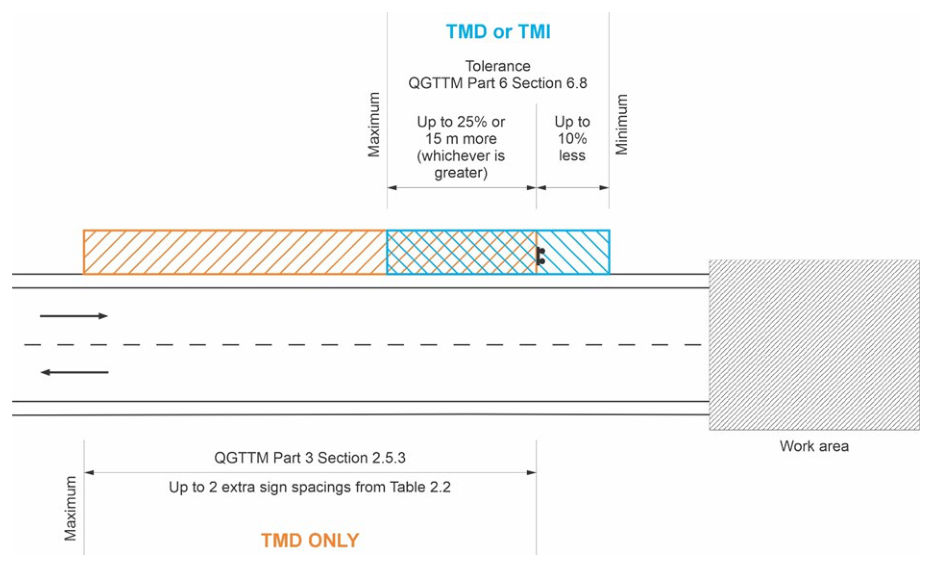
A TMD may apply tolerances (see AGTTM Part 6 Section 6.8) to the spacing requirements or increase the spacing requirements in accordance with QGTTM Part 3 Section 2.5.3 for signs and devices when preparing the design of a TGS. See Figure 4.7.3 for the tolerances that apply to a sign spacing.
If a TMD applies a tolerance, which is either the minimum or maximum allowable (as AGTTM Part 6 Section 6.8), or is so close to the maximum or minimum such that a TMI also applying the maximum tolerance as per AGTTM Part 6 Section 6.8 on site may exceed the total allowable tolerance, or uses the provisions of QGTTM Part 3 Section 2.5.3, the TMD must specify this distance as either a minimum or maximum (or provide the maximum or minimum value) on the TGS so that a tolerance is not also applied on site by the TMI which would then exceed any applicable limits.
4.7.4Documenting the risk assessments and options analysis#
The material discussed at Section 3.3 (Risk Assessment) including subsections 3.3.2 (Identify risks of each stage), 3.3.3 (Analyse the risks),3.3.4 (Identify treatment options) and 3.3.5 (Evaluate each treatment option) must be included in the TMP.
4.7.5Documenting the speed management plan, enforcement & end-of-queue treatments#
The material discussed in Sections 3.3.6 (Speed management plan), 3.3.7 (Speed enforcement) and 3.3.8 (End-of-queue treatments) must be included in the TMP.
4.9Variations#
Refer to Clause 1.9 of the Queensland MUTCD Part 3.
4.9.1Innovation#
Refer to Clause 1.5 and Clause 1.9 of the Queensland MUTCD Part 3.
4.11Monitoring#
4.11.2Site inspections and record keeping#
Replace the subsection 'Inspections' with:
Inspections should be undertaken:
- at least daily (for attended sites), or more frequently depending on location and likelihood of traffic management being disturbed
- before work starts each day
- immediately following the installation of a TGS
- before the start of work activities on site
- during the hours of work
- closing down at the end of the shift period
- periodic inspections after work hours and at night, and at unattended sites. For unattended sites, see QGTTM Part 6 Section 7.4 for requirements
- after any change in the traffic management arrangement on site, and
- following any environmental or weather events.
Provide templates for inspection registers allowing indication of:
- when traffic controls were erected
- when changes to controls occurred and why the changes were undertaken, and
- any significant observations associated with the traffic controls and their impacts on road users or adjacent properties.
Collecting information is particularly important in the event of an incident, in case legal proceedings result.