4Methodology#
The Risk Methodology is based on the Transport and Main Roads' Risk Management process and customised to ensure alignment with the context of the Traffic Management Training Program.
The methodology is applied to all licenced RTOs.
4.1Step 1. Risk Identification#
Risks can either be general risks related to the RTO Licencing Program and all licenced RTOs, or relevant to just one (or more) RTOs. Relevant factors include: Performance – data gathered about each RTO through review of previous audit outcomes, monthly report statistics, any previous issues, complaints and general feedback from various individuals who have had dealings with the RTO.
Licence Agreement Reviews – including any relevant requirements relating to Schedule 2 of the signed, current agreement.
All identified risks are described in the context of "[something happens] leading to [description of impact]".
Each identified risk indicates the source of the risk including, but not limited to:
- Advertising
- Traffic Control (TC) Placement
- Traffic Management Implementation (TMI) Practical
- Training Material
- Student Enrolment
- Assessment Records
- Assessment Method TC
- Assessment Method TMI
- 3rd Party Arrangement
- Monthly Reporting
- Training
- Trainer
- Administration.
4.2Step 2. Risk Analysis#
Individual Risk Analysis#
Each identified risk is analysed using the RTO Risk Assessment and Rating Matrix. Determination is made regarding the likelihood of the risk eventuating and the associated consequence.
The analysis considers:
- the overall consequence if training and assessment services and related outcomes are not delivered according to specified requirements
- the overall likelihood that this will occur.
Trend analysis of performance over the previous 12 months is also considered.
RTO Risk Analysis#
The collective risk information relevant to each RTO is analysed using the RTO Risk Assessment and Rating Matrix. This determines the overall risk rating for each RTO.
Analysis of the following elements of likelihood (rare, unlikely, possible, likely, almost certain) and consequence (insignificant, minor, moderate, major, severe) form the basis of allocating risk ratings for each RTO:
- Likelihood
- Total volume of students
- Total volume of training programs provided by the RTO
- Historical data regarding student issues including complaints received
- Historical data regarding employer issues including feedback and complaints received
- Historical data including feedback, complaints, warnings, or breach notices.
- Consequence
- Impact on quality of training including delivery and assessment methods
- Impact on the contractual compliance obligations to the Transport and Main Roads' RTO licence agreement
- Impact on the overall reputation of Transport and Main Roads' and the RTO program
- Impact on financial aspects of the program budget and/or funding
- Impact on program performance and capability including student completion rate.
4.3Step 3. Risk Evaluation and Treatment#
The assigned level of risk will determine the appropriate treatment strategies.
Treatment strategies are intended to reduce the overall level of risk the RTO presents to Transport and Main Roads and the Traffic Management Training program.
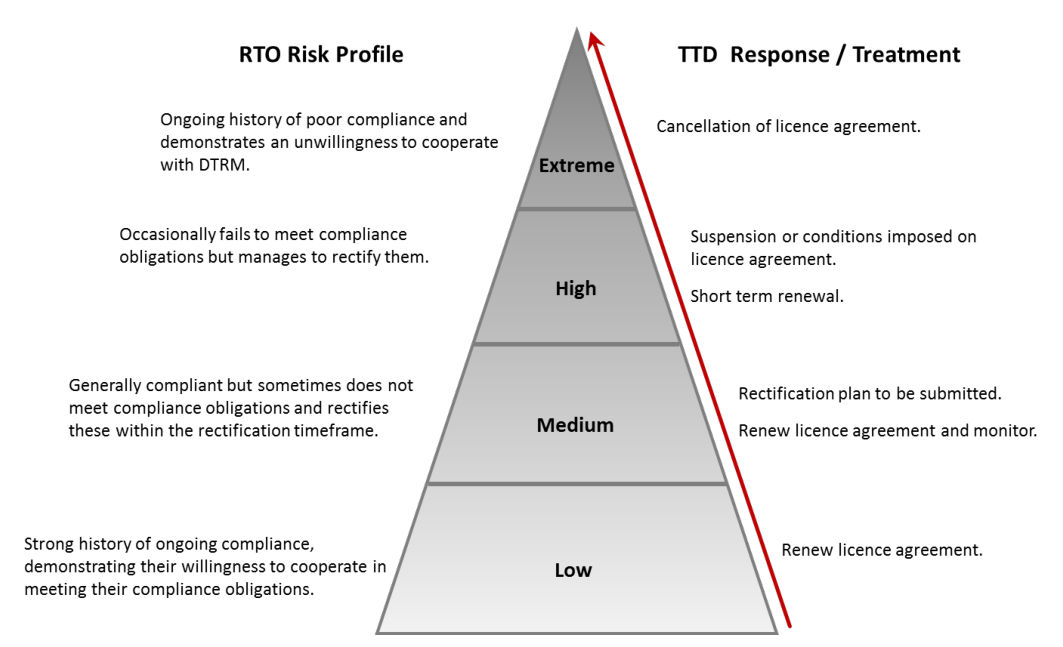
Treatment strategies will vary according to the nature and magnitude of the risk. The diagram below indicates the treatment escalation pathway employed in response to the RTO Risk Profile.
4.4Step 4. Risk Monitoring and Review#
The Technical Training and Development (TTD) team monitor and review the environment for new or changing circumstances that may have an impact on the RTO Traffic Management Training Program and related RTO Licencing Program.
The approaches outlined below address specific requirements of monitoring activities and review of the methodology and assigned RTO risk profiles.
Monitoring#
All known risks are monitored on an ongoing basis to ensure the overall level of risk remains accurate in the context of the current operating environment.
The assigned overall risk profile of each RTO is monitored through:
- the review of monthly activity reports submitted by the RTO
- feedback received from students or other interested parties in the traffic management industry, and
- RTO compliance audit results.
Ongoing monitoring influences the level of governance and oversight needed to manage licenced RTO relationships.
Review#
The Risk Methodology and related supporting documents are reviewed on an annual basis. This ensures the approach continues to remain relevant and reflect the context of the RTO Traffic Management Training Program and related RTO Licencing program.
The risk profiles assigned to each RTO are formally reviewed on an annual basis. This ensures:
- the current risk profile reflects the overall performance of the RTO during the previous 12 months, and
- considers any changes to the scope of their licence agreement.
Outcomes of the RTO Risk Profile review may influence the related compliance management program activities including the frequency of audits.