Approved Traffic Controller Training Program information#
Traffic Controller Accreditation#
To be accredited as a Traffic Controller in Queensland, the person must complete a Department of Transport and Main Roads Approved Traffic Controller Training Program. The program must be delivered through a registered training organisation (RTO) approved by Transport and Main Roads to deliver the training program.
The program must be completed within the 12-month period prior to the Traffic Controller accreditation application being lodged with Transport and Main Roads.
Accreditation as a Traffic Controller in Queensland is granted for three years.
All applicants for Traffic Controller accreditation are subject to offence history, licence history and other checks.
Prospective Traffic Controllers should refer to the department’s fact sheets, How to Become an Accredited Traffic Controller and Traffic Controller Offence History Checking Process and Medical Suitability. All fact sheets are available on the Traffic Controller Accreditation scheme web page.
In July 2017, the Department of Transport and Main Roads, in consultation with industry, released the new Traffic Controller training package.
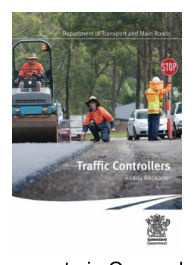
The Traffic Controller Ready Reckoner forms part of the new training package and is designed to be used as a compulsory training resource as of 1 July 2017. It serves as a quick reference guide for Traffic Controllers accredited to operate in Queensland post-training.
It is mandatory that all students undertaking both the full and renewal training will receive a Traffic Controller Ready Reckoner.
Training Program Delivery#
The training program has two parts.
Part One#
Off-the-job: In-class training program#
The program is delivered in a classroom environment using Transport and Main Roads approved training materials and resources. It includes a simulated practical exercise conducted in a controlled environment.
It is expected that the off-the-job part be delivered to trainees in eight-nine hours (nominal). This timeframe may be extended if additional training needs are identified during the training program.
Part Two#
On-the-job – Industry placement at roadwork site#
Traffic control industry employers must be confident that accredited traffic controllers can maintain an environment that is safe for Traffic Controllers, road workers and the travelling public. Trainees must demonstrate traffic control skills in ‘real world’ traffic situations and be assessed as competent before an authority card is issued by Transport and Main Roads.
Trainees must complete a minimum of 20 hours’ practical experience at a roadwork site under the direct supervision of an experienced accredited Traffic Controller. The trainee’s experience includes a range of practical activities as specified by the RTO including a significant period of STOP / SLOW traffic control activity under close supervision.
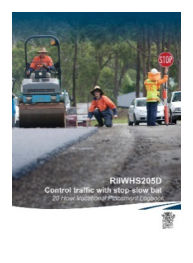
This supervision must be conducted strictly in accordance with the criteria outlined in the Traffic Controller Accreditation Scheme Approved Procedure. The practical experience is to be logged in the 20-hour vocational placement logbook.
Program assessment#
To achieve a successful outcome in the program, participants will be assessed in a range of activities. For new industry entrants this includes:
- successful completion of the written and practical assessments during the off the job component of the training program
- completion of a logbook to the satisfaction of the RTO – logging a minimum of 20 hours’ supervised experience as a trainee at roadwork sites, and
- successful onsite final assessment by the RTO after completion of 20-hour vocational placement confirming the competence of the trainee in a roadworks environment.
Certificates issued at course completion#
At the completion of the full program (parts one and two) a Statement of Attainment will be issued by the RTO.
Information for renewing Traffic Controllers#
Your Traffic Controller Industry Authority Card must be renewed every three years. To renew your Traffic Controller accreditation in Queensland you are required to demonstrate currency of industry practice as a Traffic Controller. Contact one of Transport and Main Roads approved RTO’s for renewal requirements. It is your responsibility to ensure that you maintain current accreditation when performing traffic control duties.
Traffic control duties must not be undertaken if your Traffic Controller Industry Authority Card has expired.
More information#
Training program content#
Does the approved traffic controller training program include a nationally registered unit of competency?
- Yes. The approved training package includes the national competency units: RIIWHS205E Control traffic with a stop-slow bat, RIIWHS201D Work Safely and follow WHS policies and procedures and RIICOM201D Communicate in the workplace.
- The training package is delivered in the context of traffic controlling on Queensland roads taking into account the requirements of the Manual of Uniform Traffic Control Devices (MUTCD) and the Traffic Controller Accreditation Scheme (TCAS).
On-the-job placement#
Who is responsible for arranging the placement of the trainee in the roadwork site environment to achieve the 20 hours of logged experience?
- The RTO offering the training package must organise the on-the-job experience placement of the trainee with the worksite manager and / or the registered traffic management organisation.
- No training should be undertaken unless the RTO can secure arrangements for the 20 hours worksite placement.
- The RTO must be satisfied that the trainee possesses a general construction induction card before commencing the worksite placement.
Is the Traffic Controller trainee to be paid whilst undertaking the industry placement?
- Trainees undertaking a training program including the practical experience part of the training (20 hours industry placement) are not entitled to be paid remuneration for the placement.
What are the insurance requirements for industry placements?
- The RTO conducting the training program must ensure that insurance cover is in place that indemnifies each trainee. It is the responsibility of the RTO to make the necessary arrangements with insurance providers.
- There must be no separate fee charged to the trainee for the insurance cover.
- It is not the role of Transport and Main Roads to provide any specific recommendations regarding insurance policies.
- WorkCover Queensland can provide advice to RTOs about setting up a 'training' policy.
When will the RTO issue the experience logbook to the trainee?#
- The RTO will issue a logbook to the trainee when the trainer is satisfied that the person has successfully completed off-the-job (in class) training, and is suitable to be placed in a live traffic situation to gain supervised experience (that is, to complete the on-the-job component of the course).
While on the industry placement, will the trainee be required to gain experience in a range of different traffic conditions?#
- Yes. The RTO will have arranged with the worksite host for the trainee to gain sufficient experience in a range of traffic control situations to meet course requirements. The type of experience gained is recorded in the logbook. The trainer will have explained this to the trainee when the logbook is issued.
- The trainee may be sent to more than one roadwork site if there is insufficient diversity of experience at one site.
Will the trainee have to perform tasks other than standing and directing traffic during the roadwork site placement?#
- Yes. The trainee will gain experience in a range of traffic controller functions. This may include site set-up assistance, communication on two-way radios, incident reporting and site clean-up.
What happens when the minimum 20 hours' experience has been gained and verified?#
- When 20 hours of experience is completed and recorded, the logbook is to be returned to the RTO.
- The trainer will assess the experience logged taking into account feedback received from the host site manager and any reports from the supervising traffic controllers. The trainer will determine if further experience / training is required on any specific elements.
- The trainer will then confirm that the trainee is competent through an onsite assessment.
Is there a maximum timeframe that the trainee has to complete the industry placement?#
- Yes. In all cases, the program must be completed within a three-month timeframe; however, it is generally expected that the placement will be arranged by the RTO to closely follow the completion of the theory (off-the-job) part of the program.
Proof of program completion#
What proof of training is required by the department that the traffic controller applicant has successfully completed the approved training course?#
- The applicant must provide evidence of having been issued with a Statement of Attainment by the RTO.
- The department's Traffic Controller Accreditation Application (Form F4115) requires the applicant to submit the original Statement of Attainment.
- The department will not grant the accreditation unless the approved training program has been successfully completed.
Does completion of the approved training program guarantee accreditation?#
- No. All applicants for accreditation are subject to offence history, licence history and other checks.
- Prospective traffic controllers should refer to the department's fact sheets, How to Become an Accredited Traffic Controller and Traffic Controller Offence History Checking Process (Suitability checks) and Medical Suitability (medical fitness).
- All fact sheets are available on the Traffic Controller Accreditation Scheme web page.