3Dedicated stock crossings on a SCR#
A stock crossing is a TMR approved location at which stock are moved from a paddock on one side of the road to a paddock on the other side of the road, where the stock and both paddocks are owned/leased by the same person.
Stock crossings used less than 52 times a year are deemed temporary, whilst stock crossings used more than 52 times a year are deemed permanent.
A stock crossing on a SCR, whether temporary or permanent, requires a road corridor permit under section 50 of the Transport Infrastructure Act 1994. The road corridor permit is to be in the name of the person who owns/leases (or a similar contractual arrangement to a lease) the stock and land.
When stock cross a SCR, they must be penned on the owner’s/lessee property prior to crossing and taken across the road in groups to minimise the amount of time they are on the road. The owner/lessee is responsible for the safety of traffic while stock is on the road and for the erection of signage.
3.1Stock crossing a SCR (temporary site)#
- Type of stock activity: Stock crossing at a temporary stock crossing.
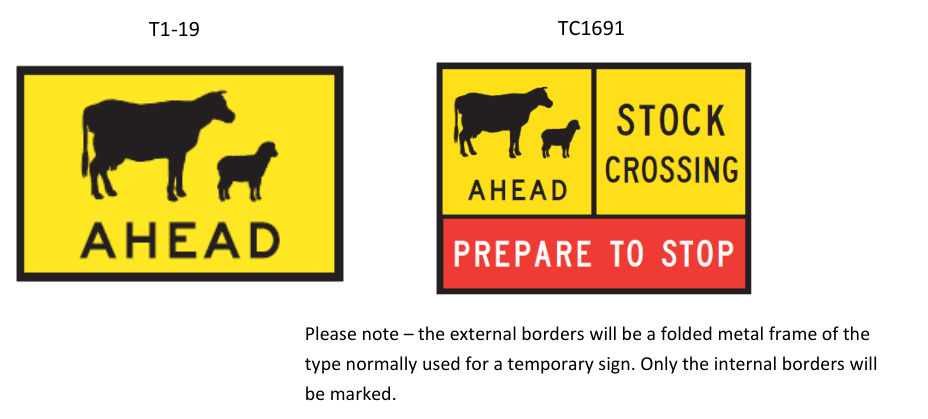
- Sign types and display times: There are 2 options for signs at temporary stock crossings. Also refer Section 3.3 for additional active signalling options for temporary stock crossings. The decision of which sign to use is that of the owner/lessee. The 2 options are as follows:
Option 1: Sign T1-19; or
Option 2: Sign TC1691.
Please note – the external borders will be a folded metal frame of the type normally used for a temporary sign. Only the internal borders will be marked.
- The T1-19 or TC1691 sign shall be displayed on a temporary basis at approved stock crossing locations.
- The sign is to be located on the road shoulder (refer to section 3.4).
- The sign shall be displayed immediately prior to and during stock movements and is to be removed immediately following the completion of stock crossing activities. However, if the sign is to be used multiple times during the day, it may be covered by an appropriate method when not in use.
- Responsibility for placing, covering or removing signs is with the owner/lessee.
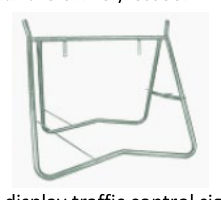
- The use of star pickets to support stock signs is prohibited. TMR recommends the use of either a timber stake or frame with a cross section no greater the 55mm x 25mm that can be easily broken on impact or a swing stand sign support as shown on the right:
- Figure 1 (refer to page 12) provides an example of how to display traffic control signs at temporary crossings. Please note, while Figure 1 shows a TC1691, a T1-19 would be displayed in the same way.
Additional requirements:
- A responsible person shall be present with the stock during the stock crossing.
- No vehicle is to be delayed more than 5 minutes by stock crossing a road.
3.2Stock crossing a SCR (permanent site)#
- Type of stock activity: Stock crossing at a permanent stock crossing.
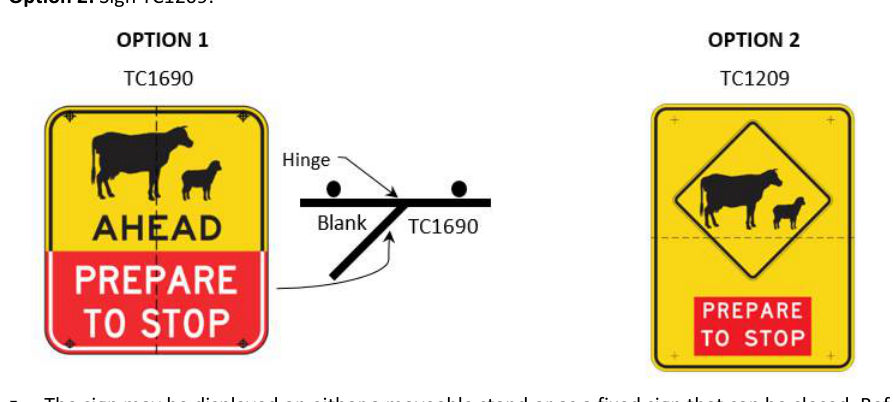
- Sign types and display times: There are 2 options for signs at permanent stock crossings. Also refer Section 3.3 for additional active signalling options for permanent stock crossings. The decision of which sign to use is that of the owner/lessee. The 2 options are as follows:
Option 1: Sign TC1690; or
Option 2: Sign TC1209.
- The sign may be displayed on either a moveable stand or as a fixed sign that can be closed. Refer section 3.4 for placement.
- The sign is to be opened or placed on display immediately prior to stock crossing the road and removed/closed immediately on completion of crossing activities. If it is a hinged sign, it is to be closed and locked when not in use.
- Responsibility for placing, covering or removing signs is with the owner/lessee.
- Figure 2 (refer to page 13) provides an example of how to display traffic control signs at permanent sites.
- A responsible person shall be present with the stock during the stock crossing.
- No vehicle is to be delayed more than 5 minutes by stock crossing a road.
3.3Stock crossing a SCR with an active signalling system (temporary and permanent sites)#
An active signalling system may be used when it is not practical or safe for the owner/lessee to open and close a hinged sign.
Sign types and display times: There are 3 options for active signalling signs with two flashing lights at temporary and permanent stock crossings. The decision of which sign to use is that of the owner/lessee. The 3 options are:
- Option 1: Sign TC1180 fitted with two flashing lights
- Option 2: A W5-38 sign fitted with the wig-wag lights on the top of the sign
- Option 3: A W5-38 sign fitted with the wig-wag lights on top and bottom of the sign.
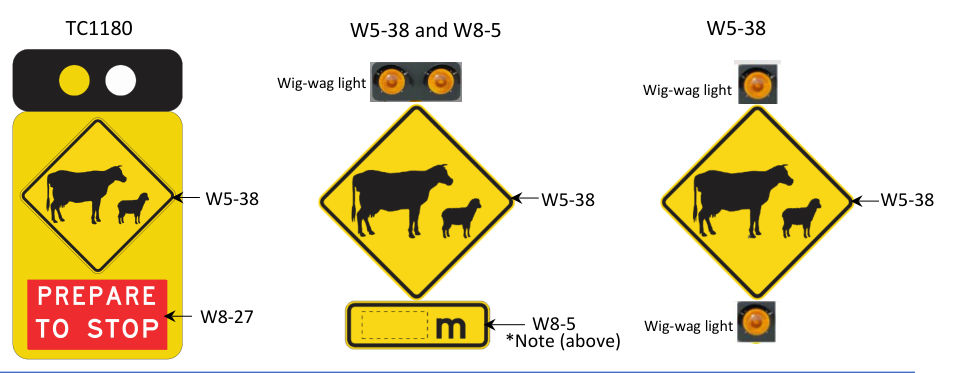
TC1180 · Wig-wag light · P R E P A R E · T O S T O P
W5-38 and W8-5 · Wig-wag light · W5-38 · W8-27 · W8-5 · *Note (above)
W5-38 · Wig-wag light · W5-38
- The owner/lessee operates the wig-wag lights immediately prior to and only when stock is on the road.
- Figure 3 (refer to page 14) shows an example of how the signs are to be displayed.
- A responsible person shall be present with the stock during the stock crossing.
- No vehicle is to be delayed more than 5 minutes by stock crossing a road.
3.4Sign placement for all stock crossings#
The sign must:
- be placed at least 1.0 metre clear of the outer road shoulder or line of guideposts
- be placed at a distance (in metres) twice the speed limit (km/h) from the designated crossing point (refer to Table 1). For example, if the speed limit is 100 km/h the minimum distance from the sign to the designated crossing point is 200 m
- allow for minimum sight distance shown in Table 1 between the sign and approaching traffic.
| SPEED (km/hr) | 1 Minimum Sight Distance to Sign for approaching traffic (m) | 2 Minimum Distance from Sign to designated Crossing Point (m) (Maximum 500 m) |
|---|---|---|
| 50 | 70 | 100 |
| 60 | 90 | 120 |
| 70 | 140 | 140 |
| 80 | 160 | 160 |
| 90 | 180 | 180 |
| 100 | 200 | 200 |
| 110 | 220 | 220 |
3.5Costs associated with stock crossings#
The owner/lessee bears all costs (for example, planning, design, installation, ongoing maintenance, replacement and removal) associated with signing on SCRs.