Traffic Management Design and RPEQs#
Worker’s interaction with construction and passing traffic represents one of the greatest risk factors on any roadwork worksite. Ensuring the safety of our workers and road users is our highest priority at all times. Over the last two years the Department of Transport and Main Roads has been working to improve the quality of traffic management on our roads through the engineering behind it, the enforcement of it, and education supporting it.
The success of traffic management on our roads is driven by the quality of the design and risk consideration, coupled with consistent implementation. Over the last 18 months the department has put significant effort into improving the training supporting traffic management design, ensuring industry personnel are operating above the minimum standard required to deliver the outcomes needed.
Traffic Management Design (TMD) training#
In July 2015 the department released the new Traffic Management Design (TMD) training course replacing the previous Traffic Management level 3. This new course reflects the minimum expectations of the department for practitioners developing Traffic Management Plans (TMPs) and Traffic Guidance Schemes (TGSs). Successfully qualifying in TMD indicates that practitioners are capable of delivering the new minimum standard. The course is targeted at all professionals involved in designing TMPs and TGSs, this includes engineers and traffic management practitioners alike.
The role of the RPEQ in traffic management design#
Registered Professional Engineers in Queensland (RPEQ) play an important role in traffic management design as outlined in the Manual of Uniform Traffic Control Devices (MUTCD) Part 3: Works on roads.
The department expects that less than 10% of full TMPs/TGSs will require RPEQ sign-off. It is important to note that an RPEQ can be asked to sign-off on elements of a TMP or TGS that are above or below MUTCD requirements, or for innovative treatments as per clause 2.2.5 of the MUTCD Part 3: Works on roads. An RPEQ may also sign off on an area of expertise such as road design (side tracks), traffic modelling and so on. This does not mean the RPEQ is signing off the full TMP/TGS.
To substantiate competence in design of traffic management for roadworks, an RPEQ is expected to demonstrate a minimum foundation knowledge. This is also a requirement in Clause 2.2.5 of the MUTCD, Part 3: Works on Roads (see back page).
It is the department’s expectation that any RPEQ operating in the traffic management field will have completed the TMD training at the appropriate level (Open or Restricted).
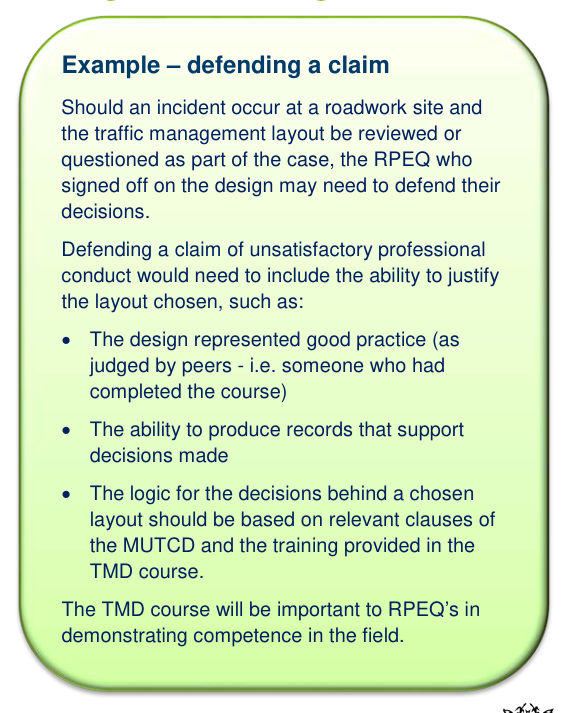
Example – defending a claim#
Should an incident occur at a roadwork site and the traffic management layout be reviewed or questioned as part of the case, the RPEQ who signed off on the design may need to defend their decisions.
Defending a claim of unsatisfactory professional conduct would need to include the ability to justify the layout chosen, such as:
- The design represented good practice (as judged by peers - i.e. someone who had completed the course)
- The ability to produce records that support decisions made
- The logic for the decisions behind a chosen layout should be based on relevant clauses of the MUTCD and the training provided in the TMD course.
The TMD course will be important to RPEQ’s in demonstrating competence in the field.
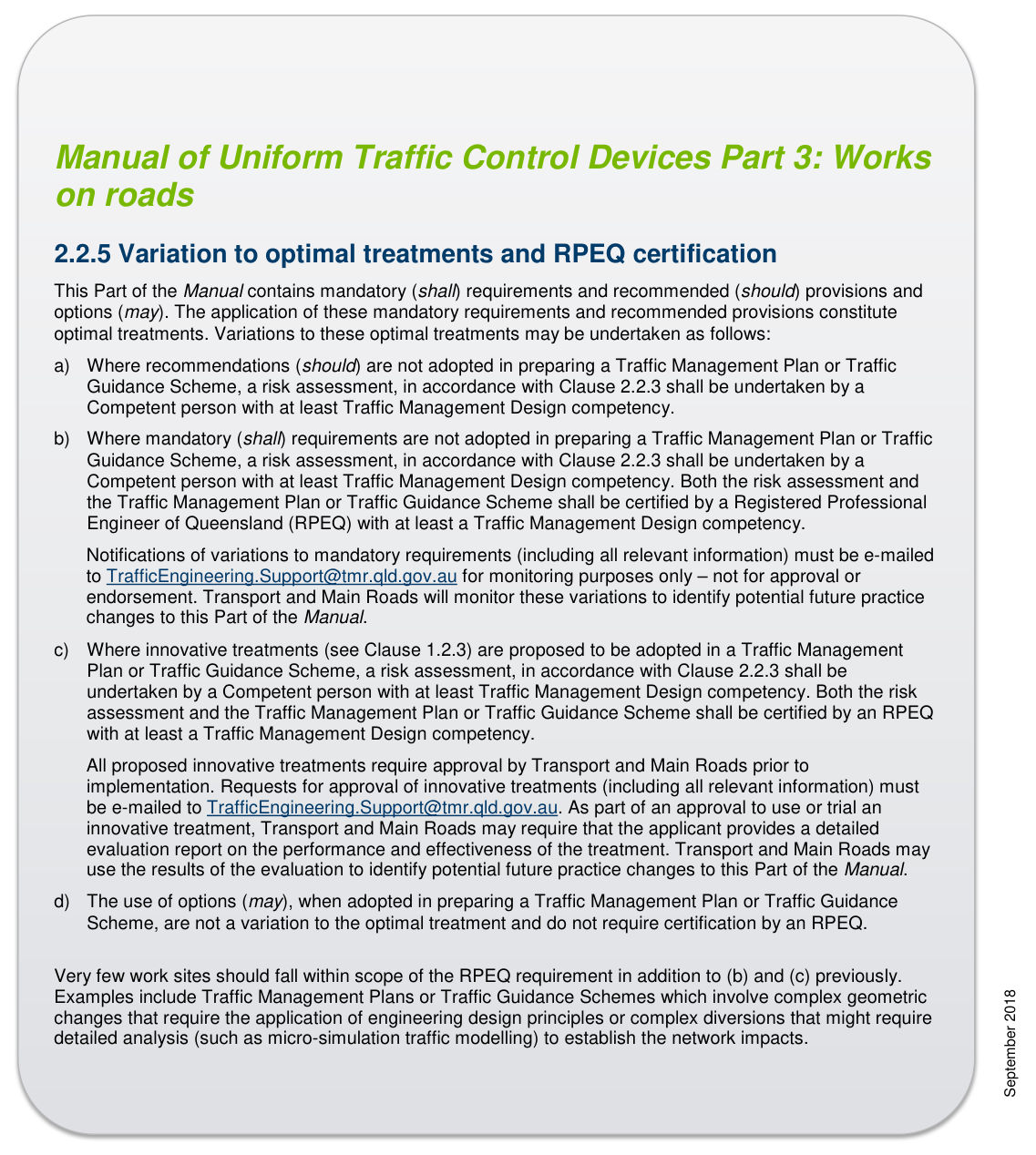
Manual of Uniform Traffic Control Devices Part 3: Works on roads#
2.2.5Variation to optimal treatments and RPEQ certification#
This Part of the Manual contains mandatory (shall) requirements and recommended (should) provisions and options (may). The application of these mandatory requirements and recommended provisions constitute optimal treatments. Variations to these optimal treatments may be undertaken as follows:
- a)Where recommendations (should) are not adopted in preparing a Traffic Management Plan or Traffic Guidance Scheme, a risk assessment, in accordance with Clause 2.2.3 shall be undertaken by a Competent person with at least Traffic Management Design competency.
- b)Where mandatory (shall) requirements are not adopted in preparing a Traffic Management Plan or Traffic Guidance Scheme, a risk assessment, in accordance with Clause 2.2.3 shall be undertaken by a Competent person with at least Traffic Management Design competency. Both the risk assessment and the Traffic Management Plan or Traffic Guidance Scheme shall be certified by a Registered Professional Engineer of Queensland (RPEQ) with at least a Traffic Management Design competency.
- c)Where innovative treatments (see Clause 1.2.3) are proposed to be adopted in a Traffic Management Plan or Traffic Guidance Scheme, a risk assessment, in accordance with Clause 2.2.3 shall be undertaken by a Competent person with at least Traffic Management Design competency. Both the risk assessment and the Traffic Management Plan or Traffic Guidance Scheme shall be certified by an RPEQ with at least a Traffic Management Design competency.
- d)The use of options (may), when adopted in preparing a Traffic Management Plan or Traffic Guidance Scheme, are not a variation to the optimal treatment and do not require certification by an RPEQ.
Notifications of variations to mandatory requirements (including all relevant information) must be e-mailed to TrafficEngineering.Support@tmr.qld.gov.au for monitoring purposes only – not for approval or endorsement. Transport and Main Roads will monitor these variations to identify potential future practice changes to this Part of the Manual.
All proposed innovative treatments require approval by Transport and Main Roads prior to implementation. Requests for approval of innovative treatments (including all relevant information) must be e-mailed to TrafficEngineering.Support@tmr.qld.gov.au. As part of an approval to use or trial an innovative treatment, Transport and Main Roads may require that the applicant provides a detailed evaluation report on the performance and effectiveness of the treatment. Transport and Main Roads may use the results of the evaluation to identify potential future practice changes to this Part of the Manual.
Very few work sites should fall within scope of the RPEQ requirement in addition to (b) and (c) previously. Examples include Traffic Management Plans or Traffic Guidance Schemes which involve complex geometric changes that require the application of engineering design principles or complex diversions that might require detailed analysis (such as micro-simulation traffic modelling) to establish the network impacts.
For further information about Traffic Management Design Training or Traffic Management Improvement at Roadworks project please contact us at TMDesign@tmr.qld.gov.au.