3Additional information#
The NSW PAMP guide is focused on planning for improved pedestrian safety and convenience in an area and is recommended for adoption in Queensland; however, there are some additional considerations relevant for pedestrian planning including the process for planning pedestrian networks, data collection, personal safety, place-making and behaviour change programs. Following is additional information on these aspects.
3.1Planning methodology#
The Transport for Victoria Guidelines for developing Principal Pedestrian Networks (May 2015) provides a detailed approach to undertaking best practice pedestrian planning. The process outlined in the guidelines can be applied at both a strategic and local scale and should be considered as a best practice approach to developing a pedestrian network.
The methodology for planning and providing for pedestrians, as documented in the Victorian guideline follows (refer to the document for further details).
| Stage | Step |
|---|---|
| Stage 1 – Delineate the pedestrian network | • Step 1: Collate background data • Step 2: Determine the primary destination (s) • Step 3: Map the pedestrian network and walking constraints • Step 4: Map the walkable catchment • Step 5: Map existing residential populations • Step 6: Map second destinations and likely populations • Step 7: Map shortest distance routes between primary and secondary destination (s) • Step 8: Assess the intensity of pedestrian routes • Step 9: Delineate the draft pedestrian network |
| Stage 2 – Validate the pedestrian network | • Step 1: Test the pedestrian network with local knowledge • Step 2: Undertake a site audit • Step 3: Pedestrian counts • Step 4: Consult with key stakeholders • Step 5: Plan for future population and infrastructure changes • Step 6: Finalise the pedestrian network |
| Stage 3 – Implement the pedestrian network | • Step 1: Pedestrian environment assessment • Step 2: Implementation plan • Step 3: Monitoring and review |
Source: Transport for Victoria Guidelines for developing Principal Pedestrian Networks (May 2015)
Project brief#
Appendix 1 of the NSW PAMP guide includes a comprehensive project brief for a suburb, town or Local Government area which is a useful starting point. To expand the PAMP and address some of the aspects raised in this document, the following amendments could be made to the project brief:
- Amend Section 4 Statements of Direction to include – ‘identify pedestrian desire lines to inform the network plan or location of pedestrian facility’.
- Amend Section 7 Study Tasks to consider the Victorian Guidelines for developing Principal Pedestrian Networks: specifically, the Study Tasks could be expanded to include detailed planning methodology outlined here in Section 3.1.
- Amend Section 7.1 Data Collection to note that, as well as surveys and interviews to help identify future pedestrian needs and desire lines, site visits / audits should be considered to understand desire lines based on a review of pedestrian generators, existing and surrounding pedestrian networks, pedestrian deficiencies and opportunities that should be incorporated into this task.
- Amend Section 7.2 Prepare Draft PAMP to include supporting facilities such as wayfinding signage and provision of shade, water and seating in items that the plan should address.
- Amend Section 9 Resources – update based on the information provided in sections 3 and 5 of this document.
- The project brief is scalable to the size of the initiative (as is the planning methodology outlined in section 3.1); however, for smaller-scale projects, it is appropriate to remove and amend content, as needed, from the brief – see following for suggested changes to the project brief for a smaller-scale project such as a pedestrian bridge, intersection design or pedestrian crossing facility.
- Amend Section 3 Study Area to reflect project scope.
- Amend Section 6 Project Deliverables to reflect project scope; that is, agree location and form of proposed pedestrian facility, deliver concept / schematic / detailed design for the proposed pedestrian facility.
- Amend Section 7.2 Prepare a Draft PAMP to reflect project scope. This may involve the removal of ranking routes but consider noting deficiencies in surrounding networks as relevant to the project (but out-of-scope) for further investigation.
3.2Data collection#
Stage 2, Step 3 in the NSW PAMP guide discusses the useful types of data that could be collected for the PAMP, including inventories and audits, counts, crash data and origin destination surveys.
Stage 3, Step 4 of the NSW PAMP guide also discusses monitoring the PAMP. Additional information on data collection and monitoring for pedestrians, to complement that detailed in the PAMP, is listed in Table 3.2.
| Data collection reference | Summary |
|---|---|
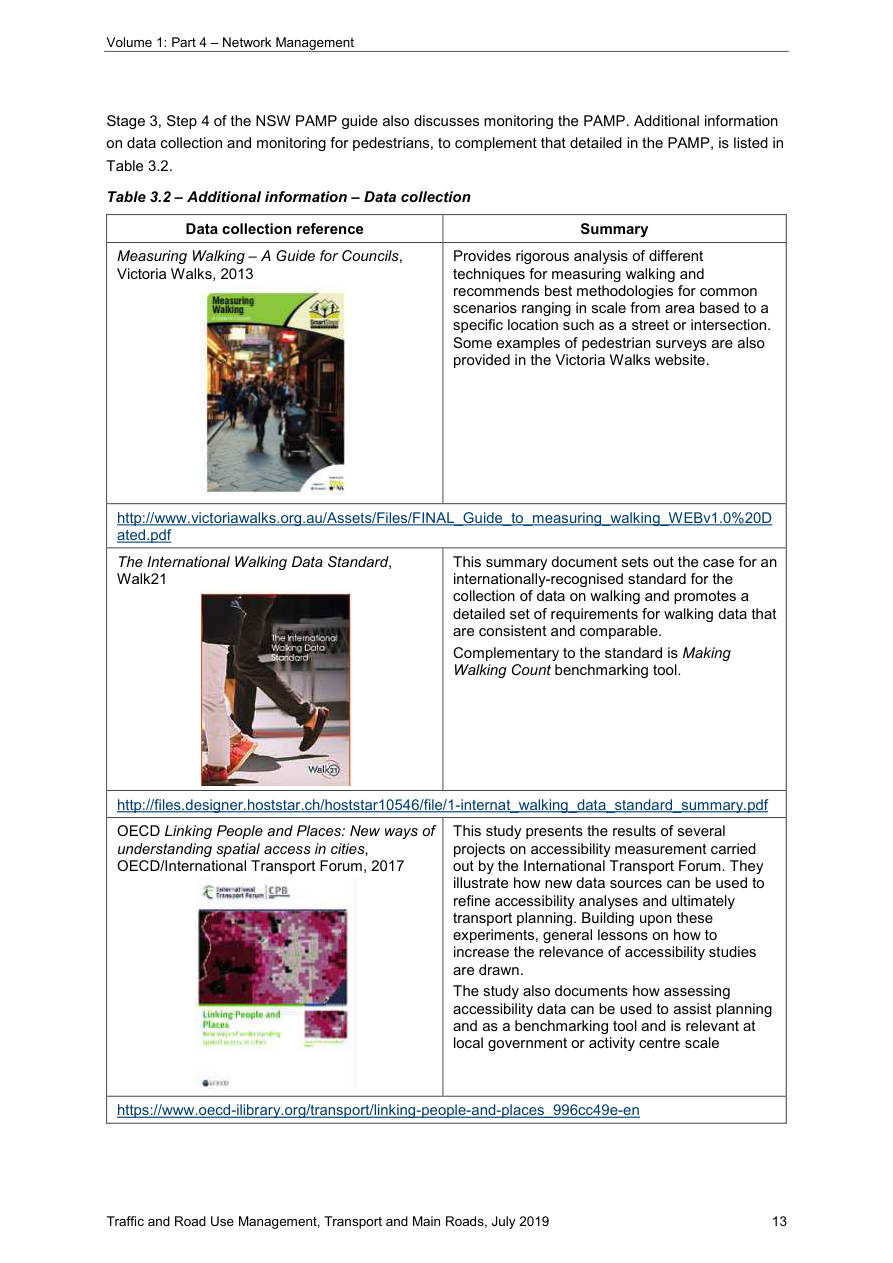
| Measuring Walking – A Guide for Councils, Victoria Walks, 2013 | Provides rigorous analysis of different techniques for measuring walking and recommends best methodologies for common scenarios ranging in scale from area based to a specific location such as a street or intersection. Some examples of pedestrian surveys are also provided in the Victoria Walks website. |
| http://www.victoriawalks.org.au/Assets/Files/FINAL Guide to measuring walking WEBv1.0%20D _ _ _ _ _ ated.pdf | |
| The International Walking Data Standard, Walk21 | This summary document sets out the case for an internationally-recognised standard for the collection of data on walking and promotes a detailed set of requirements for walking data that are consistent and comparable. Complementary to the standard is Making Walking Count benchmarking tool. |
| http://files.designer.hoststar.ch/hoststar10546/file/1-internat walking data standard summary.pdf _ _ _ _ | |
| OECD Linking People and Places: New ways of understanding spatial access in cities, OECD/International Transport Forum, 2017 | This study presents the results of several projects on accessibility measurement carried out by the International Transport Forum. They illustrate how new data sources can be used to refine accessibility analyses and ultimately transport planning. Building upon these experiments, general lessons on how to increase the relevance of accessibility studies are drawn. The study also documents how assessing accessibility data can be used to assist planning and as a benchmarking tool and is relevant at local government or activity centre scale |
| https://www.oecd-ilibrary.org/transport/linking-people-and-places 996cc49e-en _ |
Table in words
- The data collection reference Measuring Walking – A Guide for Councils, Victoria Walks, 2013 provides rigorous analysis of different techniques for measuring walking and recommends best methodologies for common scenarios ranging in scale from area based to a specific location such as a street or intersection.
- The data collection reference Measuring Walking – A Guide for Councils, Victoria Walks, 2013 notes that some examples of pedestrian surveys are also provided in the Victoria Walks website.
- The data collection reference The International Walking Data Standard, Walk21 is a summary document that sets out the case for an internationally-recognised standard for the collection of data on walking and promotes a detailed set of requirements for walking data that are consistent and comparable.
- The data collection reference The International Walking Data Standard, Walk21 notes that complementary to the standard is Making Walking Count benchmarking tool.
- The data collection reference OECD Linking People and Places: New ways of understanding spatial access in cities, OECD/International Transport Forum, 2017 presents the results of several projects on accessibility measurement carried out by the International Transport Forum.
- The data collection reference OECD Linking People and Places: New ways of understanding spatial access in cities, OECD/International Transport Forum, 2017 illustrates how new data sources can be used to refine accessibility analyses and ultimately transport planning.
- The data collection reference OECD Linking People and Places: New ways of understanding spatial access in cities, OECD/International Transport Forum, 2017 draws general lessons on how to increase the relevance of accessibility studies.
- The data collection reference OECD Linking People and Places: New ways of understanding spatial access in cities, OECD/International Transport Forum, 2017 documents how assessing accessibility data can be used to assist planning and as a benchmarking tool and is relevant at local government or activity centre scale.
| Data collection reference | Summary |
|---|---|
| Global Street Design Guide, National Association of City Transportation Officials (NACTO), 2016 | This resource includes guidance on measuring the success of streets, covering three main categories of metrics: • physical and operational changes • shifts in use and function, and • resulting impacts. |
3.3Personal safety#
Personal safety is relevant when planning and designing for pedestrians. Addressing the barrier of how safe users feel walking in different environments (fear of crime) can be important to getting more people walking. Following are some additional sources to assist consideration of personal safety when undertaking a PAMP.
| Personal safety reference | Summary |
|---|---|
| Crime Prevention Through Environmental Design: Guidelines for Queensland (CPTED), Queensland Government, 2007 | A guideline that covers principles and includes an implementation guide to incorporate CPTED principles into practice |
| https://www.police.qld.gov.au/programs/cscp/safetyPublic/Documents/CPTEDPartA.pdf https://www.police.qld.gov.au/programs/cscp/safetyPublic/Documents/CPTEDPartB.pdf | |
| Queensland Police Service Safety Audit Program | A framework for members of the community to undertake a safety audit of a public place |
| https://www.police.qld.gov.au/programs/cscp/safetyPublic/audit.htm |
Table in words
- The personal safety reference Crime Prevention Through Environmental Design: Guidelines for Queensland (CPTED), Queensland Government, 2007 is a guideline that covers principles and includes an implementation guide to incorporate CPTED principles into practice.
- The personal safety reference Queensland Police Service Safety Audit Program is a framework for members of the community to undertake a safety audit of a public place.
3.4Place-making#
Place-making is relevant when planning and designing for pedestrians. Considering place-making and high-quality street design improves the environment and encourages people to walk. Following are some additional sources to assist consideration of place-making and street design when undertaking a PAMP.
| Place-making reference | Summary |
|---|---|
| Creating Places for People: An Urban Design Protocol for Australian Cities, 2011 | The Urban Design Protocol is founded on five pillars: productivity, sustainability, liveability, leadership and design excellence. These are underpinned by 12 basic principles: 1. enhancing: enhances the local economy, environment, and community 2. connected: connects physically and socially 3. diverse: diversity of options and experiences 4. enduring: sustainable, enduring and resilient 5. comfortable: comfortable and welcoming 6. vibrant: vibrant, with people around 7. safe: feels safe 8. walkable: enjoyable and easy to walk and bicycle around 9. context: works within the planning, physical and social context 10. engagement: engages with relevant stakeholders 11. excellence: fosters excellence, innovation and leadership, and 12. custodians: considers custodianship and maintenance over time |
| https://urbandesign.org.au/content/uploads/2015/08/INFRA1219 MCU R SQUARE URBAN PRO _ _ _ _ _ TOCOLS 1111 WEB FA2.pdf _ _ _ | |
| The Healthy Spaces and Places Manual, Heart Foundation, PIA and ALGA, 2009 | Healthy Spaces and Places identifies the following key design principles to encourage built environments that provide opportunities for physical activity, including walking and other health related activities: • active transport • aesthetics • connectivity • environment for all people • mixed density • mixed land use • parks and open space • safety and surveillance • social inclusion, and • supporting infrastructure Healthy Spaces and Places also shows how the healthy design principles can be applied to a range of development types in different locations. |
| http://www.healthyplaces.org.au/userfiles/file/HS&P%20An%20overview.pdf | |
| Liveable Neighbourhoods, WA Department of Planning and WA Planning Commission, 2015 | Liveable Neighbourhoods is a performance-based policy that sets high-level objectives, design principles and requirements to address both strategic and operational aspects of structure planning and subdivision. The document is a compilation of six interrelated design elements as follows: Element 1: Community design Element 2: Movement design Element 3: Activity centres Element 4: Lot design Element 5: Public open space Element 6: Education The document also includes: • site and context analysis guide • the walkable catchment technique, and • movement network tables of technical specifications. |
| https://www.planning.wa.gov.au/dop pub pdf/LiveableNeighbourhoods 2015.pdf _ _ _ | |
| Complete Streets: Guidelines for Urban Street Design, 2010 | A guide for designers and design assessors on how to develop sustainable communities and provides more diverse solutions where current street designs might not be appropriate. The objectives of Complete Streets are to allow and encourage streets which support active and interactive communities, through: • improving safety and security • increasing vitality and interaction • reducing private motor vehicle dependence • improving development efficiency • providing valuable community space, and • retaining economic activity in communities. To achieve the objectives, the following key strategies are employed: • focusing design on maximising opportunities for a street to be a place, not a thoroughfare • connecting streets and places through permeable networks without any corresponding increase in vehicle speeds or ‘rat-runs’ • describing a user hierarchy that places people and active modes at the top, and • classifying streets by the type of place they form part of, not their traffic function. |
| http://ipweaq.intersearch.com.au/ipweaqjspui/handle/1/2946 |
| Place-making reference | Summary |
|---|---|
| Global Street Design Guide, National Association of City Transportation Officials (NACTO), 2016 | The Global Street Design Guide is supporting practitioners to redefine the role of streets in cities around the world. The Guide offers technical details to inform street design that prioritises pedestrians, cyclists, and transit riders. The document provides specific guidance for designing streets for people with detailed information for different types of streets, geometry and design guidance. It also provides details of street typologies, and many practical and detailed examples of street transformations for each typology. |
| https://globaldesigningcities.org/publication/global-street-design-guide/ | |
| Transit Orientated Development (TOD) Standard, Institute for Transportation and Development Policy, New York, 2017 | The TOD Standard details eight core principles for urban design and land use, supported by performance objectives and metrics to score new urban developments. Walking forms a key component of the principles and measurables for a high-quality transit-orientated development but can be considered for activity centres and other land uses. |
| https://www.itdp.org/tod-standard/ | |
| Subtropical Design in South East Queensland: A Handbook for Planners, Developers and Decision-Makers, Centre for Subtropical Design, QUT, Queensland Government and Brisbane City Council, 2010 | The handbook identifies the following subtropical design principles: 1. recognise sub-regions 2. respect topography 3. diversify the built environment 4. consider the local character and design 5. integrated with nature 6. acknowledge informality 7. use vegetation 8. ensure open space diversity 9. incorporate access to open space 10. design for water 11. develop outdoor centres, and 12. develop outdoor meeting places. Although not specific to walking, it identifies key design principles to suit the Queensland weather and character which should be considered for users of the public realm. |
| https://eprints.qut.edu.au/40934/1/2011003087 Kennedy ePrints.pdf _ _ |
| Place-making reference | Summary |
|---|---|
| Cities Safer by Design, World Resources Institute, Washington, 2015 | A resource ‘…addressing issues such as enhancing urban design to increase walkability, reducing vehicles speeds that threaten all road uses, providing high-quality space for pedestrians and bicyclists, and improving access to mass transport…’ In addition to descriptions of good urban design principles there is also chapters on traffic calming and pedestrian spaces and access to public space. |
| https://www.wri.org/sites/default/files/CitiesSaferByDesign final.pdf _ |
3.5Travel behaviour change#
Stage 2, Step 9 of the NSW PAMP guide discusses promoting the PAMP; however, encouraging people to walk more for a variety of purposes is also a complementary tool for a PAMP. The following are some additional sources to assist with travel behaviour change which may be considered in addition to a PAMP.
| Travel behaviour change reference | Summary |
|---|---|
| Australian Government, TravelSmart | An archived site with toolkits and resources as well as information for government, employers and schools looking to implement travel behaviour change programs |
| http://www.travelsmart.gov.au/ | |
| Victoria Walks | An independent health promotion charity implementing ‘…”nudge” strategies to prompt increases in walking for shorter trips…’ Their website provides different campaigns, research and case studies that could be useful. |
| http://www.victoriawalks.org.au/ | |
| Walk21 | An international charity dedicated to supporting and promoting more walking. The first step to encouraging change could be for an organisation to sign a commitment to the International Charter for Walking. Annual conferences also present best practice approaches to improving walking. |
| https://www.walk21.com/ | |
| Easy Steps, Queensland Government, 2005 | Part C4 Promoting Walking and Part C5 Positively Influencing Travel Choices cover program development, program implementation and program monitoring and evaluation for promoting walking |
| https://www.tmr.qld.gov.au/Travel-and-transport/Pedestrians-and-walking/Easy-Steps.aspx | |
| The Switch Campaign Guide and Toolbox, SWITCH Consortium, Cologne, 2016 | Provides practical advice for campaigns to promote a switch from car-based travel to active modes of travel |
| http://www.rupprecht-consult.eu/uploads/tx rupprecht/Switch Campaign Guide Fin Web.pdf | |
| Soft Measures – Hard Facts, Department of Health South West, UK, 2011 | Discusses various travel demand management programs and documents evidence on their success |
| http://www.sthc.co.uk/Documents/DoH Soft Measures Hard Facts.pdf |
Table in words
- The travel behaviour change reference Australian Government, TravelSmart has the summary: An archived site with toolkits and resources as well as information for government, employers and schools looking to implement travel behaviour change programs.
- The travel behaviour change reference http://www.travelsmart.gov.au/ has the summary: .
- The travel behaviour change reference Victoria Walks has the summary: An independent health promotion charity implementing ‘…”nudge” strategies to prompt increases in walking for shorter trips…’ Their website provides different campaigns, research and case studies that could be useful.
- The travel behaviour change reference http://www.victoriawalks.org.au/ has the summary: .
- The travel behaviour change reference Walk21 has the summary: An international charity dedicated to supporting and promoting more walking. The first step to encouraging change could be for an organisation to sign a commitment to the International Charter for Walking. Annual conferences also present best practice approaches to improving walking.
- The travel behaviour change reference https://www.walk21.com/ has the summary: .
- Easy Steps, Queensland Government, 2005: Part C4 Promoting Walking and Part C5 Positively Influencing Travel Choices cover program development, program implementation and program monitoring and evaluation for promoting walking.
- The Switch Campaign Guide and Toolbox, SWITCH Consortium, Cologne, 2016: Provides practical advice for campaigns to promote a switch from car-based travel to active modes of travel.
- Soft Measures – Hard Facts, Department of Health South West, UK, 2011: Discusses various travel demand management programs and documents evidence on their success.