4Treatments between intersections#
4.2Pavement markings and delineation#
4.2.4Guide posts#
4.2.4.2Design and construction#
The Department of Transport and Main Roads has issued a standard drawing for road edge guide posts. Refer to SD1356 Road Edge Guide Posts – Post and Installation Details.
4.2.4.4Longitudinal spacing#
(f): Bridges and culverts
Hazard marker posts may be installed to warn road users and maintenance personnel of a hazard in the vicinity of the hazard marker post. The Department of Transport and Main Roads has issued a standard drawing for hazard marker posts that indicate the location of hazard marker posts in relation to road edge guide posts at bridges at culvert sites that may be used. Refer to SD1851 Hazard Marker – Post and Installation Details.
4.2.7Maintenance marker posts#
Maintenance marker posts should be installed in accordance with Department of Transport and Main Roads SD1358 Maintenance Marker Posts – Post and Installation Details to indicate any item that requires regular maintenance, or which may otherwise be damaged by operation of maintenance machinery.
4.3Treatment of substandard horizontal curves#
4.3.5Signs for substandard horizontal curves#
(k): Tilting Truck (W1-8 Series)
W1-8-Q01
The Tilting Truck (W1-8-Q01) shall only be used when W1-8 series signs cannot be installed due to physical constraints.
(l): WATCH FOR TRUCKS (W8-Q12)
W8-Q12
The WATCH FOR TRUCKS (W8-Q12) supplementary plate should only be used to supplement curve warning signs on narrow winding roads where there have been problems with large vehicles sweeping across the centre line.
4.3.6Determination for the use of Curve Alignment Marker signs#
4.3.6.2Curve Alignment Marker signs#
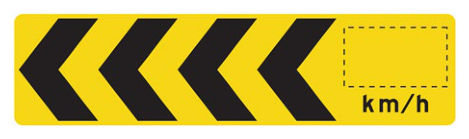
(b) Curve Alignment Marker x km/h (D4-7) (L and R)
D4-7-Q01
The Curve Alignment Marker x km/h (D4-7-Q01) sign may replace the first Curve Alignment Marker sign in a series of CAMs around a curve in accordance with the guidance for use of D4-7 where additional delineation is considered required.
4.5Treatment of approaches to structures and obstructions#
4.5.6Signs for approaches to structures and obstructions#
4.5.6.1Regulatory signs#
(d): RAMP LOAD LIMIT x t GROSS (R6-3-Q01)
R6-3-Q01
The RAMP LOAD LIMIT x t GROSS (R6-3-Q01) sign may be used in Queensland to indicate the maximum permissible gross load in tonnes of an on/off ramp.
(e): OVERALL WIDTH LIMIT x m (R6-33-Q01)
R6-33-Q01
The OVERALL WIDTH LIMIT x m (R6-33-Q01) sign may be used in Queensland to indicate the maximum permissible overall width in metres of a vehicle on a section of road and if used shall be erected on the immediate approaches to the restricted section.
Detour signs shall be erected before and at an appropriate intersection in advance of the section to divert over-width vehicles (see Clauses 4.5.2.4 and 4.5.6.2).
4.5.6.2Detour signs#
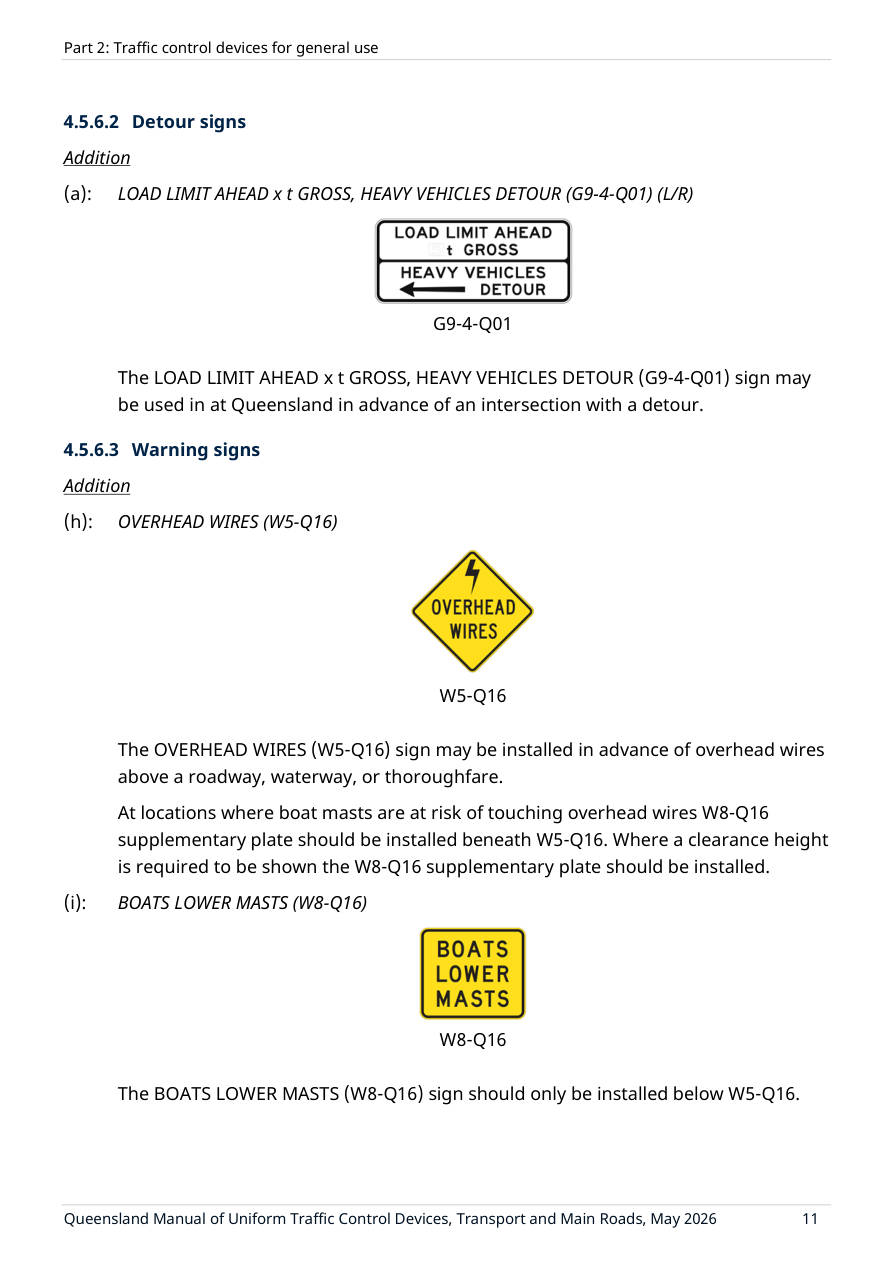
(a): LOAD LIMIT AHEAD x t GROSS, HEAVY VEHICLES DETOUR (G9-4-Q01) (L/R)
G9-4-Q01
The LOAD LIMIT AHEAD x t GROSS, HEAVY VEHICLES DETOUR (G9-4-Q01) sign may be used in at Queensland in advance of an intersection with a detour.
4.5.6.3Warning signs#
(h): OVERHEAD WIRES (W5-Q16)
W5-Q16
The OVERHEAD WIRES (W5-Q16) sign may be installed in advance of overhead wires above a roadway, waterway, or thoroughfare.
At locations where boat masts are at risk of touching overhead wires W8-Q16 supplementary plate should be installed beneath W5-Q16. Where a clearance height is required to be shown the W8-Q16 supplementary plate should be installed.
(i): BOATS LOWER MASTS (W8-Q16)
W8-Q16
The BOATS LOWER MASTS (W8-Q16) sign should only be installed below W5-Q16.
(j): CLEARANCE x m (W8-Q17)
W8-Q17
The CLEARANCE x m (W8-Q17) sign should only be installed below W5-Q16.
4.6Changes in pavement width#
4.6.5Signs for lane reductions (merges) and approaches to changes in pavement width#
4.6.5.2Signs for lane changes#
Where a lane change requires the right lane to merge left, signs and pavement arrows in this clause shall be modified accordingly.
4.9Water crossings#
4.9.6Signs for water crossings#
(n): ON SIDE ROAD (G9-21-1-Q01)
G9-21-1-Q01
The ON SIDE ROAD (G9-21-1-Q01) supplementary plate shall be used with ROAD SUBJECT TO FLOODING INDICATORS SHOW DEPTH (G9-21-1 and G9-21-2) and ROAD SUBJECT TO FLOODING DO NOT ENTER WHEN FLOODED (G9-21-3) signs where a floodway on a side road is too close to the main road for G9-21-1, G9-21-2 or G9-21-3 to be installed on the side road.
4.10Road block barriers#
4.10.3Associated device and marking#
Boom Barrier (W5-Q11)
W5-Q11
Where a boom barrier is used across the roadway other than for active railway crossings (refer to Queensland MUTCD Part 7), the Boom Barrier (W5-Q11) warning sign shall be used in advance of the barrier at a distance in accordance with Appendix D.
4.11Physical obstructions, road conditions and other hazards#
4.11.3Signs for warning of hazardous road conditions#
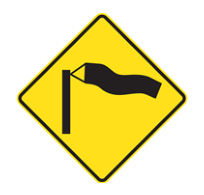
(h): High Wind Area (W5-Q12), HIGH WIND AREA (W8-Q14)
W5-Q12 W8-Q14
The High Wind Area (W5-Q12) and HIGH WIND AREA (W8-Q14) signs may be used in exposed areas where there are potential vehicle stability issues arising from strong cross winds.
(i):
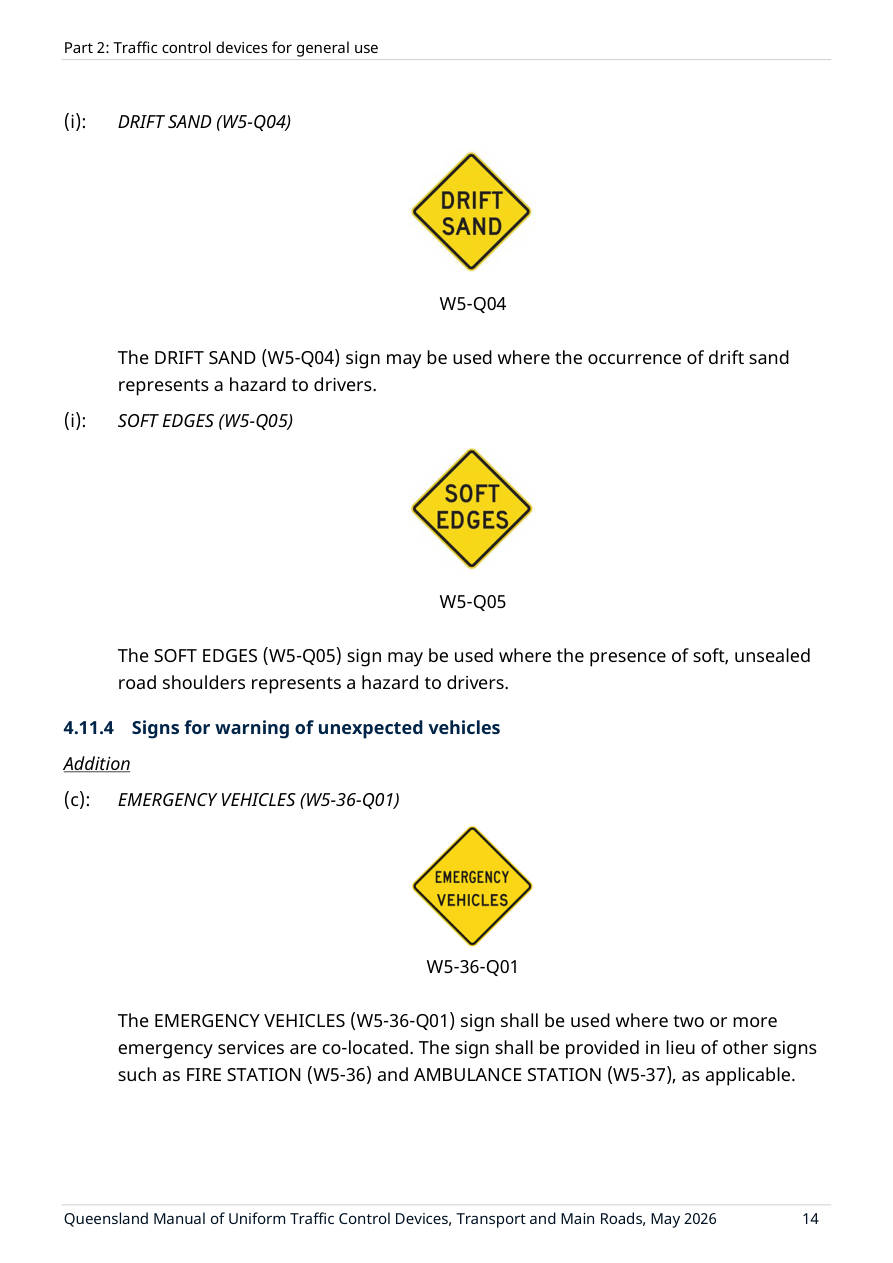
DRIFT SAND (W5-Q04)
W5-Q04
The DRIFT SAND (W5-Q04) sign may be used where the occurrence of drift sand represents a hazard to drivers.
(i):
SOFT EDGES (W5-Q05)
W5-Q05
The SOFT EDGES (W5-Q05) sign may be used where the presence of soft, unsealed road shoulders represents a hazard to drivers.
4.11.4Signs for warning of unexpected vehicles#
(c):
EMERGENCY VEHICLES (W5-36-Q01)
W5-36-Q01
The EMERGENCY VEHICLES (W5-36-Q01) sign shall be used where two or more emergency services are co-located. The sign shall be provided in lieu of other signs such as FIRE STATION (W5-36) and AMBULANCE STATION (W5-37), as applicable.
(g):
Queued Traffic (W5-Q13)
W5-Q13
The Queued Traffic (W5-Q13) sign may be used to give advance warning to drivers of queued traffic ahead where stopping sight distance to the end of queue may not be achieved.
Where the Queued Traffic sign is installed, active devices that operate during times when queues are anticipated should be considered.
(h):
Buses (W5-Q14)
W5-Q14
The Buses (W5-Q14) sign may be used in advance of locations where entering buses may constitute an unexpected hazard, such as an intersection or driveway in proximity to a bus depot.
4.11.5Signs for warning of wandering stock#
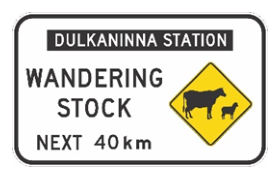
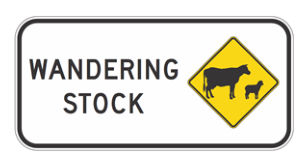
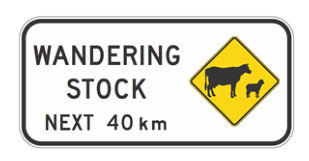
The following signs may be used to provide warning of unfenced roads and wandering stock:
W5-Q10
W5-Q10
W8-Q13
The WANDERING STOCK (W5-Q10) signs may be used for the warning of wandering stock due to adjacent unfenced property. If used, a sign shall be placed at the beginning of the section of road concerned and repeated as necessary. A station/property name should be used where applicable.
The examples included above show both sheep and cattle. Where a single type of stock or horses are prevalent an alternate warning sign may be used.
The WANDERING STOCK (W8-Q13) supplementary plate shall only be used below the Stock (W5-38) warning sign.
4.11.6Signs for warning of hazardous wildlife#
4.11.6.1Warning signs#
Wildlife warning signs shall be installed when:
- wildlife frequently encroaches onto the road or roadside in localised areas when there is a significant traffic volume, or
- where drivers are unlikely to expect wildlife.
Wildlife warning signs may be repeated (if warranted) at intervals of not less than 5 km in rural areas, or as appropriate in urban areas. It may also be appropriate to sign short, individual lengths of road in specific locations where the risk of an animal / vehicle collision is greatest.
Wildlife warning and information signs are not specifically intended to perform an animal preservation role and research indicates that they are not particularly effective for this purpose. If the preservation of animals is critical other traffic management and animal management treatments will be required; signs alone are not adequate.
Wildlife warning signs should:
- not be provided for migratory animals,
- be continually assessed for their need and relevance, and
- be removed if no longer relevant.
4.11.6.2Temporary warning signs#
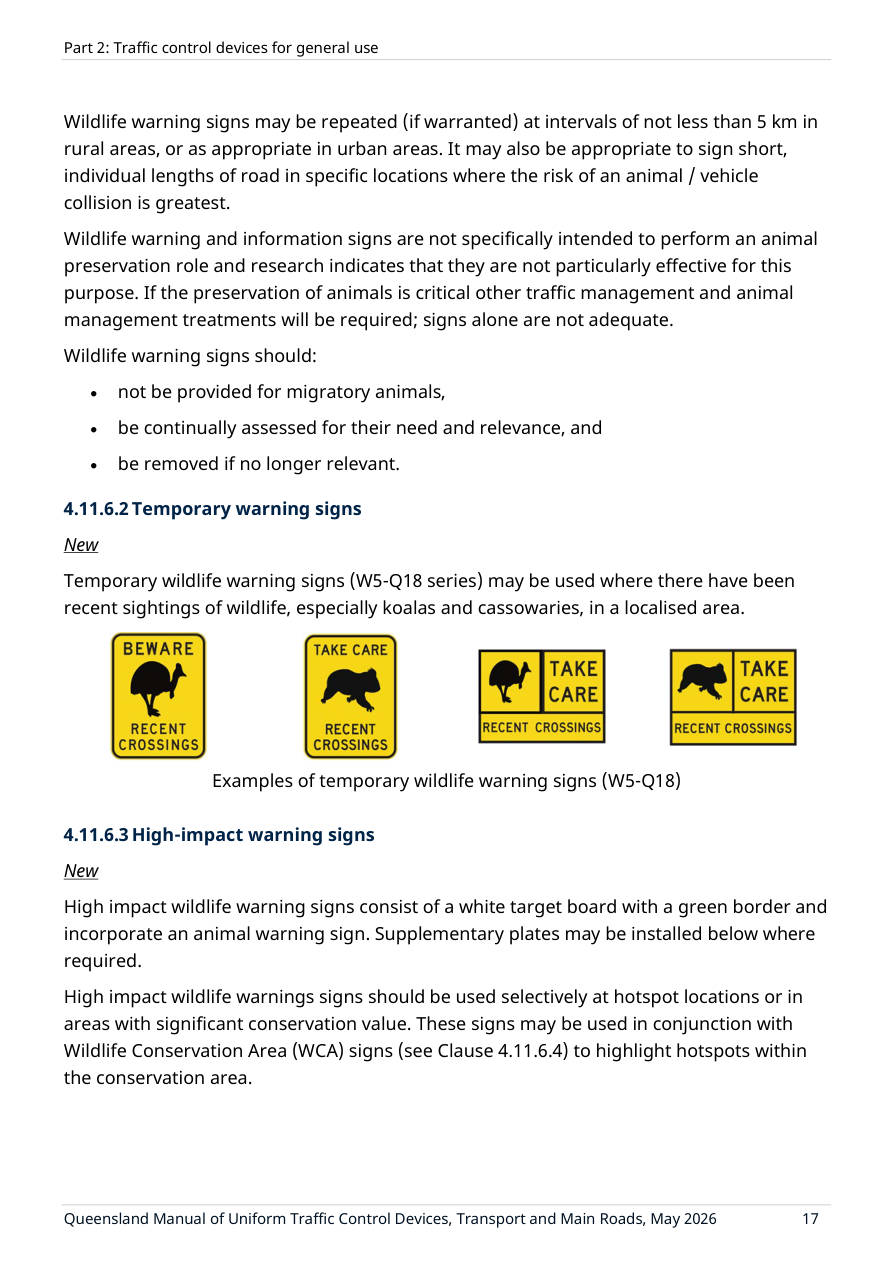
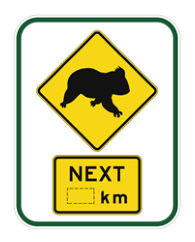
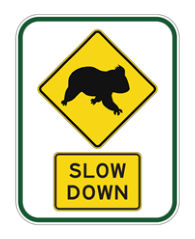
Temporary wildlife warning signs (W5-Q18 series) may be used where there have been recent sightings of wildlife, especially koalas and cassowaries, in a localised area.
Examples of temporary wildlife warning signs (W5-Q18)
4.11.6.3High-impact warning signs#
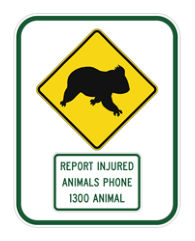
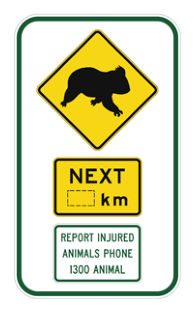
High impact wildlife warning signs consist of a white target board with a green border and incorporate an animal warning sign. Supplementary plates may be installed below where required.
High impact wildlife warnings signs should be used selectively at hotspot locations or in areas with significant conservation value. These signs may be used in conjunction with Wildlife Conservation Area (WCA) signs (see Clause 4.11.6.4) to highlight hotspots within the conservation area.
4.11.6.4Wildlife Conservation Area (WCA) signing#
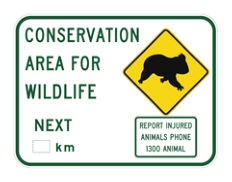
Wildlife Conservation Area (WCA) signs (W5-Q19) should include the animal symbolic warning sign of the most prevalent animal in the area. WCA signs shall only be installed where the warrants for the included warning sign in accordance with Section 4.11.6 are met.
W5-Q19
WCA signs shall only be installed within the following locations where a 'conservation' status is related to wildlife and not for other reasons (such as scenic value or flora):
- protected areas under the Nature Conservation Act 1992 where vehicle / animal collisions are deemed likely:
- − national parks
- − conservation parks
- − resources reserves
- − nature refuges
- − coordinated conservation areas
- − wilderness areas
- − World Heritage management areas, and
- − international agreement areas.
- land within state forests, timber reserves or dedicated as a reserve (or protected area) for environmental purposes under the Land Act 1994
- a World Heritage Area under the World Heritage Convention
- an area supporting a critically endangered or endangered ecological community in the list established under the Commonwealth Environment Protection and Biodiversity Conservation Act 1999 (EPBC Act)
- a declared RAMSAR wetland under the EPBC Act
- an area of high nature conservation value under the Vegetation Management Act 1999, or
- an area, other than state-controlled land, identified in a local government's planning scheme as an area that has special environmental significance for native wildlife.
WCA signs should be erected as close as possible to the boundary of the conservation area but shall be placed so as not to compete with other traffic control devices or pose a safety hazard to road users.
WCAs may be marked with the wildlife threshold pavement marking in accordance with Clause 4.11.6.5. Green RRPMs should be used in conjunction with WCA signs (see Clause 4.11.6.6).
4.11.6.5Wildlife threshold pavement marking#
The wildlife threshold pavement marking is detailed in TC2321 and may be used to identify the start of signed WCAs. The wildlife threshold pavement marking should not be used at locations that do not meet the requirements of a WCA (see Clause 4.11.6.4). Wildlife threshold pavement marking should not be used on multi lane arterial roads.
The purpose of the wildlife threshold pavement marking is to complement the entry signs into a WCA and shall bear the words 'WILD LIFE', which shall be marked in accordance with Section 5.8.
Wildlife threshold pavement markings shall meet the skid resistance requirements of Transport and Main Roads' Technical Specification MRTS110 Coloured Surface Treatments and shall consist of a green background with a yellow border.
Green RRPMs shall be installed at all wildlife threshold pavement marking installations (see Clause 4.11.6.6).
4.11.6.6RRPMs#
Green RRPMs may be used at locations with WCA signs (see Clause 4.11.6.4) to highlight areas of greater wildlife significance, or where vehicle / animal collisions are significantly overrepresented. Green RRPMs shall not be installed with wildlife information signs.
Where green RRPMs are used for signing WCAs, they shall:
- a)be installed over the length the WCA
- b)be removed where no longer required
- c)be bi-directional and installed adjacent to the road edge line on both sides of the road
- d)be installed in addition to standard RRPM requirements as specified in Section 5.9
- e)not be installed on motorways
- f)not be installed on roads or in locations where they may pose a hazard to other road users, and
- g)have a minimum spacing of 48 m and not exceed a spacing of 96 m; spacing (m) shall be uniform over the length of the area defined by the WCA.
4.11.6.7Vehicle activated devices#
Vehicle activated devices incorporate a radar device that activates when a vehicle is travelling above a pre-set speed threshold and may be used as an alternative to passive signs. Either flashing lights (wig wags) or the whole sign may be vehicle activated.
These devices may be used where:
- there is an increased risk of animal / vehicle collisions, or
- due to elevated impacts with animals.
Vehicle activated flashing lights#
Vehicle activated flashing lights shall be installed with a radar device capable of detecting vehicle speeds that activate the flashing of the lights in a wig wag arrangement. The devices shall be used with high impact wildlife warning signs (see Clause 4.11.6.3) to enhance sign conspicuity. The flashing lights shall operate alternately when activated by an approaching vehicle which is exceeding a nominated speed within the prescribed times of operation, or during set times when animals are likely to be encountered. The flashing lights shall continue to flash until the vehicle speed reduces to below the nominated speed or the vehicle continues past the sign.
Vehicle activated flashing light signs should be used selectively at critical locations where high impact wildlife warning signs need enhancement to improve driver speed compliance.
Vehicle activated signs#
Vehicle activated signs may be used where the presence of animals along the road is expected and there is a poor compliance with the posted speed. These devices are installed with a radar device capable of detecting vehicle speeds and shall be pre-set with the posted speed limit. A relevant animal symbol that is easily understood by drivers shall be displayed on the sign. When a vehicle is detected, the sign shall activate as follows:
- Vehicle at or below the posted speed limit: device shall activate and cycle between a green symbolic of the animal and the message 'THANK YOU'. Cycle shall be between 1–2 seconds.
- Vehicle above the posted speed limit: device shall activate and cycle between a red symbolic of the animal and the message 'SLOW DOWN'. Cycle shall be between 1-2 seconds.
4.11.7Signs for warning of temporary or part time hazards#
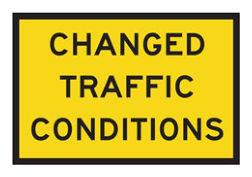
(f): CHANGED TRAFFIC CONDITIONS (T1-23-Q01)
T1-23-Q01
The CHANGED TRAFFIC CONDITIONS (T1-23-Q01) sign may only be used on roads with both a maximum posted speed limit of 60 km/h and where the available verge width is less than 2 m.
4.11.8Vehicle mounted signs#
(c): Other vehicle mounted signs
4.12Miscellaneous signs#
4.12.2Miscellaneous regulatory signs#
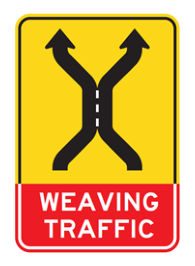
(h) WEAVING TRAFFIC (W5-Q15)
W5-Q15
The WEAVING TRAFFIC (W5-Q15) sign may be used where traffic has a short distance to cross between adjacent lanes to enter or exit a road.
(i) Lane Filtering Prohibited (R6-020-Q01), END Lane Filtering Prohibited (R6-020-Q02)
R6-020-Q01 R6-020-Q02
The Lane Filtering Prohibited (R6-020-Q01) sign and END Lane Filtering Prohibited (R6-020-Q02) sign shall be installed where motorcycle riders are to be prohibited from lane filtering.
4.12.3Heavy vehicle control and information signs#
Replace Item (c) with:
The BUSES MUST ENTER (R6-18) and TRUCKS MUST ENTER (R6-27) signs shall not be used at the entrance to heavy vehicle checking stations (heavy vehicle interception sites).
For guidance on the signing and line marking for heavy vehicle interception sites, refer to the Signing and Line Marking for Heavy Vehicle Interception Sites Guideline.
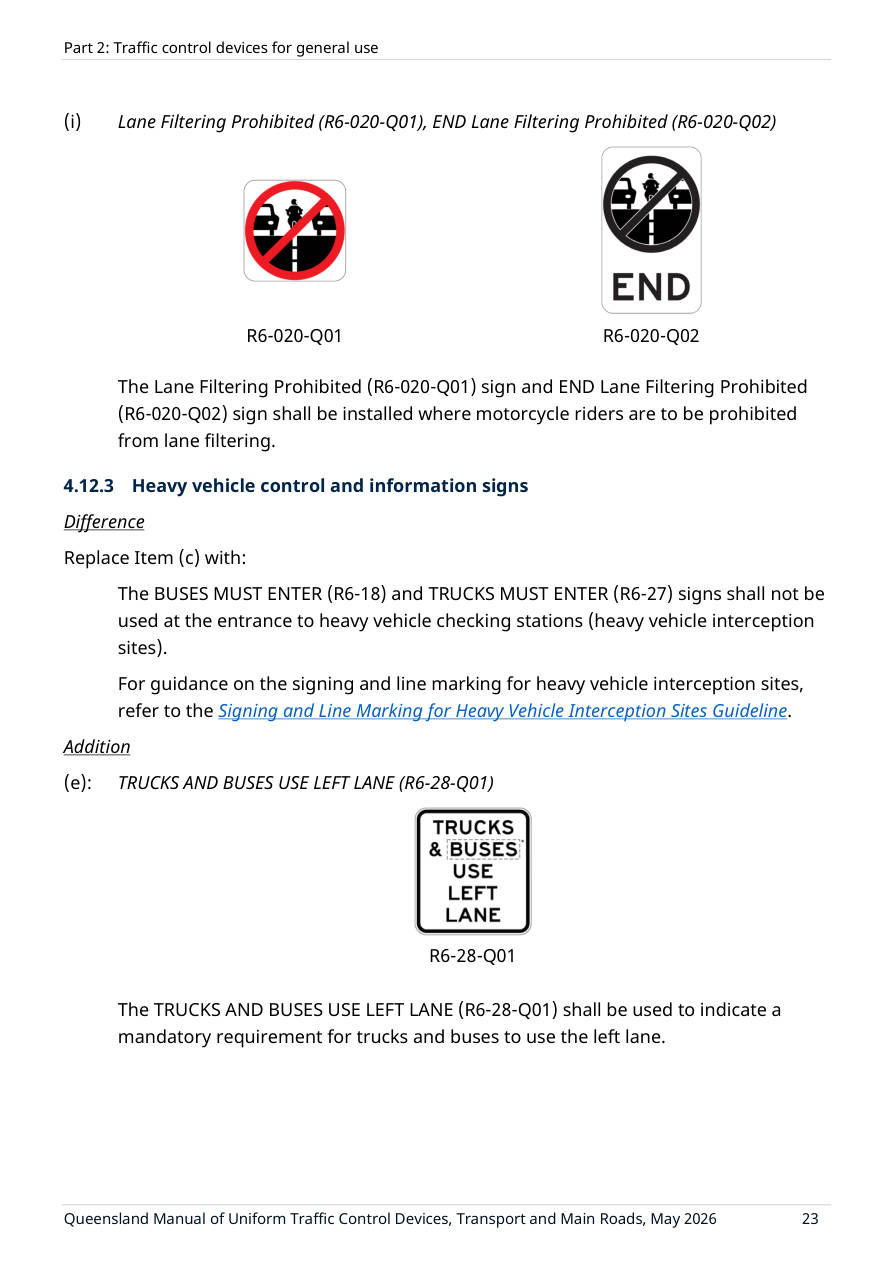
(e): TRUCKS AND BUSES USE LEFT LANE (R6-28-Q01)
R6-28-Q01
The TRUCKS AND BUSES USE LEFT LANE (R6-28-Q01) shall be used to indicate a mandatory requirement for trucks and buses to use the left lane.
4.12.4Emergency access location signs#
(a): Emergency Median Crossing (GE9-23-1), Emergency Median Crossing x m (GE9-23-2)
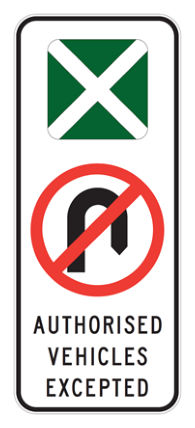
At emergency access locations located in the median, a combination of Emergency Median Crossing (GE9-23-1), No U Turn (R2-5), and AUTHORISED VEHICLES EXCEPTED (R9-Q04_2) signs may be used where there is a history or high likelihood of unauthorised vehicles performing U-turns.
GE9-23-1 R2-5 R9-Q04_2
(b): Emergency Access (GE9-24-1), Emergency Access Direction (GE9-24-2) (L and R)
Where an advance sign may be required for an Emergency Access (GE9-24-1) or Emergency Access Direction (GE9-24-2) (L and R) sign, a Supplementary Distance Plate x m (G9-66) may be added below the GE9-24 series signs.
4.12.5Signs for warning of cane vehicles#
The following signs may be used to warn of cane vehicles:
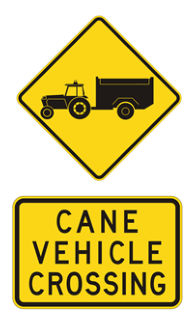
(a) Cane Vehicle Crossing (W5-50-Q01), CANE VEHICLE CROSSING (W5-50-Q02)
W5-50-Q01 W8-Q15
The Cane Vehicle Crossing (W5-50-Q01), CANE VEHICLE CROSSING (W8-Q15) signs may be used at locations where cane vehicles cross the roadway. Where cane vehicles are likely to cross multiple locations along a road, or travel along a road, see item (b).
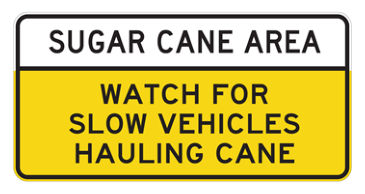
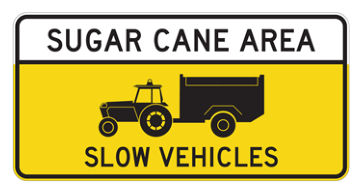
(b) SUGAR CANE AREA WATCH FOR SLOW VEHICLES HAULING CANE (G9-Q03_1), SUGAR CANE AREA SLOW VEHICLES (G9-Q03_2)
G9-Q03_1 G9-Q03_2
The SUGAR CANE AREA WATCH FOR SLOW VEHICLES HAULING CANE (G9-Q03_1), SUGAR CANE AREA SLOW VEHICLES (G9-Q03_2) signs may be used where cane vehicles are likely to cross multiple locations along a road, or travel along a road.