5Pavement markings#
5.3Longitudinal lines#
5.3.10Audio-tactile line marking#
5.3.10.1General#
For additional guidance on the use of audio-tactile line marking in Queensland refer to the RPDM Part 6.
5.4Wide centre line treatment#
5.4.2Application#
5.4.2.1General#
For additional guidance on the use of wide centre line treatment in Queensland refer to the RPDM Part 3.
5.4.2.2Width#
Replace:
Where the seal width is not sufficient to provide a separation width of 1 m, the width may be reduced to a minimum of 0.6 m. Widths narrower than 0.6 m may be permitted by jurisdictional guidance.
with:
Where the seal width is not sufficient to provide a separation width of 1 m, a redesign of the treatment is required in accordance with the RPDM Part 3.
5.4.2.3Start and end transitions#
Replace Note 2 of Figure 5.10:
L is the transition distance calculated from traffic speeds and rate of lateral movement in accordance with road design practice, where W is the lateral movement distance (i.e. shift from normal dividing line to one side of the wide centre line treatment line).
with:
Refer to RPDM Part 3 for WCLT transition distance requirements.
5.4.2.6Transitions at narrow structures and overtaking lanes#
Replace Note 2 of Figure 5.13:
A transition back to normal dividing line is shown. However, the WCLT may be continued through the structure if the residual width available, after maintaining the lane widths, is greater than 0.6 m, see Clause 5.4.2.2.
with:
The width of the WCLT over the narrow bridge structure is the residual width available while maintaining the lane and shoulder widths. These widths may vary at successive structures dependent on the residual width available.
5.4.2.7Sign requirements#
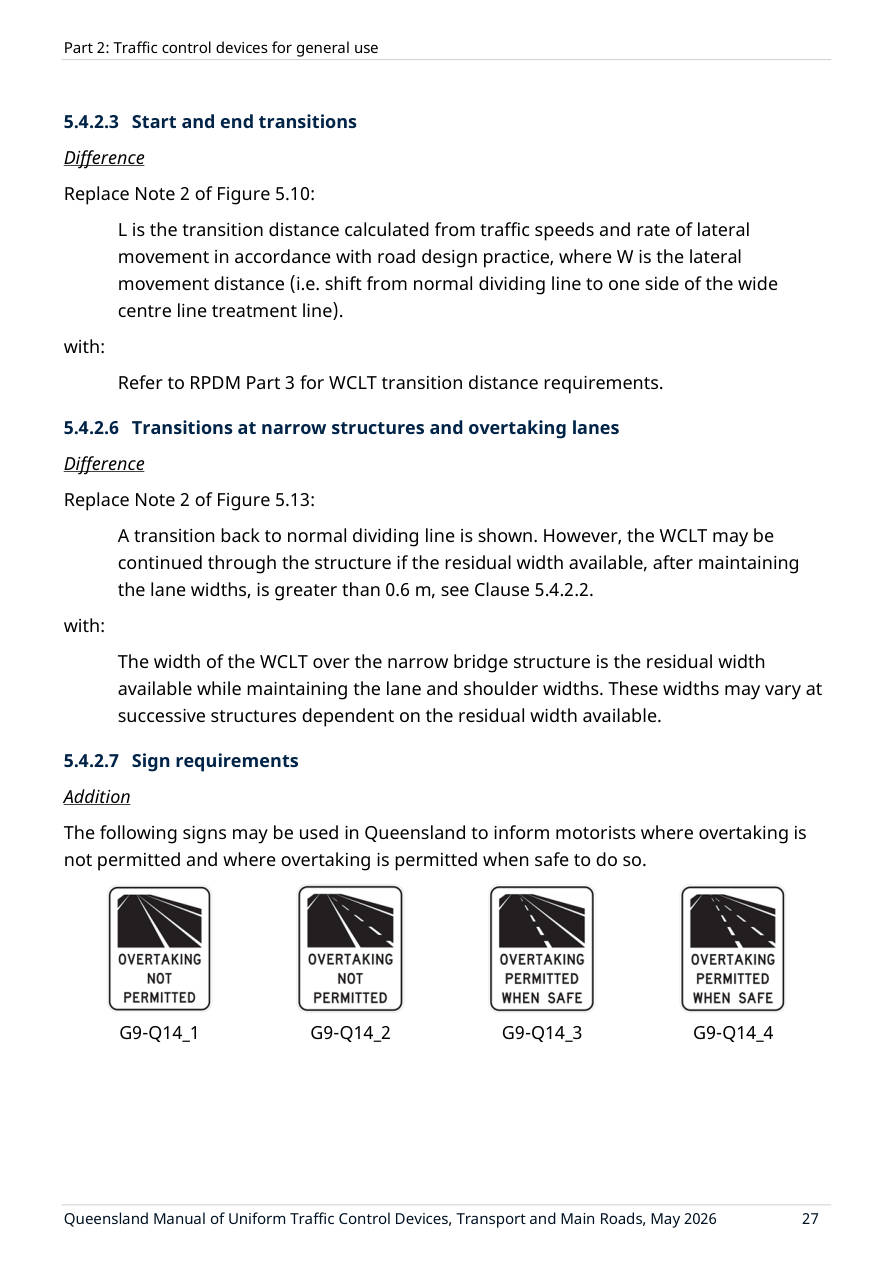
The following signs may be used in Queensland to inform motorists where overtaking is not permitted and where overtaking is permitted when safe to do so.
G9-Q14_1 G9-Q14_2 G9-Q14_3 G9-Q14_4
5.5Transverse Lines#
5.5.2Give way lines#
Replace Item (c) with:
At a roundabout, to indicate the safe position for a vehicle to be held before entering. The line shall be placed across the entering road. The line may be along the edge of the circulating roadway (see Figures 2.8 and 2.9) or set back up to 5 m from the edge of circulating roadway. The line may be staggered on multiple lane approaches.
5.8Messages on pavements#
5.8.5KEEP CLEAR marking#
Where an installation of KEEP CLEAR pavement marking applied in accordance with this clause has proven to be ineffective, the KEEP INTERSECTION CLEAR G9-67-Q01 sign may be installed to further discourage queuing across the intersection.
G9-67-Q01
5.9Raised pavement markers#
5.9.5Application of raised pavement markers#
5.9.5.2General#
Where RRPMs are used to augment lane lines, edge lines, and outline markings adjacent to bicycle lanes (or sealed shoulders forming part of an identified cycle network) which are less than 1.5 m wide, they shall not be placed within the bicycle lane (or sealed shoulder), but on the opposite side of the line which they are augmenting.
5.11Pavement markings at entrance and exit ramps#
5.11.7Exit ramp marking#
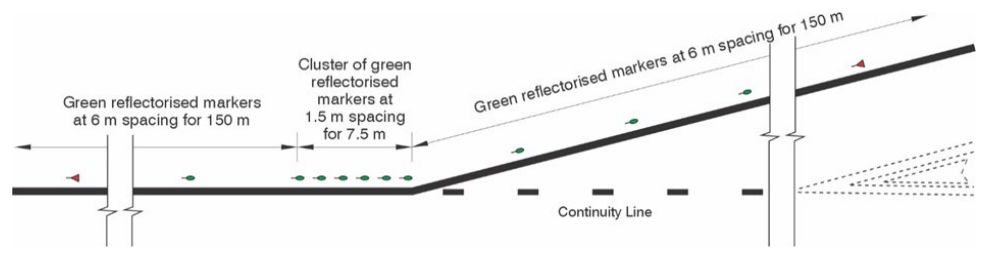
The making shown in Figure 5.11.7 is the normal exit ramp marking. To delineate the approach to and entrance of an off ramp, green uni-directional RRPMs are used in association with the edge line.