2Signs, devices and assemblies – description and use#
2.1General#
The following assemblies may be used in Queensland:
| Assembly | Assembly designation | Signs incorporated | Reference Clause |
|---|---|---|---|
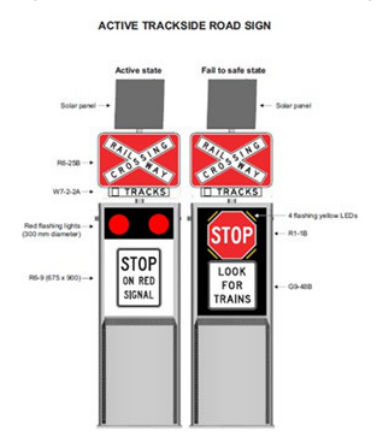
| Active Trackside Road Sign | RX-5-Q01 | Active state: R6-25, W7-2-2, R6-9 Fail to safe state: R6-25, W7-2-2, R1-1, G9-48 | 2.3.1 |
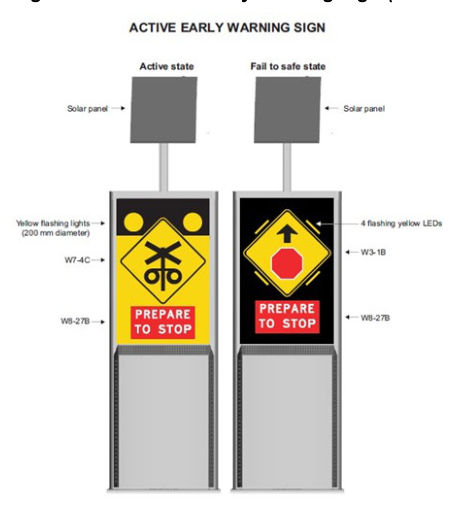
| Active Early Warning Sign | RX-11-Q01 | Active state: W7-4, W8-27 Fail to safe state: W3-1, W8-27 | 2.3.7 |
The following signs may be used in Queensland:
| Sign | Sign number | Size, mm |
|---|---|---|
| CANE RAILWAY CROSSINGS NEXT … km | G9-32-Q01 | 1800 x 750 |
| END CANE RAILWAY CROSSINGS | G9-32-Q02 | 1800 x 750 |
| GIVE WAY – CANE TRAMS ONLY | R1-2-Q01A R1-2-Q01B R1-2-Q01C | 1000 x 1200 1300 x 1600 1600 x 2000 |
| Railway Level Crossing Warning Sign | W7-13-Q01 1 _ W7-13-Q01 2 _ W7-13-Q01 3 _ W7-13-Q01 4 _ W7-13-Q01 5 _ W7-13-Q01 6 _ W7-13-Q01 7 _ | A-600 x 600 B-750 x 750 C-900 x 900 |
| Railway Level Crossing Warning Sign – Short Stacking | W7-Q01 1 _ W7-Q01 2 _ W7-Q01 3 _ W7-Q01 4 _ W7-Q01 5 _ W7-Q01 6 _ W7-Q01 7 _ | 1200 x 900 1200 x 1100 1200 x 1200 1200 x 1400 1200 x 1500 1200 x 1400 1200 x 1400 |
| Railway Level Crossing Warning Sign – When Lights Flashing - No Right Turn - Keep Tracks Clear | W7-Q02 1 _ W7-Q02 2 _ | 1800 x 2600 |
| Railway Level Crossing Warning Sign – Limited Clearance to Rails | W7-Q03 | 2900 x 2100 |
| CANE RAILWAY | W8-Q01A W8-Q01B W8-Q01C | 600 x 400 750 x 500 900 x 600 |
2.2Passive control devices#
2.2.6Diagrammatic warning signs, on side road (W7-12, W7-13, W7-17)#
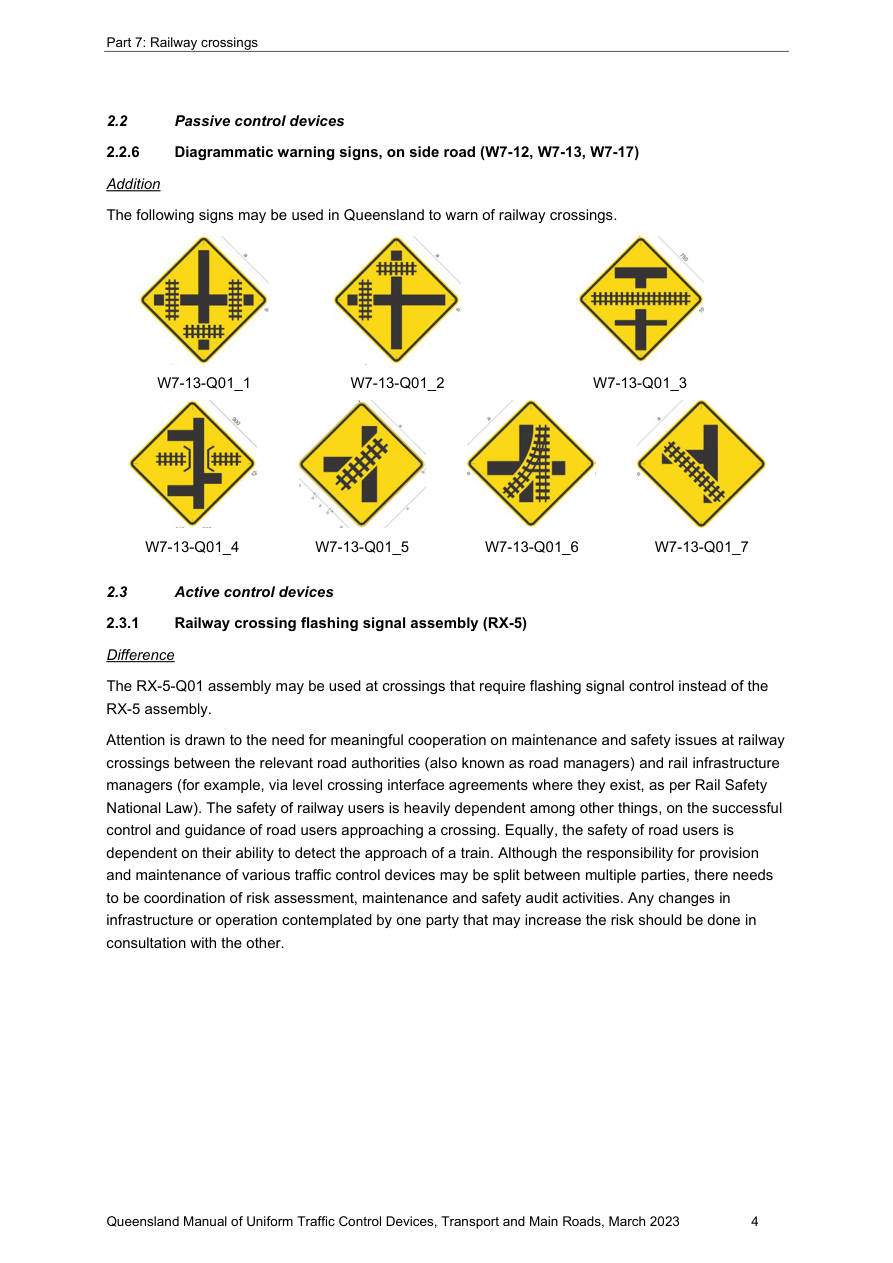
The following signs may be used in Queensland to warn of railway crossings.
W7-13-Q01_1 W7-13-Q01_2 W7-13-Q01_3 W7-13-Q01_4 W7-13-Q01_5 W7-13-Q01_6 W7-13-Q01_7
2.3Active control devices#
2.3.1Railway crossing flashing signal assembly (RX-5)#
The RX-5-Q01 assembly may be used at crossings that require flashing signal control instead of the RX-5 assembly.
Attention is drawn to the need for meaningful cooperation on maintenance and safety issues at railway crossings between the relevant road authorities (also known as road managers) and rail infrastructure managers (for example, via level crossing interface agreements where they exist, as per Rail Safety National Law). The safety of railway users is heavily dependent among other things, on the successful control and guidance of road users approaching a crossing. Equally, the safety of road users is dependent on their ability to detect the approach of a train. Although the responsibility for provision and maintenance of various traffic control devices may be split between multiple parties, there needs to be coordination of risk assessment, maintenance and safety audit activities. Any changes in infrastructure or operation contemplated by one party that may increase the risk should be done in consultation with the other.
2.3.7Active advance warning assembly (RX-11)#
The RX-11-Q01 assembly may be used at crossings that require active advance warning assemblies instead of the RX-11 assembly.
Attention is drawn to the need for meaningful cooperation on maintenance and safety issues at railway crossings between the relevant road authorities (also known as road managers) and rail infrastructure managers (for example, via level crossing interface agreements where they exist, as per Rail Safety National Law). The safety of railway users is heavily dependent, among other things, on the successful control and guidance of road users approaching a crossing. Equally, the safety of road users is dependent on their ability to detect the approach of a train. Although the responsibility for provision and maintenance of various traffic control devices may be split between multiple parties, there needs to be coordination of risk assessment, maintenance and safety audit activities. Any changes in infrastructure or operation contemplated by one party that may increase the risk should be done in consultation with the other.