2Sign types#
There are two series of signs recommended for signing diversion routes, 'Series 1' and 'Series 2'.
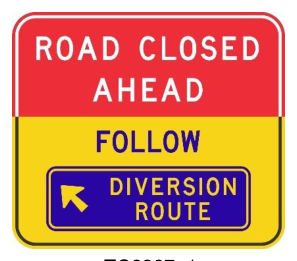
Series 1 diversion route signs are designed for high traffic volume / high-speed roads, such as motorways or key arterial roads. On these road types, there can be many challenges and/or distractions facing motorists, such as navigating complex interchanges (and deciphering associated guide signing), roadside advertising devices, roadside development or the sheer volume of traffic on the road ahead. Series 1 diversion route signs are large, making them highly visible and easily recognised and understood by motorists in what is generally a cluttered visual environment. Series 1 signage is designed for use in highly-developed areas, such as south-east Queensland.
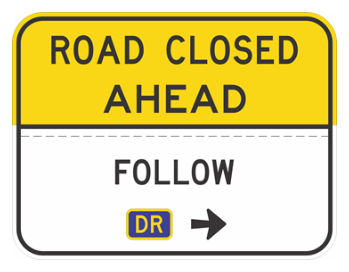
Series 2 diversion route signs are smaller signs designed for lower traffic volume roads where the layout of the network is not complex, and the existing level of guide signing is not excessive. As with Series 1 signs, Series 2 signs are high visibility signs due to their unique design. Series 2 signs are abbreviated to 'DR' as they are typically installed in an uncomplicated road network.
While the following details describe the different and preferred application of Series 1 and Series 2 diversion route signs, unique site conditions may necessitate the use of a particular Series 2 sign in a Series 1 sign layout and vice versa.
2.1Series 1 diversion route signs#
There are three types of Series 1 signs used to guide motorists through an approved diversion route:
- advance diversion warning sign
- diversion direction sign, and
- end diversion sign.
The effectiveness of static sign faces can be diminished over time as motorists become complacent with the information on the sign. To enhance the effectiveness of diversion route signing, all sign faces should be hinged and opened only while the related diversion route is in use. While the initial set up cost will be higher, there should be instant traffic efficiency benefits with the high-visibility diversion routes signs capturing motorists' attention. There are also longer-term maintenance benefits with hinged sign faces, given their limited exposure to atmospheric conditions that can deteriorate the sign face material.
2.1.1Advance diversion route warning sign – Series 1#
Advance diversion route warning signs are installed on the state-controlled road network on approach to the exit point to the diversion route. Their function is to give advance warning of the changed traffic condition ahead and provide adequate time for motorists to make driving decisions.
The advance diversion warning sign has been designed with optional wig-wag lighting. The inclusion of wig-wag lighting will only be required in exceptional circumstances, such as high speed / high volume multi-lane motorways or locations where unique site conditions warrant additional driver attention.
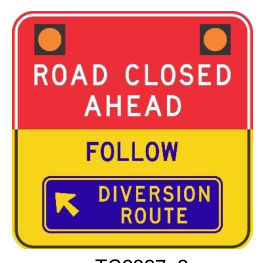
TC2327_1 · TC2327_2
2.1.2Diversion route direction sign#
Diversion direction signs are installed to guide motorists along the diversion route. The placement of diversion direction signs at key intersections or decision points is intended to provide greater traffic safety and efficiency benefits. Given motorists driving the diversion route may be unfamiliar with the road network, these signs should be used as reassurance devices at suitable mid-block locations and on long diversion routes in rural areas where motorists may be disorientated or concerned a key intersection has been missed.
The Series 1 diversion route direction sign includes the word DIVERSION ROUTE and includes an arrow facing the direction a motorist is required to take as follows:
- Where a motorist is required to continue ahead, the straight arrow is used on the sign.
- Where a motorist is required to proceed left, a left facing arrow is placed to the left of the sign.
- Where a motorist is required to proceed right, a right facing arrow is placed to the right of the sign.
These signs are shown in Figure 2.1.2. The use of these signs at and/or in advance of interchanges / intersections along the diversion route depends on the complexity of the subject road network. The level of existing standard guide signing should indicate the need to provide diversion direction signs at or in advance of interchanges / intersections.

TC2328 (Example)
2.1.3End diversion route sign – Series 1#
END DIVERSION ROUTE sign must be installed at the end of a signed diversion route. Their purpose is to inform motorists they have completed the diversion and are returning to unrestricted route selection. Ideally, end diversion route sign should be located within sight of the major road network and, where applicable, near existing guide signing that provides motorists with further route selection choices.
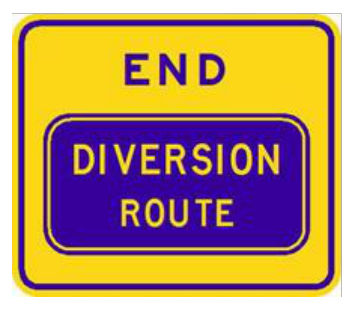
TC2329
2.2Series 2 diversion route signs#
There are three types of Series 2 signs used to guide motorists through an approved diversion route:
- advance diversion route warning sign
- diversion route direction sign, and
- end diversion route sign.
2.2.1Advance diversion route warning sign – Series 2#
Advance diversion warning signs are installed on the state-controlled road network on approach to the exit point to the diversion route. Their function is to give advance warning of the changed traffic condition ahead and provide adequate time for motorists to make driving decisions.
The advance diversion warning sign has been designed with optional wig-wag lighting. It is expected the inclusion of wig-wag lighting will only be required in exceptional circumstances where unique site conditions warrant additional driver attention. Given the unique design and specific information contained on advance diversion route warning signs, a hinged sign face allowing the device to open only while the diversion route is operational is recommended.
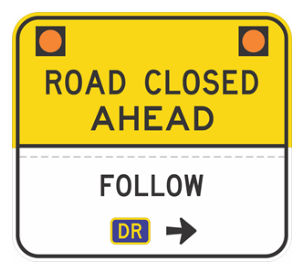
TC2330_1 · TC2330_2
2.2.2Diversion route direction sign – Series 2#
These signs are installed to guide motorists along the road network of the diversion route. The placement of these signs at key intersections or decision points is intended to provide greater traffic safety and efficiency benefits. Given motorists driving the diversion route are likely to be unfamiliar with the road network, these signs may be used for reassurance at suitable mid-block locations. Reassurance signing should be used on long diversion routes in rural areas where motorists may be worried or concerned a key intersection has been missed.
There are many variations of Series 2 diversion route direction signs, given the characteristics of each diversion route is unique. These signs may be erected on independent sign posts or incorporated into existing guide signing. The method of signing diversion routes should provide the clearest level of signing; for example, incorporating diversion route information onto existing guide signs may be complementary and reinforce the correct direction of travel or the additional information could clutter and complicate the existing guide signing so diversion route signs should be erected on independent posts.
Where diversion routes are temporary (that is, around traffic incident sites) and it is practical to drive the route prior to re-directing traffic, hinged sign faces may be installed.
Prior to designing diversion route signs, practitioners should obtain the latest copy of approved TC sign designs at the department's TC signs webpage at https://www.tmr.qld.gov.au/business-industry/Technical-standards-publications/TC-signs.
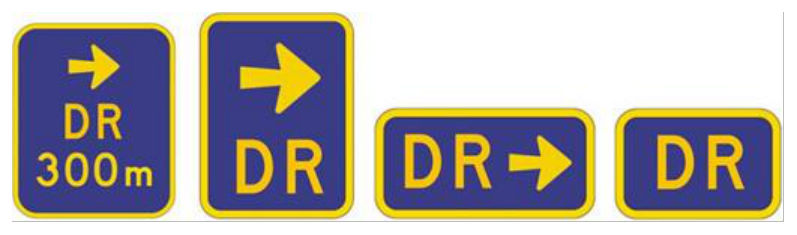
TC2332_1 · TC2332_2 · TC2332_3 · TC2331
2.2.3End diversion sign – Series 2#
End diversion route signage (TC2333) must be installed at the end of a signed diversion route. Their purpose is to inform motorists they have completed the diversion and are returning to unrestricted route selection. Ideally, end diversion route signage should be located within sight of the major road network and, where applicable, near existing guide signing that provides motorists with further route selection choices.
The choice of end diversion route signing is based on the complexity of the subject road network. The sign (TC2333) should be used at more complex locations so it is clearly visible to approaching motorists. The use of a hinged sign face is also recommended for the larger sign to avoid the device becoming an unnecessary distraction while the diversion route is not in operation.
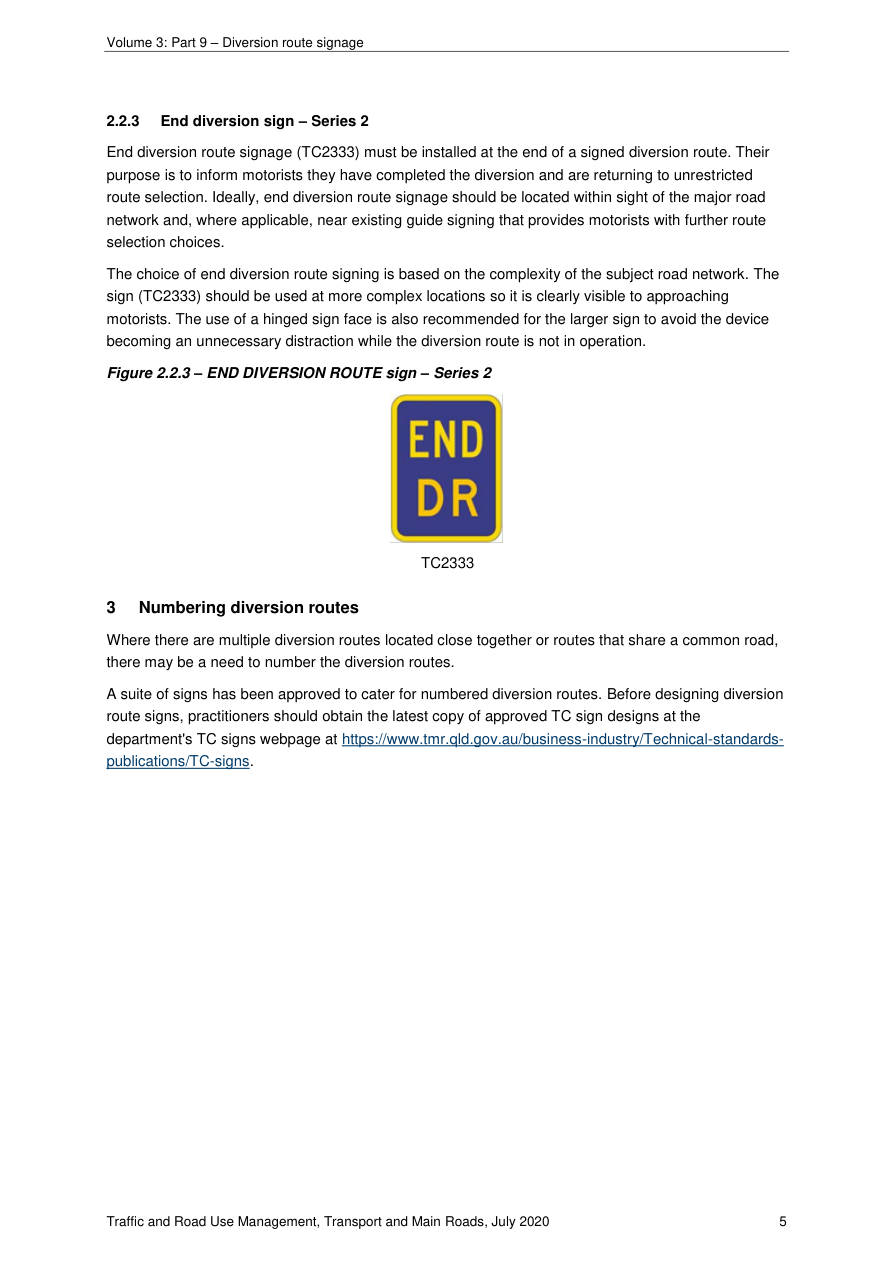
TC2333