
5Overcurrent protection unit (terminal box) – O.P.U#
The O.P.U is to be used alongside portable generators to provide independent overcurrent protection for LED traffic signal intersections. The O.P.U is a protection device that has been designed to safely disconnect a load within 400 ms in the event of a short circuit fault. In addition, the unit shall only be used if all of the requirements under Clause 5 have been met.
5.1Requirements#
The overcurrent protection unit has been designed to provide fault protection under the following conditions:
- a)The nominal load of a Traffic Signal Intersection shall not exceed 6A.
- b)The O.P.U shall only be used on intersections with LED lanterns.
- c)Incandescent and quartz-halogen traffic lanterns shall not be used with the O.P.U.
- d)EFLI shall be in accordance with the TRUM Volume 4, Part 3 Electrical Design for Roadside Devices.
- e)The Generator must be an inverter generator type.
- f)The minimum rated power of the generator shall be capable of sustaining a 1600VA normal running load.
- g)Intersection between 5 AMPS – 6 AMPS (nominal load) shall use generators capable of sustaining a 2000VA normal running load.
- h)Traffic signal intersections shall have a power generation facility switch installed before the O.P.U is connected. See Figure 6.1.1.
- i)Portable generators must be maintained installed and operated as per manufacturer instructions to ensure reliable operation.
- j)Refer to Transport and Main Roads website for a full list of type approval approved Generators and O.P.U suppliers.
5.2Connection to a Traffic Signal Controller#
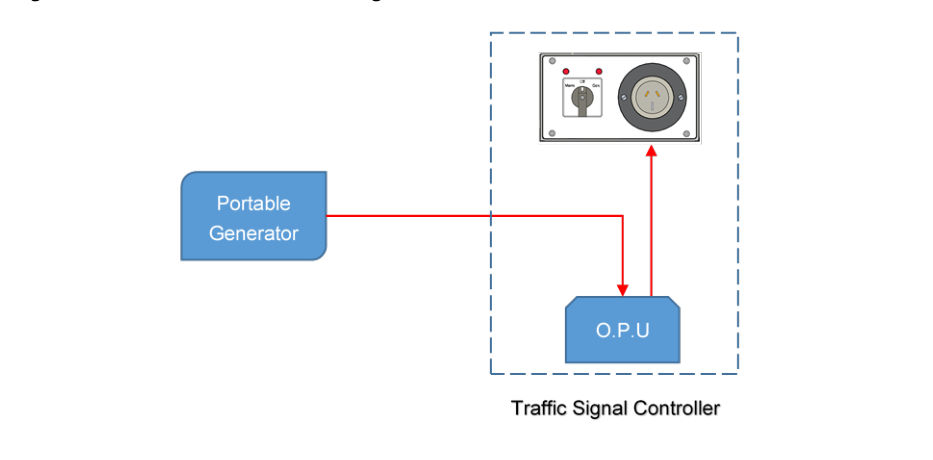
The portable generator is to be connected directly to the O.P.U via the 15A 3pin socket
5.3Generators tested#
The following generator models have been tested and trialled to work correctly under short circuit fault conditions.
- Yamaha EF2800i (2.5 KVA normal running load)
- Yamaha ES2000iS (1.6 KVA normal running load)
- Ryobi 2Kva RYi2000T (1.6 KVA normal running load)
Generators must only be used in full compliance with Clause 5.1.