6Operation#
6.1Operational procedure#
6.1.1Preparation#
Prior to energising a traffic signal controller (TSC) from a portable generator, the operator must ensure:
- a)all crew have read and understood the Job Safety and Environmental Analysis (JSEA) and Work Method Statements (WMS) relevant to the site.
- b)all crew are familiar with the site risks (Clause 6.2).
- c)availability of a fit-for purpose, adequately fuelled generator for the load and duration of the operation.
- d)availability of serviceable extension leads rated at 15A.
- e)that the cabling from the generator is suitably protected against mechanical damage and as a possible tripping hazard.
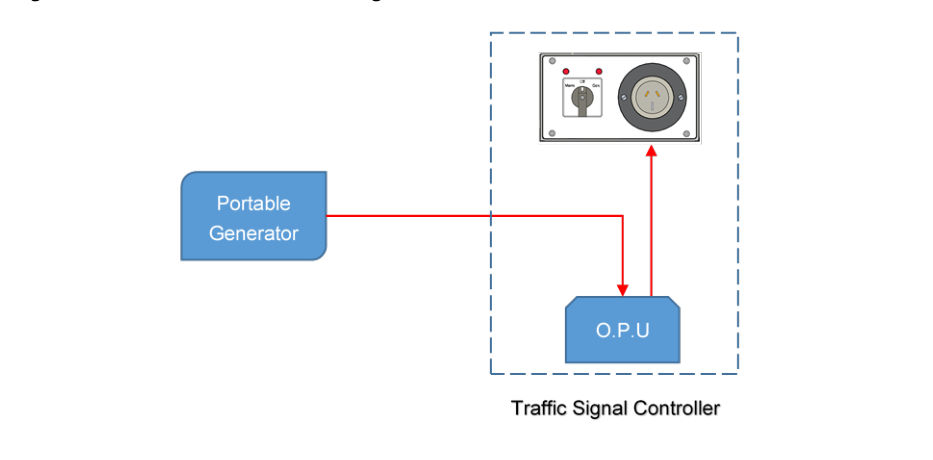
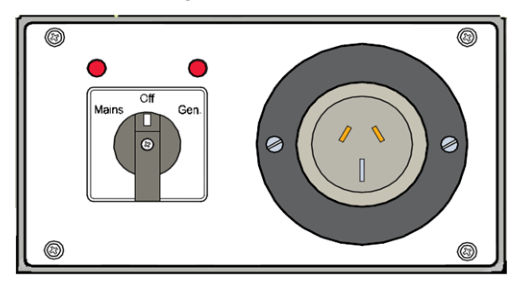
- f)that a generator connection and change-over switch is present at the controller (Figure 6.1.1 as an example).
- g)availability of "Overcurrent Protection Unit" (O.P.U)
- h)compliance with requirements under Clause 5
6.1.2Connecting generator to controller#
Once on site:
- a)Connect the generator to the controller / O.P.U using the extension lead.
- b)The connection must be inspected by a licenced electrical inspector before generator is operated.
- c)Start the generator for a few seconds before switching the changeover switch to GEN, thus connecting the TSC load onto the generator.
6.1.3Disconnecting generator from controller#
To disconnect the generator from the controller:
- a)Switch from generator mode to OFF mode or Mains mode using the changeover switch.
- b)Switch off the generator.
- c)Disconnect the generator / O.P.U from the TSC.
- d)Clear site to resume normal operation.
6.2Risk analysis#
6.2.1Site Hazard identification#
To ensure safe installation of generators, the hazards associated with the site must be clearly identified before attempting to connect a transportable generator to a traffic signal controller. Hazards are site specific and operators must ensure they cover all possible hazards associated with a particular site. Below is a non-exhaustive list of hazards that may apply to most sites, pertaining to transportable generators:
- a) theft, vandalism and arson
- b) electric shock
- c) generator being hit by an errant vehicle
- d) generator catching or starting fire
- e) injury resulting from manual handling of the generator
- f) smoke inhalation due to dangerous concentration of exhaust gases, smoke, fumes and so on.
Each captured hazard must be controlled by effective risk management as detailed below, prior to commencing installation.
6.2.2Risk characterisation#
The Transport and Main Roads risk matrix shall be used for the risk analysis of the above hazards. Each of the above non-exhaustive list of identified hazard in Clause 6.2.1 is analysed for possible risk mitigation as shown in Table 6.2.2. The operator should include additional hazards as each site demands.
A likelihood and a consequence is allocated for each hazard item as per the TMR risk matrix. In the absence of any controls, the risks may be either “Extreme” or “High”. The aim is to introduce controls such that the risk is reduced to the acceptable level of either “Medium” or “Low” before connecting the generator.
| Hazard | INITIAL RISK Likelihood | INITIAL RISK Consequence | INITIAL RISK Risk | Suggested Mitigation Measures | Revised Risk Likelihood | Revised Risk Consequence | Revised Risk Risk |
|---|---|---|---|---|---|---|---|
| Theft, Vandalism, Arson | Use generator with anti-vandal, anti-theft features (e.g. GPS locator) | ||||||
| A dedicated person to watch over the generator while in operation | |||||||
| Caging the generator to prevent public access | |||||||
| Bolting the generator to the floor for the duration of the operation | |||||||
| Electrocution | Ensure electrical safety kit available on site | ||||||
| At least two persons on site while connecting or disconnecting generator | |||||||
| A dedicated person to watch over the generator while in operation | |||||||
| Caging the generator to prevent public access | |||||||
| Hit by errant car | Place generator behind a barrier where possible | ||||||
| Place generator behind the signal controller, shielded from traffic | |||||||
| Traffic management plan | |||||||
| Fire | Suitable Fire extinguisher on site | ||||||
| Electrical/Fire safety kit available on site | |||||||
| Ensure generator is not prone to fuel leakage | |||||||
| Avoid vicinity of high temperature surfaces which leaking fuel may ignite | |||||||
| Avoid equipment that may emit arcs, sparks or hot particles | |||||||
| Injury from handling | Ensure no moving parts are exposed | ||||||
| Proper manual handling procedures are used | |||||||
| Smoke Inhalation | Ensure adequate ventilation | ||||||
| Ensure work is done away from direction of exhaust fumes |