
5Pedestrian (zebra) crossing#
5.2Description#
Information contained in the sixth paragraph in this clause about the use of twin alternating flashing signals (lights) shall be replaced with the following: The R3-1 sign may be supplemented with twin, diagonally opposed, alternatively flashing yellow signals (lights). Where flashing signals (lights) are installed they shall only be used where activated passively by pedestrian detection technology. Push button activation of such lights is not accepted. Where used, the display and flash cycle should be consistent throughout a region.
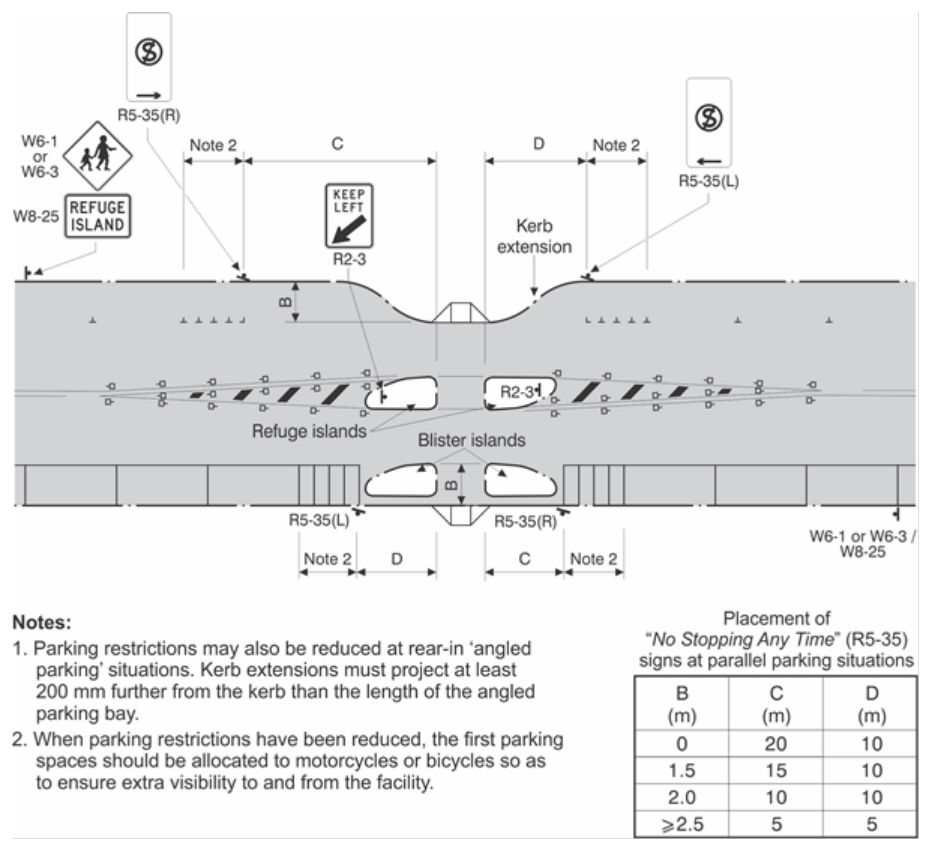
Foreshortening of the no stopping zone may be implemented as shown in Figure 5.2(a).
5.3Requirements for installation#
The following replaces that in the standard: Requirements and options for the installation of pedestrian (zebra) crossings are as follows:
- a)Mid-block crossing (not raised and without physical speed control features [see Section (e) for raised crossings on multi-lane roads]). The following shall apply:
- i.No more than one lane of moving traffic in any one direction shall be encountered by a pedestrian using a crossing.
- ii.There shall be adequate sight distance between approaching vehicles and pedestrians about to use the crossing for the former to be able to stop in time to give way to the latter. This may be achieved primarily by means of parking restrictions near the crossing (see Figure 5.1). Kerb extensions (Clause 5.2) may also be required to achieve this sight distance where kerbside parking is frequent (see Figure 5.2(a)). Limits to the height of any vegetation and, control of the speed of motor vehicles may also be provided.
- iii.The 85th percentile operating speed at the crossing once constructed should not be expected to exceed 50 km/h. This criterion shall be applied to enhance crossing safety, not remove existing crossings. Measures to reduce 85th percentile speed at crossings shall be considered to align with safe system principles so far as is reasonably practical (refer to Road Planning and Design Manual Part 4B Table 5.1.1(b) for ramp grade speed reductions).
- iv.Approach sight distance to the leading edge of the crossing pavement marking shall be provided appropriate to the 85th percentile speed of the site.
- v.If at a location with a posted speed limit greater than 50 km/h and speed limiting devices are not incorporated into the design, an RPEQ certified risk assessment (for example a Safe System Assessment) shall be undertaken to support the use of the treatment at the site, including an assessment of the risk of a 'do nothing' option.
- b)Crossings on slip lanes
- The conditions specified for crossings in Item (a) and (e) shall also apply to pedestrian crossing installations on slip lanes.
- c)Other locations
- Pedestrian crossings may be provided at other locations including roundabouts and side roads by following the principles given for mid-block crossings and providing sufficient sight distance for the likely speed of vehicles. In the immediate vicinity of a roundabout which physically slows all vehicles, a pedestrian crossing may be provided on a road with an 85th percentile speed not expected to exceed 50 km/h at the crossing once a speed limiting device is constructed (such as a raised platform). See Figure 5.7 for regulatory and warning signs for raised pedestrian crossings at roundabouts.
- d)Advanced warning
- Where the presence of a pedestrian crossing, the pedestrians who use it, or the presence of a raised platform may be unexpected or difficult to anticipate, warning of the crossing shall be provided, see AS 1742.10 Clause 11.2(b) and Clause 11.2(e).
- e)Pedestrian (zebra) crossings with physical features to control motor vehicle speed at the crossing (for example zebra on raised platform [wombat] or zebra adjacent to speed cushions). The following shall apply:
- i.If more than one lane of moving traffic in any one direction is encountered by a pedestrian using a crossing, an RPEQ certified risk assessment (for example a Safe System Assessment) shall be undertaken to support the use of the treatment at the site, including an assessment of the risk of a 'do nothing' option. Figures 5.5 and 5.6 show typical layouts incorporating setback lines and visibility islands, which can be used alone or in combination to treat the multiple vehicle visibility blockage (of pedestrians crossings) risk at multi-lane pedestrian crossings.
- ii.As per s5.3(a)(ii).
- iii.As per s5.3 (a)(iii).
- iv.Approach sight distance to the top of the raised crossing leading edge ramp shall be provided appropriate to the 85th percentile speed of the site.
For guidance on selecting and planning crossings, refer to Queensland Guide to Traffic Management Part 6, Transport and Main Roads’ Technical Guidelines for Raised Priority Crossings on Pedestrian and Cycle Paths, and Selection and Design of Cycle Tracks. Refer to Raised Priority Crossings for Pedestrian and Cycle Paths for examples of application of Queensland MUTCD Part 10 85th percentile speed requirements for raised priority crossings.
5.5Pavement markings#
Point (a), replace the second paragraph with the following. The road pavement between the bars shall be of a uniform colour that contrasts with the white bars. This uniform colour shall extend for at least 1 m at each end of the bars, so that the crossing is clearly identifiable and visually isolated. The only permitted encroachment into this area of uniform colour is the markings described in Item (b). See also Item (d).
Red and yellow pavement treatments do not contrast sufficiently with white bars for people with vision impairments.
For the profile of raised pedestrian (zebra) crossings at any location refer to Road Planning and Design Manual 2nd Edition Part 4B.
5.6Typical layouts#
Widths shown in typical layouts are desirable. They should be adapted as needed to allow for crossing installation at constrained sites.
- e) A multi-lane raised pedestrian crossing consideration with a splitter island, see Figure 5.5.
- f) A multi-lane raised pedestrian crossing consideration with setback give way line, see Figure 5.6.
- g) Regulatory and warning signs at a roundabout with raised pedestrian crossings, see Figure 5.7.
Figure 5.1 NOTE 5
The following replaces that in the standard:
The R3-1 sign may be supplemented with twin, diagonally opposed, alternatively flashing yellow signals (lights). Where flashing signals (lights) are installed they shall only be used where activated passively by pedestrian detection technology. Push button activation of such lights is not accepted.
Figure 5.2 NOTE 5
The following replaces that in the standard:
The R3-1 sign may be supplemented with twin, diagonally opposed, alternatively flashing yellow signals (lights). Where flashing signals (lights) are installed they shall only be used where activated passively by pedestrian detection technology. Push button activation of such lights is not accepted.
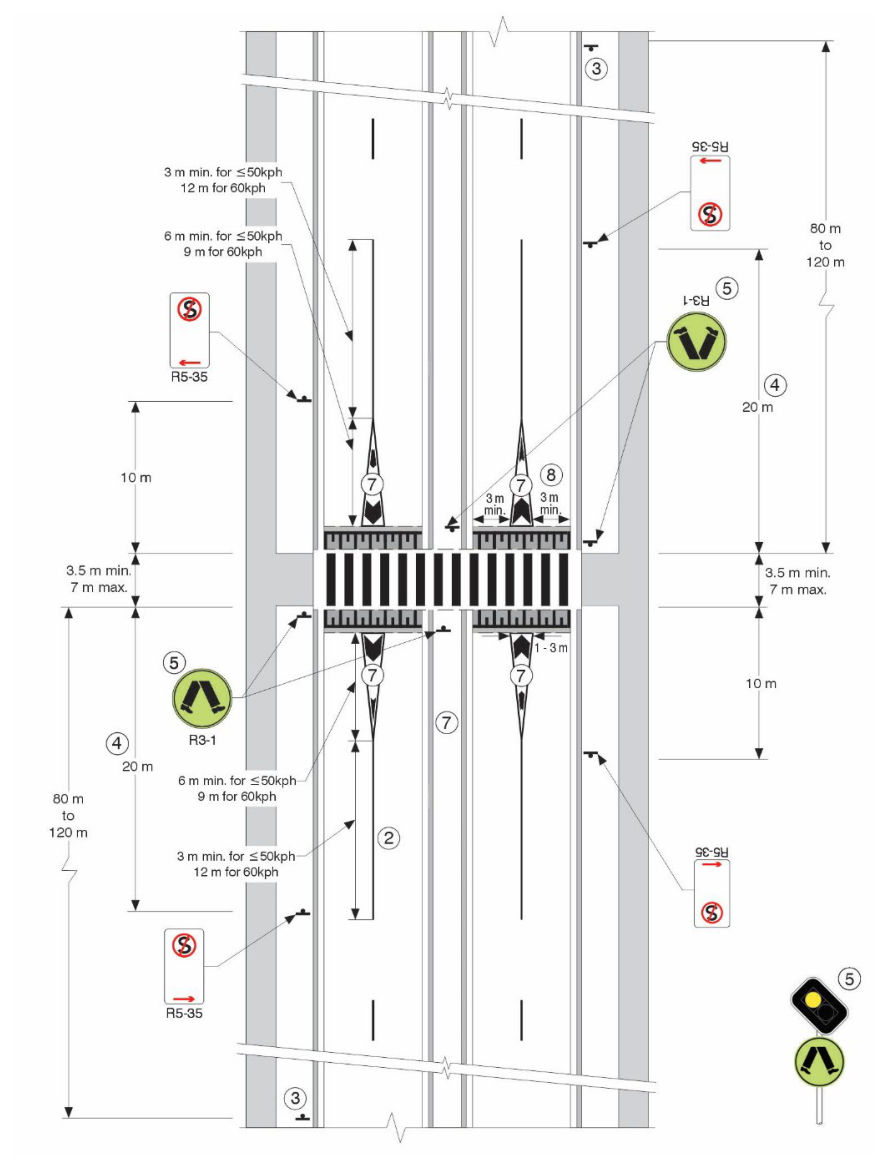
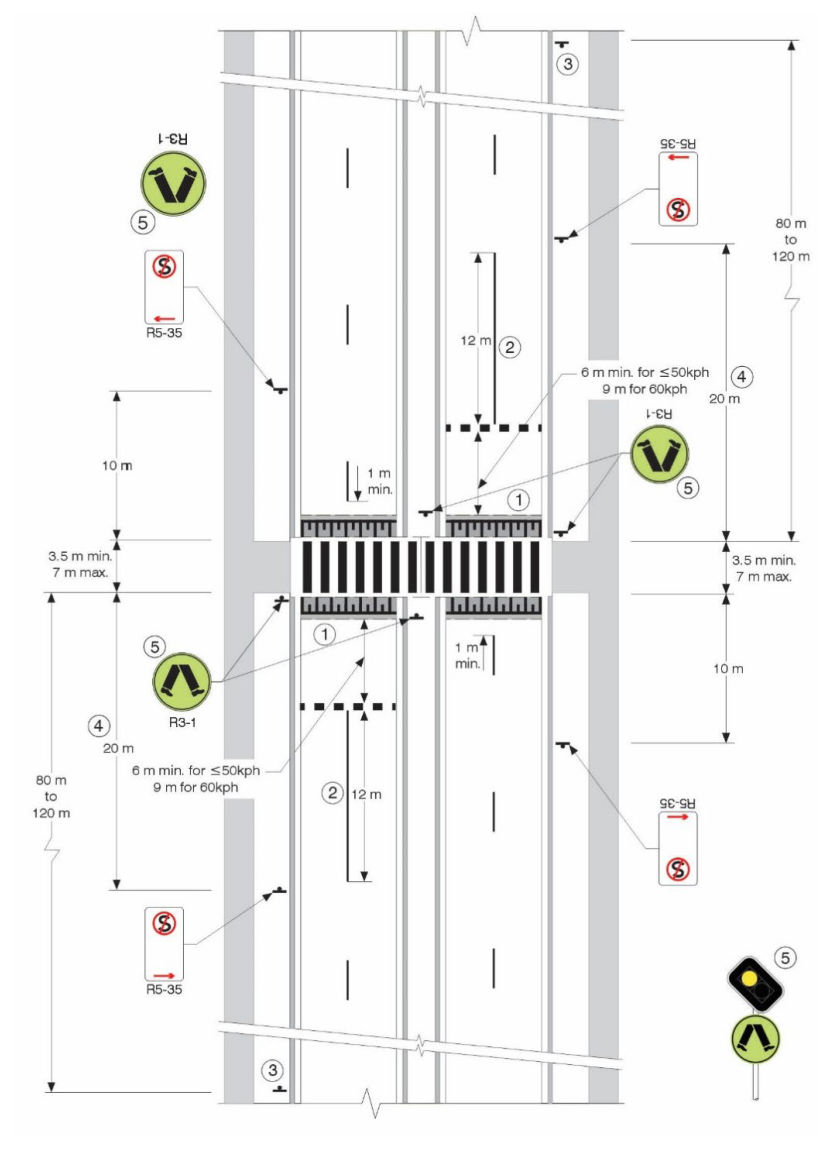
- 3.The W6-2-1 sign is used in advance of the crossing where sight distance to the R3-1 signs is substandard, see Clause 11.2(b). If required, the W8-31 sign is located here and is mounted below the W6-2-1 sign, Clause 11.2(e).
- 4.Variations to no stopping distances may be required, see Clause 5.2.
- 5.The R3-1 sign may be supplemented by flashing yellow signals when passively activated by a pedestrian presence detector.
- 6.For additional speed reduction on approach to the crossing, speed reduction devices such as speed cushions or speed bumps may be installed, see Queensland MUTCD Part 13 for further information.
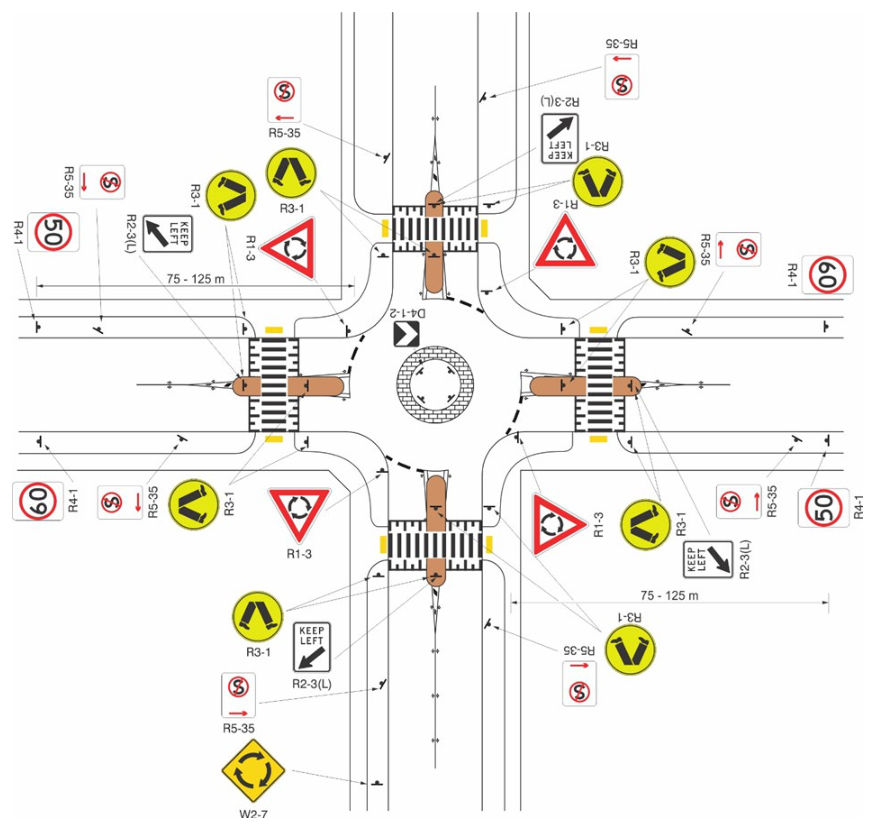
Figure 5.7: · NOTE 1 · Pedestrian Crossing (R3-1) sign shall be installed on both sides of the lane and facing each approach, at or in the immediate vicinity of the pedestrian crossing, refer to Queensland MUTCD Part 10.