7Children’s crossing#
7.1Purpose and safe operation#
The following replaces that in the Standard:
The children’s crossing is a part-time facility catering primarily for school children. It is only in operation when the CHILDREN'S CROSSING (R3 3) flags are displayed.
CHILDREN’S CROSSING (R3 3) flags shall only be displayed during school zone times of operation.
7.2Description#
The following replaces that in the Standard:
A children’s crossing as shown in Figure 7.2(a) shall comprise the following items:
- i.STOP lines minimum 450 mm wide.
- ii.Two posts painted in red and white alternate bands on each side of the road at the crossing and one post in red and white alternate bands in advance of the crossing at the STOP line.
- iii.The CHILDREN'S CROSSING flags (R3 3) displayed to indicate that the crossing is in operation.
- iv.Provision for mounting the CHILDREN'S CROSSING flags on the advance posts specified in Item ii.
- v.NO STOPPING signs (R5 36) for control of parking near the crossing during the times the crossing is in operation.
- vi.The hand STOP banner (R6 7) which is used by a crossing supervisor when in attendance.
- vii.The advance warning sign assembly, Children's Crossing Ahead (W6 5-1) used where sight distance to the crossing is substandard.
- viii.Dashed crosswalk lines.
- ix.Yellow pedestrian holding lines each side of the crossing.
At some schools, a pedestrian crossing may be required for use by pedestrians outside of school zone hours. This facility would normally be installed in accordance with Clause 6. Figure 7.2(b) provides details for signing and marking a combined children’s crossing and pedestrian crossings (zebra) at schools.
7.4Signs#
The following sentence replaces the first sentence after the STOP sign image in the standard.
No other sign shall be displayed in the immediate vicinity of a children’s crossing unless it is combined with a pedestrian crossing.
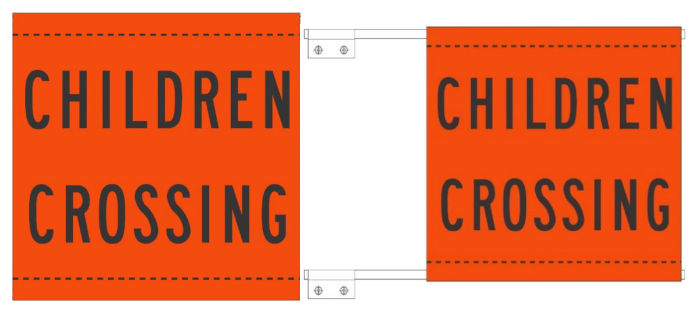
REGULATORY FLAG AND FITTINGS – “CHILDREN CROSSING” (R3-3-Q01)
R3-3-Q01 (TC9472)
For flag details refer to R3-3. R3-3-Q01 specifies materials, colours and fittings. Flag material shall be opaque and double thickness. Legend shall be provided on both sides of the flag.
7.5Typical layouts#
Replace Figure 7.1 with 7.1(a)
Include Figure 7.1(b)
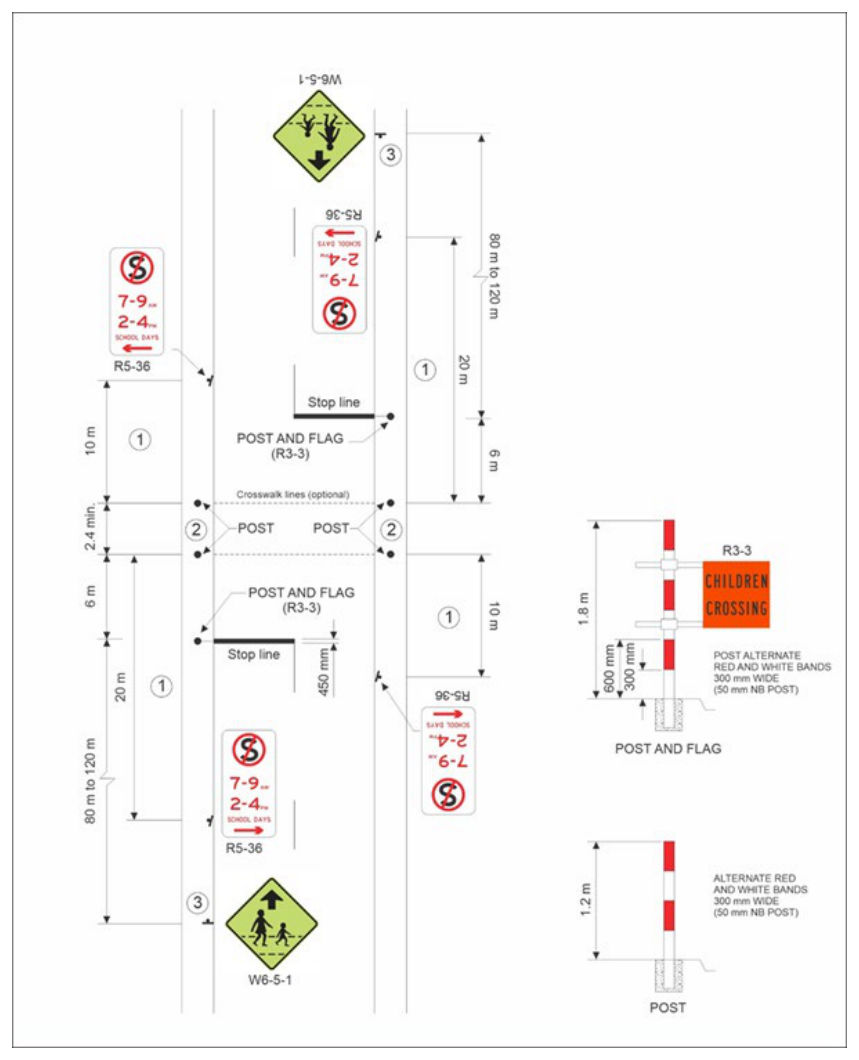
Notes: · Variations to no stopping distances may be required where visibility to the crossing is substandard. · A yellow line (approximately 100 mm wide) shall be painted on the footpath – at least 0.5 m behind the face of the kerb – to indicate the position where pedestrians should wait until directed to cross the roadway. · Where used, this line extends the width of the sealed apron connecting the footpath and kerb or a distance of 2.4 metres, that is, between the crossing posts (without flags). · The W6 5-1 assembly is required if the sight distance to the crossing is substandard.
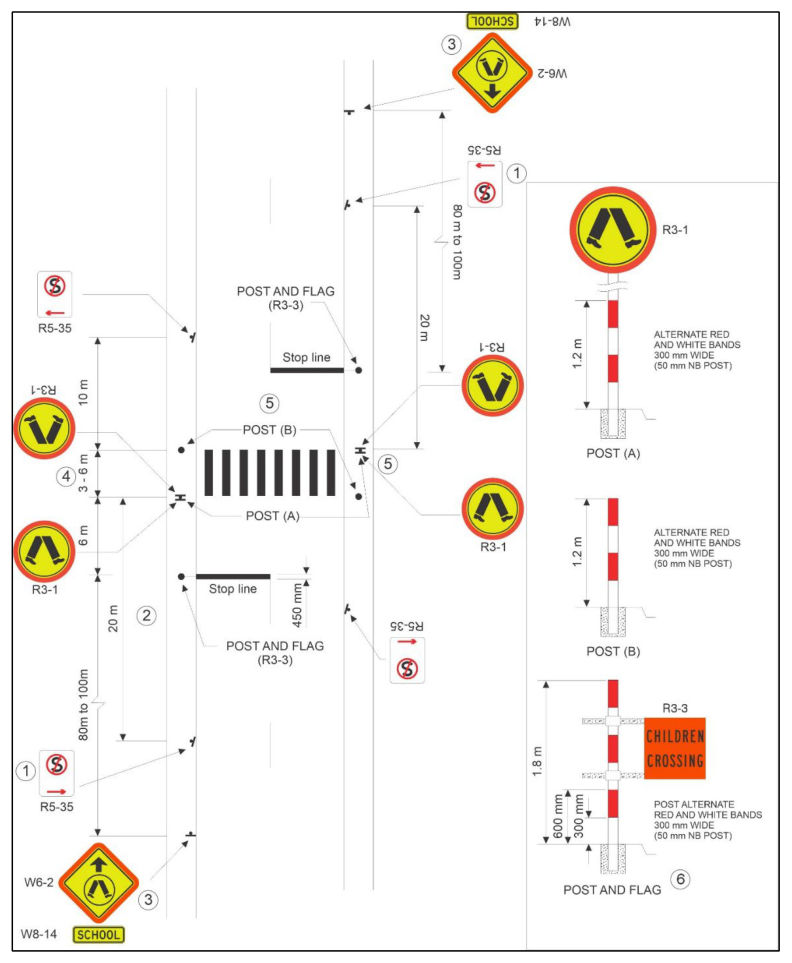
Notes: · Times of operation may be specified by use of R5 36 1 sign. · Where stationary vehicles near a crossing seriously limit visibility between drivers and pedestrians, an increase in these distances may be required. · Warning signs may be supplemented with advance pavement messages. · See Queensland Road Safety Technical User Volumes (QRSTUV) Guide to Schools. · A yellow line (approximately 100 mm wide) shall be painted on the footpath – at least 0.5 m behind the face of the kerb to indicate the position where pedestrians should wait until directed to cross the roadway. · Where used, this line extends the width of the sealed apron connecting the footpath and kerb or a distance of 3–6 metres, that is, between the crossing posts (without flags). · Kerb ramps should be installed. · A raised platform may be installed as part of this crossing layout. · Refer to QRSTUV Guide to Schools. · Post and flag may be installed on build out islands.