Appendix FGuidelines for the application of parking controls#
F1Specific parking provisions#
F1.1Bus stops and bus stands#
Picking up or setting down of passengers on a bus route occurs at fixed locations (bus stops) which are defined by signs. Bus stops may be located mid-block between intersections or on the far side or near side of intersections. Where bus stops are required on both sides of the road, they should be staggered except on median divided roadways or where a stationary bus does not impinge upon the normal flow lanes. At intersections, far side stops offer advantages in avoiding stationary vehicles on approaches to intersections, and in improving intersection capacity; however, depending on the form of intersection control, there may be a need to stop twice, first to give way to cross traffic and second to pick up or set down passengers. This may be avoided by using a near side stop, especially if it is located very close to the intersection. Where a bus has to turn right at an intersection, the far side location is preferred since less interference to through traffic results. Alternatively, stops could be located well away from the intersection, so long as the location is convenient for passengers. Far side locations are preferred for bus stops near school crossings, pedestrian actuated signals and marked pedestrian crossings as buses are less likely to obscure the visibility of pedestrians on such facilities. At railway and tramway level crossings, far side bus stops are preferred. However, they should be designed and located in a manner which prevents vehicles queuing behind stationary buses, thus blocking the crossing (see AS 1742.7). The mid-block stop uses more kerb space but removes the run-in / run-out manoeuvres as far from intersections as possible, generally causing less interference to traffic. Where the full width of the roadway between kerbs is required for moving traffic, bus bays can be indented into the adjacent footpath or reservation up to a depth of 3.7 m over an appropriate length. Run-in and run-out tapers should be provided for deceleration and acceleration. The length of a bus stop depends upon the number of buses likely to use it at any one time. Minimum lengths may be obtained from the following expressions:
- a)For near side or far side of intersections: 18 + l (n - 1)
- b)For mid-block stops in parallel parking areas: 24 + l (n - 1)
- c)For mid-block stops in angle parking areas: 27 + l (n - 1)
where l = the length of bus, in metres n = number of buses likely to use a stop at the one time.
Bus stands are areas where buses may remain for some time before commencing a trip. They should be located clear of the through traffic lanes or at a more distant location where parking demand is not high and obstruction of traffic does not occur.
F1.2Taxi stands and feeder stands#
Taxi stands should be provided in locations convenient for patrons. It is desirable that taxis stop parallel to the kerb, facing in the direction of the main traffic stream so that waiting taxis may progress from the tail of the taxi queue to the head. Minimum length of taxi stands should be (5.4 n + 1.0) metres, where n is the number of taxis to be accommodated. Should demand exist for greater allocation of space at any particular location, the main stands should be fed from feeder stands established at a reasonable distance from the main stand. The feeder stand should be so placed that the lead taxi in the rank can observe when a space becomes vacant at the main stand. A feeder stand may feed one or more main stands.
F1.3Loading zones#
Loading zones should be provided where it is necessary to allow commercial or other vehicles to stop for the picking up or setting down of goods or passengers. They should allow stopping parallel to the kerb and should have a length which will accommodate the vehicles which normally use them (generally not less than 9 m). Bearing in mind the need to locate loading zones close to the premises being served, consideration should be given to placing loading zones at the beginning or end of a section of parking, rather than in the middle, to reduce the need for awkward vehicle manoeuvring. Loading zones may be reserved for commercial vehicles.
- a)Commercial vehicles (in relation to stopping in a loading zone). These are defined in the Transport Operations (Roads Use Management) (TORUM) Act 1995 as:
- 1)Any horse-drawn vehicle constructed, fitted or equipped for the carriage of goods;
- 2)Any motor vehicle (excluding any motor car or motor bike) constructed, fitted or equipped for the carriage of goods; and
- 3)Any motor vehicle constructed, fitted or equipped for the carriage of persons to which is affixed a form of identification as an approved commercial vehicle.
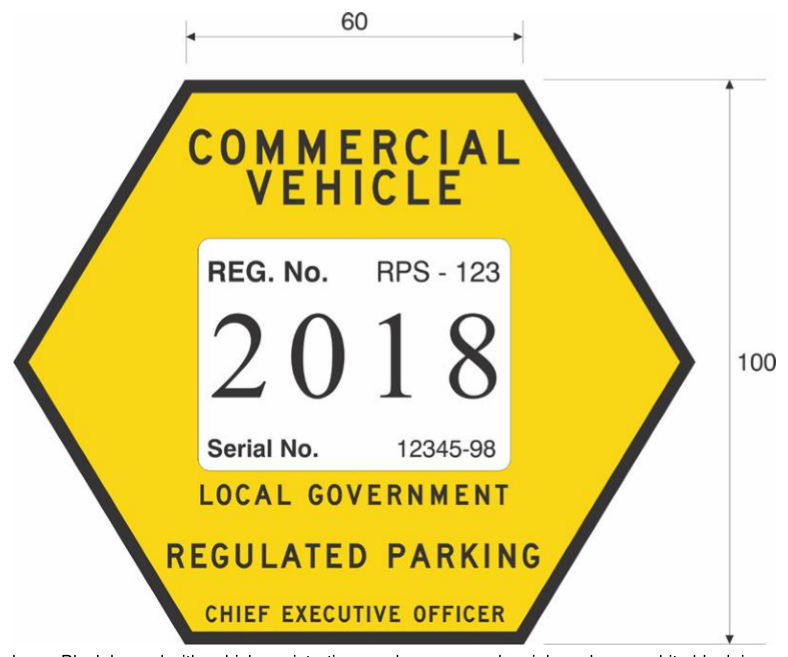
- b)Commercial Vehicle Identification Label. The form of the identification is specified in Figure F1.3.
It shall be prominently displayed on the left-hand side front of the vehicle. The label shall be affixed to the hinged ventilation window if fitted. If no hinged ventilation window is fitted, the label shall be affixed on the lowest most left-hand section of the windscreen. In the case of vehicles not equipped with a windscreen, the label shall be affixed to a prominent position on the vehicle so that it is clearly visible at all times. Identification labels shall be issued by a local government.
F1.4Parking for people with disabilities#
Power to issue permits for the identification of vehicles used for the carriage of people with disabilities is contained in the TORUM Act. Vehicles displaying a people with disabilities permit are generally permitted to be parked longer than the posted time limit. Such parking spaces are not convenient for all people with disabilities, especially where parking demand is high, parking is parallel to the kerb or there is no useable ramp between road and footpath level. In these circumstances, consideration should be given to providing parking spaces for the exclusive use of vehicles displaying a people with disabilities permit, issued by the appropriate authority. The design and location of such spaces shall be in accordance with AS 1428 Set: Design for access and mobility, AS/NZS 2890.1 Parking facilities – Off-street parking and AS 2890.5 Parking facilities, Part 5: On-street parking and shall take account of the:
- a) demand for spaces with wheelchair access
- b) proximity of the spaces to the activity to be assessed, and
- c) ease of access from the spaces by wheelchair.
F1.5Other specific parking demands#
The demand for other types of parking restriction depends on the types of adjacent activities to which people wish to gain vehicle access. Temporary signing may be necessary for works zones, to allow construction vehicles to deliver materials and goods to building construction sites. Permit schemes may be introduced, for example, to allow residents to park their vehicles in the street in which they live, for periods longer than the duration indicated on parking panels. In these schemes, one of the primary aims of introducing short duration parking is to increase the likelihood of unoccupied parking spaces being available for permit vehicles, whilst at the same time minimising inconvenience to visitors and others with legitimate business in the area. Permit zones may also be established for similar purposes.
However, these prohibit visitors’ vehicles and other non-permit vehicles from parking even for short durations. Other special requirements may be provided for by using No Stopping or No Parking signs with appropriate exceptions. Each case should be considered on its merits, but the number of special provisions should be kept to a minimum to avoid motorist confusion or the expectation that special exceptions are easy to obtain.
F2Time-limit parking#
Where the available space meets the demand for parking without rationing, there is no reason to place a time limit on parking. Where demand exceeds supply, it is necessary to impose rationing to increase the turnover and so allow more people to use the more sought after spaces to gain access to the adjacent facilities. The limits to be applied in any locality should be determined only from a proper study of parking patterns. Generally, with adequate enforcement, an efficient time limit results in some spaces being vacant at any time.
In business districts, turnover demands are usually too high for long term, on street parking. Limits of increasing duration are usually applied at increasing distances from the heart of the district. This ensures the highest turnover for premium demand areas while allowing longer term parking at greater walking distances.
The usual periods provided for are half, one, two, three and four hours, but in the vicinity of post offices, banks, or other ‘errand’ type locations, limits as low as five minutes may be used to advantage.
Time limits may be introduced by the exercise of powers given to a local government by the TORUM Act.
F3Fee payment parking#
F3.1General#
If time limits are to operate successfully, they have to be adequately enforced. A very small number of consistent violators parking for lengthy periods will reduce the advantages of any scheme. Where competition for parking is intense and satisfactory enforcement is difficult to maintain, meter parking or ticket parking should be implemented.
Properly designed fee payment parking schemes provide the following benefits:
- a) increased turnover in parking spaces, which often has the effect of reducing traffic volumes by eliminating vehicles circulating in search of parking places
- b) an accurate time check on parking duration, thereby simplifying enforcement
- c) discouragement of all day or other long term parkers from parking in areas restricted to short term parkers
- d) reduction in the number of people required for time limit enforcement, and
- e) the opportunity to impose price controls on the demand for kerb space. Maximum charges can be imposed where demand is greatest while lower charges can assist in redistributing demand to less competitive areas.
However, if fee payment parking schemes are not properly designed or effectively enforced, possible disadvantages of such schemes are as follows:
- a) many users may not pay the fee
- b) strong public resentment may be generated, and/or
- c) meter feeding (exceeding the posted time limit by paying the fee again) may be encouraged.
F3.2Guidelines for the implementation of fee payment parking areas#
The implementation of fee-payment parking may be considered under the following conditions:
F3.2.1Time-recording meters#
- a) Where an insufficient turnover of spaces is indicated by short term parkers resorting frequently to illegal parking or double parking.
- b) Where a high demand is indicated by the continuous usage of at least 70 per cent of available parking bays during business hours, a parking limit of one hour or less may be introduced by parking meters. Where 50–70% of available space hours are used, the limit may be increased up to two hours.
- c) Where studies reveal insufficient off street parking facilities within reasonable walking distance from large generators of high short term parking demand, such as stores, banks or other commercial centres.
F3.2.2Non-time-recording meters (parkatareas)#
- a) Where traffic surveys show that 90 per cent of all parkers park for periods of four hours or greater.
- b) Where the installation of time recording meters is not warranted.
F3.3Delineation of fee-payment parking areas#
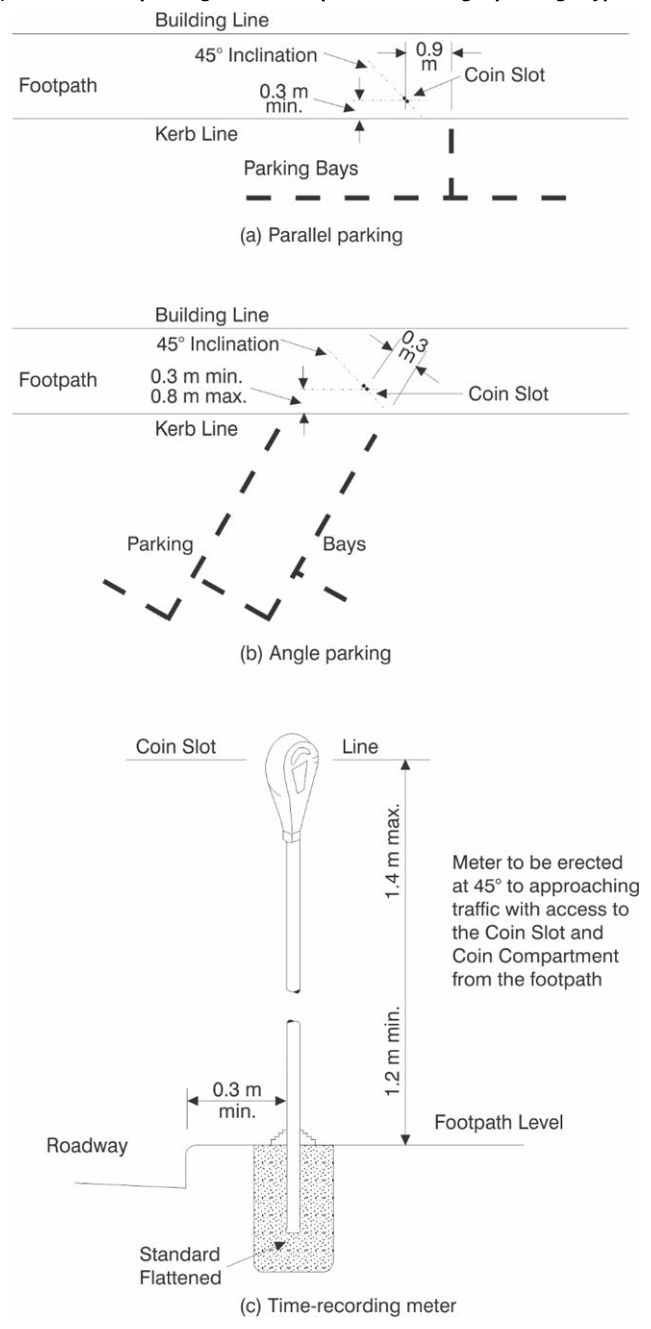
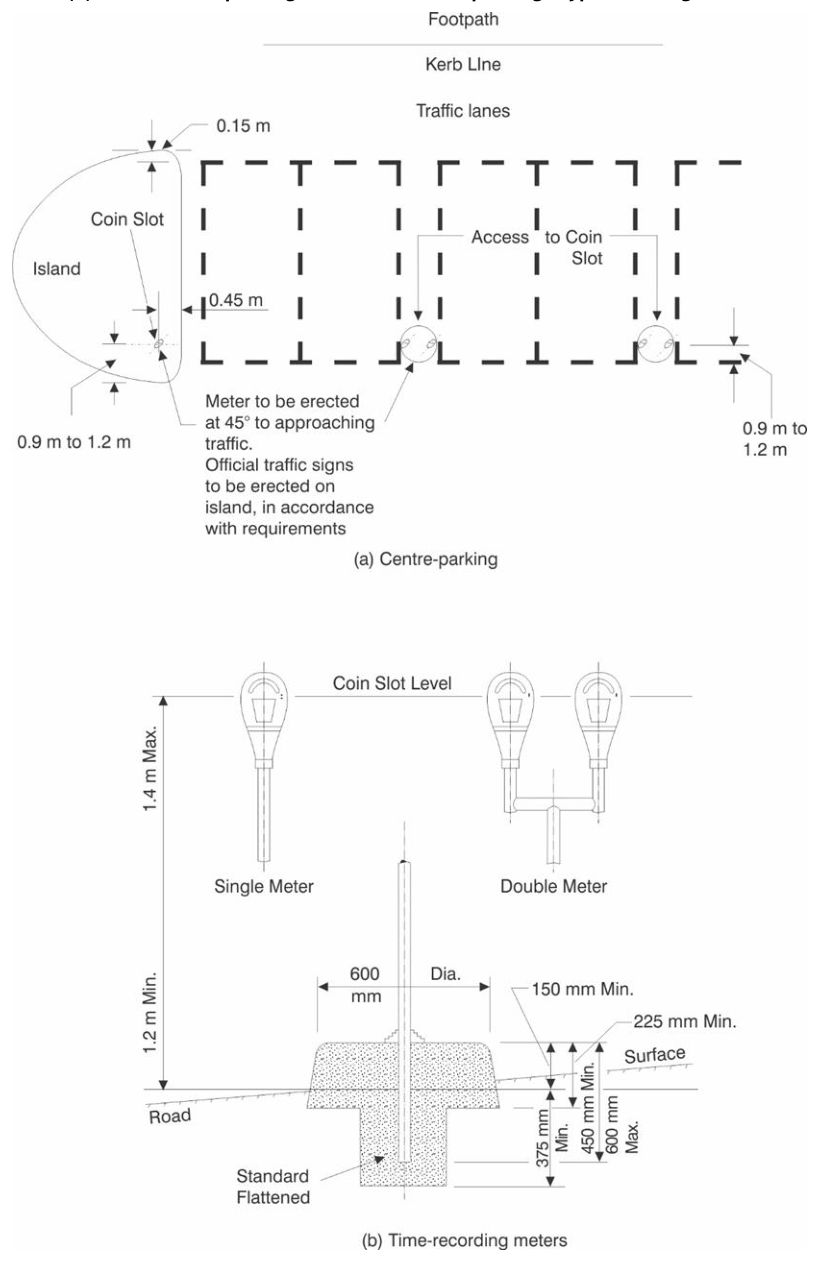
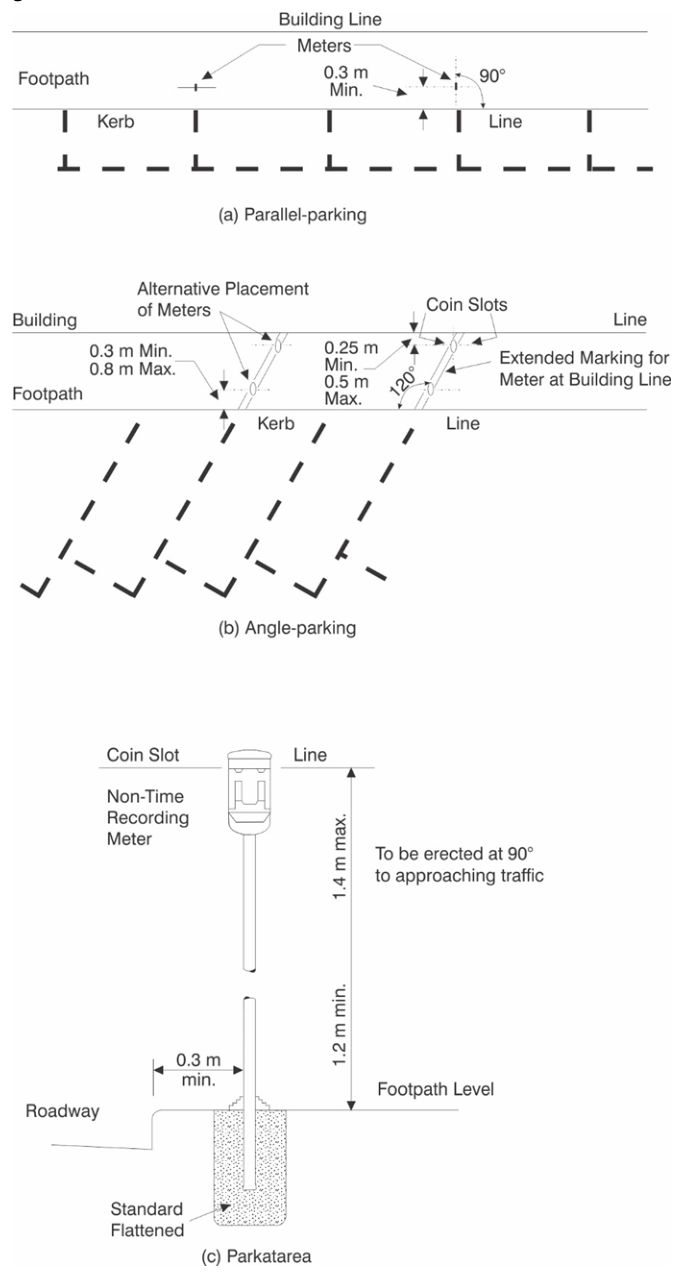
Signs and pavement markings are used to delineate fee payment parking areas. Typical layouts for parking meters are shown in Figures F3.4.5(a), F3.4.5(b) and F3.4.5(c). To reduce the number of footpath obstructions, double head meter stems may be used. Centralised (or multi bay) parking meters, ticket or coupon parking schemes provide alternative methods of minimising footpath obstructions or minimising the number of fixtures in a sensitive environment. Centralised (or multi bay) parking meters, ticket issuing machines or coupon purchase locations are required at regular intervals along a parking area. The spacing and location of ticket issuing machines will depend on the parking angle, the convenient walking distance and the location of any intersecting footpaths. On all roads except those with low traffic volumes, a user should not have to cross a road to purchase a ticket or coupon.
It is important that the time limit applicable to a fee payment area is prominently displayed. This shall be indicated on the Parking Control sign and should also be indicated on each parking meter or ticket issuing machine. Where centralised parking meters are provided, consideration may be given to the installation of a MULTI-BAY METER PARKING sign at the entrance(s) to the street.
F3.4Parking meters#
F3.4.1General#
Meters permit reasonable and effective enforcement of time limits by displaying a signal to an enforcement officer indicating whether or not the limit has been overstayed.
Meters may be time recording or non-time recording. The former indicates unexpired time by a pointer on a graduated time scale or other indicator. The latter (parkatareas) has a coin window to expose the required parking fee to an enforcing officer. Non time recording meters are usually restricted to long term (day or half day) restrictions. Meters are only installed in areas where regulated parking has been established in accordance with the TORUM Act (see Clause 5.1).
F3.4.2Temporary prohibition of use of parking meters#
Where a local government desires to temporarily prohibit the use of a metered space, the meter shall be covered with a suitable hood on which a legend shall indicate that parking is prohibited in that space.
F3.4.3Installation of parking meters#
Where parking meters are to be installed the following procedure shall be observed:
- i.Pavement marking shall be made in accordance with this Part of the Manual.
- ii.Standard signs shall be erected in accordance with this Part of the Manual.
- iii.The meter should be installed relative to the bay as shown in Figures F3.4.5(a), F3.4.5(b) and F3.4.5(c) (for single or double bays) as appropriate.
- iv.The height of the coin slot shall be 1.2 m–1.4 m above the footpath.
F3.4.4Time-recording meters#
Where metered parking has been duly authorised and parking meters are to be installed, they shall comply with at least the following:
- i.They shall be so designed and constructed that:
- a.operation of the time mechanism requires the insertion of a coin and compliance with other directions, if any, for the effective operation of the meter as specified on the meter
- b.unexpired time is indicated by scale and needle or other indicator, and
- c.a red ‘expired’ flag or equivalent indicator is easily visible to an enforcing officer checking the meter by vehicle.
- ii.A plate and sign shall be attached to the meter showing:
- a.the period for which the meter may be actuated
- b.the denomination of the coin or coins the meter will accept
- c.the hours of day which are subject to metered parking operation, and
- d.any further directions for the effective operation of the meter.
F3.4.5Parkatareas#
Where parkatarea parking has been duly authorised and parkatareas are to be installed, they shall generally comply with the following:
- i.They shall be so designed and constructed that:
- a.Each parkatarea should be capable of applying to two consecutively marked spaces and each face of the meter should comprise a hinged door incorporating two coin slots. These coin slots should be suitable for the insertion of coins prescribed on the plate and sign attached to the meter.
- b.Below each of these slots there should be a coin window of sufficient height to expose a minimum amount of the appropriate coins.
- c.The coin slots and windows should be designed in both width and thickness to receive the appropriate coins. The arrangement of the slots and windows should permit the coins to fall freely under gravity immediately upon insertion, to a stop provided to hold the coins in a visible position until released by a coin release device.
- d.The top section of the parkatarea should be fitted with a key operated lock and cam, to release and open the hinged coin slot and window sufficiently to allow the deposited coins to fall into the coin receptacle below.
- e.The coin receptacle should be mounted below the hinged windows and coin slots, and be fitted with a suitable lock.
- ii.A plate and sign shall be attached to the parkatarea showing:
- a.the hours of operation;
- b.the denomination of the coins accepted by the parkatarea;
- c.the amount to be inserted for any period of parking.