Advisory speeds on roundabout diagrammatic signs#
The purpose of this section is to introduce the use of a supplementary advisory speed information panel, in conjunction with advance direction signs at isolated roundabouts on high-speed roads.
Advance roundabout direction signs are used to indicate to drivers the presence of a roundabout on the road ahead and the layout of the roads intersecting at the roundabout.
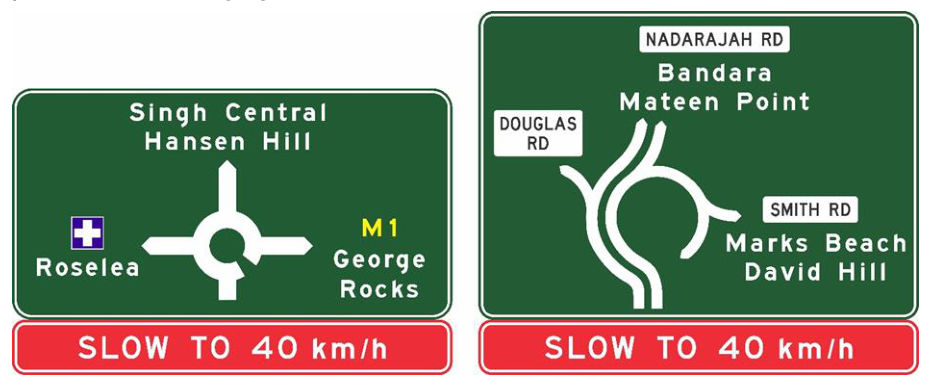
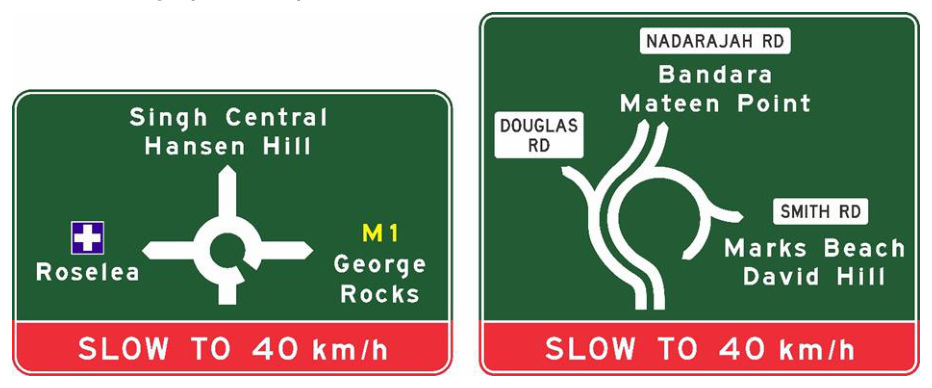
The advance roundabout direction sign may take the form of a standard advance direction sign for simple roundabout layouts, for example, G1-5 type as shown in Figure 6.5(a).
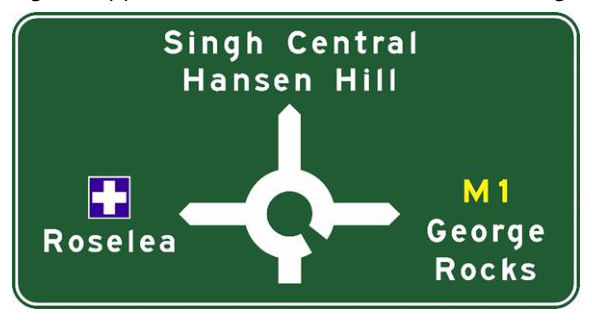
Where the geometry of a multi-lane roundabout is such that selection of the correct lane is not clearly apparent to drivers with a standard advance roundabout direction sign, a special advance direction sign indicating the lane(s) to be used is usually provided as shown in Figure 6.5(b).
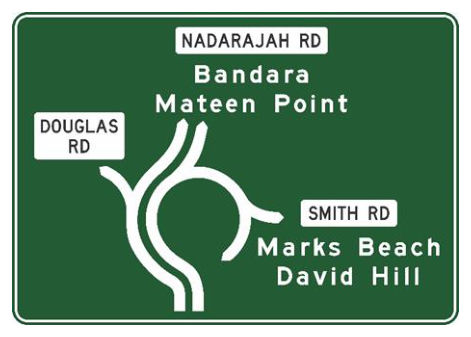
At isolated roundabouts on high-speed roads in rural and outer metropolitan areas, drivers may not perceive the need to reduce speed in sufficient time to slow down and negotiate the roundabout in safety.
The supplementary advisory speed information panel has been introduced to assist in addressing this need. It is based on practice in Victoria which, for some years, has used the advisory speed panel to supplement roundabout advance direction signing for this purpose.
The supplementary advisory speed information panel is used to inform drivers of the ‘safe’ speed at which vehicles should travel through the roundabout.
The supplementary advisory speed information panel for use, in conjunction with advance roundabout direction signs, is only used on rural and outer metropolitan roads where typical approach speeds are higher than 80 km/h.
The supplementary advisory speed information panel is shown in Figure 6.5(c).

The advisory speeds shown on the supplementary advisory speed information panel apply to through movements only as it is reasonable to assume that drivers of vehicles turning at a roundabout would already be aware of the need to slow down to turn.
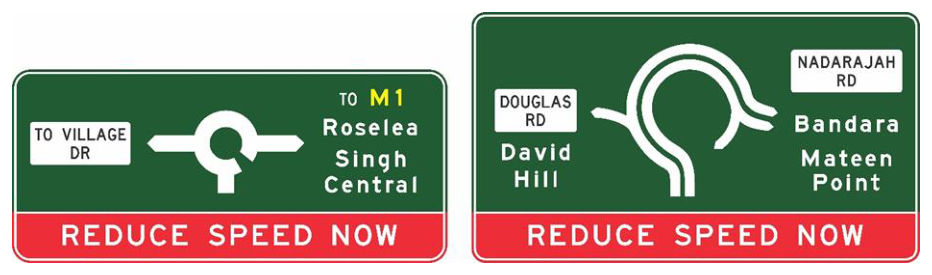
In view of this, the supplementary advisory speed information panel is not normally used where drivers are approaching a T-intersection roundabout along the ‘stem’ or terminating road approach. In this case, an alternative information panel REDUCE SPEED NOW, as shown in Figure 6.5(d), may be used where there is an existing or potential safety concern. This alternative information panel may also be considered for use on an approach which does not have a clearly defined through movement, but where at least one movement at the roundabout might not be perceived by drivers as a turn movement requiring substantial speed reduction.

The advisory speed for a particular roundabout approach is determined in the same manner as advisory speed signing on curves along rural roads. A ball bank indicator or other suitable means is used to determine the advisory speed in accordance with procedures in Part 2 of the Queensland MUTCD. Calculated speed values are then rounded to the nearest multiple of 10 km/h for display as the ‘safe’ speed on the supplementary panel.
Where there is more than one lane available for through movements on the circulating carriageway for the particular approach to the roundabout, the ‘safe’ speed is determined for each lane and the lower speed shown on the supplementary panel. In this case, the car must remain in one lane as it passes through the roundabout, rather than changing lanes through the roundabout to drive the path of least deflection.
The supplementary advisory speed information panel, for example, SLOW TO 40 km/h and the alternative information panel REDUCE SPEED NOW will be designed as part of the advance roundabout diagrammatic direction sign, with letter heights consistent with the balance of the sign, but with a white legend on red background.
Examples of supplementary advisory speed information panels are shown in Figure 6.5(e) and Figure 6.5(f). Examples of alternative information panel REDUCE SPEED NOW are shown in Figure 6.5(g).