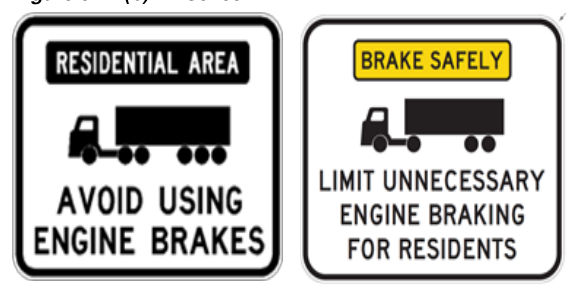
Engine compression braking signs#
The objective of this section is to minimise noise levels from trucks and heavy vehicles while travelling through residential areas. See Transport Noise Management Code of Practice for related information.
Many heavy vehicles are fitted with engine compression brakes to relieve the loads exerted on traditional braking systems working at the wheels.
Most states and territories have produced guidelines for the use of engine brake signage, but most see signage as a short-term measure that will only be used until effective regulation of engine noise is implemented.
Trucks are defined as those vehicles that are Class 3 or above in the Austroads Vehicle Classification system.
Truck noise signs may be installed on roads where
- the posted speed limit is 80 km/h or less – generally, signs should not be required on roads with a speed limit above 80 km/h, but may be considered in special circumstances
- abutting areas are predominantly residential rather than commercial and adjoining built-up area as defined in the Transport Operations (Road Use Management—Road Rules) Regulation 2009
- the 12-hour truck volume is at least 60 at night (7pm–7am) or at least 500 during the day (7am–7pm). and/or
- in advance of a requirement for traffic to stop or slow (for example, signals, roundabout, pedestrian crossing STOP or GIVE WAY signs, curves, or road sections commonly subject to congestion) or steep downgrades.
- Further requirements are given in the traffic control signs TC9709 and TC2350 that have been developed for use.
Sites shall not be selected on the basis of managing an individual complainant at a specific location.
- Signs shall be installed 300 metres or more in advance of a built-up area.
- Signs shall be installed 300 metres or more in advance of a requirement for traffic to stop or slow (for example, signals, roundabout, pedestrian crossing STOP or GIVE WAY signs, curves, or road sections commonly subject to congestion) or steep downgrades.
- Signs shall be sited at least 5 kilometres apart on a particular route, for each direction of travel or at least 10 kilometres apart where the route is in excess of 20 kilometres.
- Only one sign should be used on each entrance to a rural town.
Details of the truck noise advisory signs are given on drawing TC9709 and TC2350.
RESIDENTIAL AREA is a white legend on a black patch.