1Introduction#
This Technical Specification applies to the control of traffic during roadworks and describes the project specific requirements for control of all traffic through the roadworks site. This Technical Specification shall be read in conjunction with MRTS01 Introduction to Technical Specifications, MRTS50 Specific Quality System Requirements and other Technical Specifications as appropriate. This Technical Specification forms part of the Transport and Main Roads Specifications Manual.
1.1Principal's documents for control of traffic during construction of roadworks#
This Technical Specification forms part of the suite of documents to be applied for provision for traffic during road construction and maintenance activities. The suite of documents includes:
- Transport and Main Roads Specification MRS02 Provision for Traffic, including Annexures.
- Transport and Main Roads Technical Specification MRTS02 Provision for Traffic, including Annexures (this document).
- Queensland Manual of Uniform Traffic Control Devices – Part 3, Traffic Control for Works on Roads (Queensland MUTCD Part 3) including amendments published on the Department of Transport and Main Roads website.
- Queensland Guide to Temporary Traffic Management (QGTTM) – Parts 1 through 10, including amendments published on the Department of Transport and Main Roads website.
- Traffic Management for Construction or Maintenance Work – Code of Practice 2008 (Workplace Health and Safety Queensland and Department of Justice and Attorney General).
- Guideline – Traffic Management at Works on Roads (TMWOR) including amendments published on the Department of Transport and Main Roads website.
- Traffic and Road Use Management Manual (TRUM), Volume 1 – Guide to Traffic Management, Part 3: Traffic Studies and Analysis published on the Department of Transport and Main Roads website.
- Technical Notes: Traffic Engineering including amendments published on the Department of Transport and Main Roads website.
Where any conflicts occur between the requirements in these documents, the order of precedence shall be as listed above except:
- where document precedence is specified in the contract
- if not specified in the contract, shall be approved in writing by the Administrator, and
- where there are conflicting provisions in the Queensland MUTCD Part 3 and the QGTTM, seek advice from the department's Traffic Engineering Practice team at trafficengineering.support@tmr.qld.gov.au.
1.2Departures from standards and innovation#
The requirements and recommendations set out in this Technical Specification and the associated Principal's documents for control of traffic during construction of roadworks (refer Clause 1.1), should not be inferred to preclude innovative or alternative traffic management solutions that provide improved value for money outcomes which meet the intent of this Technical Specification. The primary principle in developing a Traffic Management Plan (TMP) and Traffic Guidance Scheme (TGS) is to ensure the safety of road workers and road users. Safety should at all times be maintained or improved. The secondary principle of the TMP and TGS is to balance the:
- a)efficient movement of traffic, and
- b)construction and traffic management costs.
Innovative treatments that provide improved value for money outcomes are therefore encouraged. Such treatments may include:
- Changes to the work scheduling / programming to occur during periods of lower traffic demand. Planning for greater network impacts through reducing the Level of Service (LOS) for the road user typically enables works to be undertaken in a more time efficient manner.
- Innovative treatments for the deployment of devices.
- Alternative device layouts using new / improved devices.
Contractors undertaking works on roads are encouraged to propose / submit innovative or alternative traffic management solutions that provide improved value for money outcomes. These solutions may involve impacts outside the specified requirements but will be considered against the benefits that are provided and submitted as an Alternative Tender, as set out in the Conditions of Contract. Safety should at all times be maintained or improved. Any Alternative Tender shall be submitted in addition to a Conforming Tender. Further guidance on innovations and preparing an Alternative Tender is provided in the Conditions of Tendering and the Conditions of Tendering Annexure. It is also recognised that in some cases, conditions specific to the site, and proposed traffic management layout may result in it not being possible to implement all the requirements as outlined in this Technical Specification and the associated departmental documents for control of traffic during construction of roadworks (refer Clause 1.1). In those cases where compliance is impractical, the Contractor should propose minor departures from the standards and/or alternative traffic management solutions in the TMP (Clause 5). Where any innovation, alternative traffic management treatment or departure from standards is proposed, it shall be identified in the TMDs risk assessment, as part of that proposal, in accordance with Queensland MUTCD Part 3 Clause 1.9 and the QGTTM Part 2.
1.3Traffic control principles#
The purpose of traffic control at roadworks is to clearly communicate to all road users, including vehicle operators, pedestrians and cyclists, the path and speed at which it is safe to travel through, past or around the roadworks site. The Queensland MUTCD Part 3 and QGTTM provide detailed guidance on the devices and most appropriate forms of traffic control for roadworks sites respectively, these documents should be applied as the optimal treatment at works on roads.
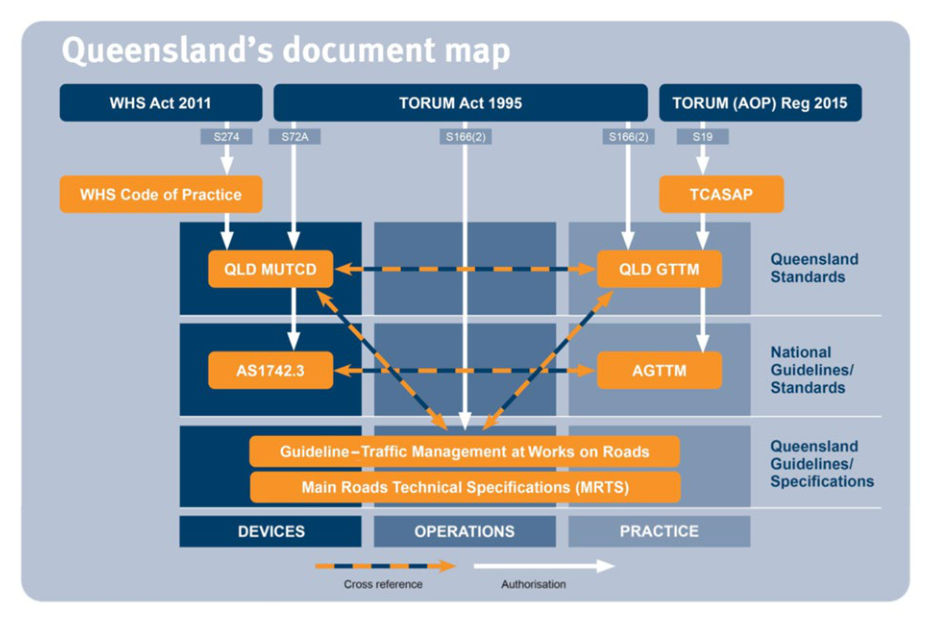
A summary of the documents relevant to Temporary Traffic Management (TTM) practice in Queensland, and their linkages, is provided following:
When applying the relevant TTM standards in Queensland, the following apply:
- The Queensland MUTCD Part 3 shall be read in conjunction with Australian Standard AS 1742.3 Manual of uniform traffic control devices, Part 3: Traffic control for works on roads, and
- The QGTTM shall be read in conjunction with Austroads Guide to Temporary Traffic Management (AGTTM).
The TGS and its relevance / relation to the roadworks site needs to be clear for the scheme to be accepted and credible to the road user, and effective in its implementation. Unless there is clear reason to comply with the TGS, drivers may disregard traffic control devices, most notably speed limit signs. It is in both the Contractor’s and Principal’s interest that speed limit choices in the TGS are realistic, self-enforced by road users, and enforceable.
As a result, there will be a focus on ensuring that the following requirements are met:
- Roadwork signage shall be in accordance with the TGS, Queensland MUTCD Part 3, QGTTM and installed and maintained to the required standards.
- Reduced speed zones shall be kept to minimum lengths. This requires speed limit reinstatement signs to be in place as close to the end of the works requiring the limit as practicable.
- Reduced speed zones shall be kept to minimum durations. This requires speed signs to be changed or removed as soon as they are no longer appropriate.
- A speed zone for road worker safety shall only be in place if there are road workers present and while they are undertaking the works for which the speed limit is required.
- A reduced speed zone in place for road user safety (as a result of changes to the road environment) shall be justified and the danger shall be evident or made evident to the road user by the installation of appropriate warning signage. Portable VMS may be used in advance of the work area to advise changed road conditions.
- A reduced speed zone in place to protect works (for example, as outlined in the early trafficking requirements in MRTS11 Sprayed Bituminous Treatments (Excluding Emulsion)) shall be justified and the reason shall be evident or made evident to the road user, and
- Speed zones should be implemented as close to the time of commencement of works as practicable, and no longer than one hour prior to the commencement of works requiring the speed zone, and should be removed as soon as practicable, and within one hour following the completion of the works requiring the speed zone.
The Contractor retains ultimate responsibility for traffic control and management and is responsible for ensuring that the traffic guidance system is adequately designed, installed correctly and regularly reviewed on site.
Re-inspection costs will apply for breaches of these situations as identified at Clause 8.3.