A3Documentation#
The Speed Management Plan should include information detailed in the following clauses.
A3.1.Speed choices#
- Permanent speed limits at the site and on the sections of road adjoining the site.
- Constraints and considerations impacting on the choice of speed limits to be applied throughout the works.
- The speed limits adopted for the project.
- Conditions under which temporary speed limits are required for worker and traffic safety.
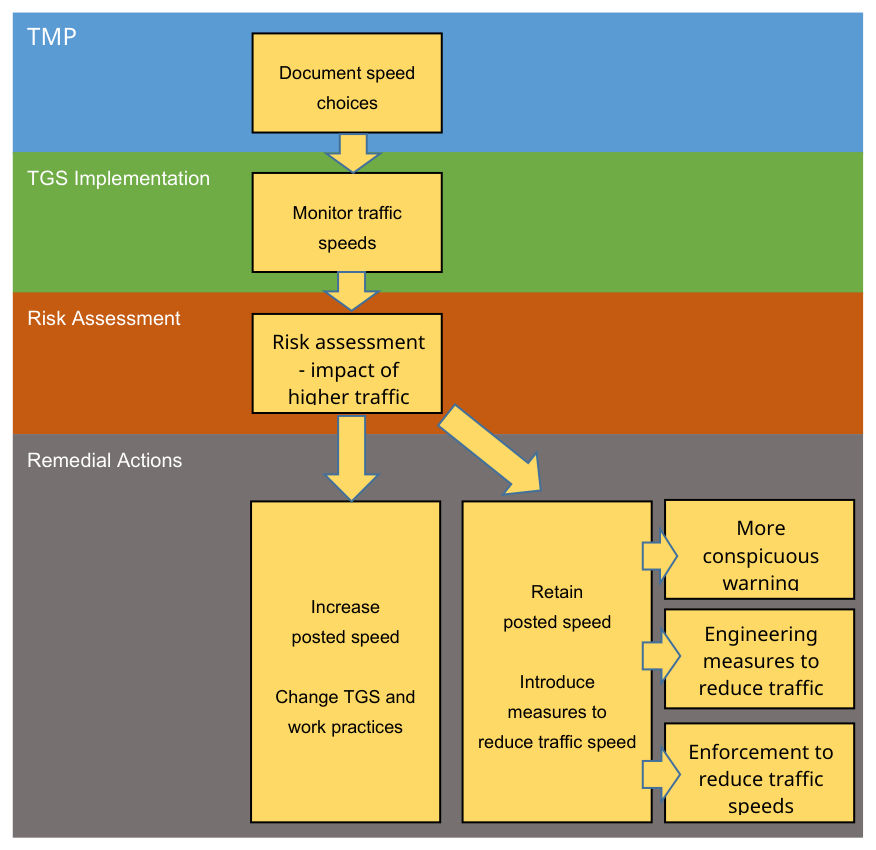
- Measures included within the TMP and TGS to restrict traffic speeds to the posted speed limits.
A3.2Speed monitoring#
Speed surveys for sites in place ≥ 2 weeks shall be undertaken in accordance with one of the following:
- 1.Austroads Guide to Traffic Management, Part 3 Traffic Studies and Analysis
- 2.Queensland Road Safety Technical User Volumes (QRSTUV): Guide to Speed Management Appendix A, or
- 3.Speed indicator devices as per TMWOR Chapter 1.
Speed surveys for sites in place < 2 weeks may be undertaken in accordance with one of the following:
- 1.speed indicator devices as per TMWOR Chapter 1
- 2.manual travel time surveys, see Clause A3.2.1 of this Appendix, or
- 3.other industry accepted method, subject to a risk assessment by the traffic management designer and acceptance by the Administrator.
Documentation should address the following:
- Speed monitoring arrangements:
- contractual requirements, and
- risk assessed additional requirements.
- Collection frequency, and
- Reporting arrangements.
A3.2.1Manual time travel surveys#
Manual travel time surveys involve recording the time it takes a vehicle to go from one datum to another and may be undertaken by a traffic management implementer, a site worker under the direct supervision of a traffic management implementer, or a traffic controller. Time travel surveys should comply with the following steps:
- 1.A start and end datum are to be established within the site by placing an additional delineating device at each point.
- The added delineating device is to be different to the general devices used in the vicinity for identification, that is, where 450 mm cones are the typical device, an additional 700 mm cone may be placed to identify the datums.
- These points are to be sufficiently distanced from the traffic control point, is not to be within the safety buffer and is not to be in a location where changes in speed, due to manoeuvring, are likely to occur.
- 2.The distance between these points is to be measured in metres.
- 3.A competent site worker is to be suitably positioned to allow observation of both points. This location is to be offset from the travelled path and must have a suitable escape path.
- 4.Site worker is to record the time required for each vehicle to travel between the datums using a stopwatch or device with similar capability. The following also apply:
- a)Stopwatch, or similar, must be capable of recording times to 1/10th of a second.
- b)Ideally there is to be at least four seconds headway between each vehicle, to ensure free flow speeds are observed. Where platooning is frequently observed, which often occurs under PTCD or STOP / SLOW control, this requirement may be reduced to two seconds.
- c)Minimum sample sizes, as per the Table A3.2.1 following, are to be observed as far as reasonably practicable.
| Permanent posted speed (km/h) | 40 | 50 | 60 | 70 | 80 | 90 | 100 | 110 |
|---|---|---|---|---|---|---|---|---|
| Minimum sample size | 55 | 65 | 85 | 95 | 110 | 130 | 155 | 200 |
Table in words
- For a permanent posted speed of 40 km/h the minimum sample size is 55.
- For a permanent posted speed of 50 km/h the minimum sample size is 65.
- For a permanent posted speed of 60 km/h the minimum sample size is 85.
- For a permanent posted speed of 70 km/h the minimum sample size is 95.
- For a permanent posted speed of 80 km/h the minimum sample size is 110.
- For a permanent posted speed of 90 km/h the minimum sample size is 130.
- For a permanent posted speed of 100 km/h the minimum sample size is 155.
- For a permanent posted speed of 110 km/h the minimum sample size is 200.
- 5.Samples including their respective times are to be tabulated and the 85th percentile speed calculated. Example manual calculation below:
- a)Count number of samples (N).
- 𝑁𝑁= 25 (𝑎𝑎𝑎𝑎𝑎𝑎𝑎𝑎𝑎𝑎𝑎𝑎𝑎𝑎 𝑓𝑓𝑓𝑓𝑓𝑓 𝑒𝑒𝑒𝑒𝑒𝑒𝑒𝑒𝑒𝑒𝑒𝑒𝑒𝑒)
- b)Multiply N by 0.85 to get the 85th percentile sample (n), round down to nearest whole number:
- 𝑛𝑛= 0.85 ∗𝑁𝑁= 0.85 ∗25 = 21.25 ≈21
- c)Arrange samples from largest to smallest based on travel time and select nth sample from step (b).
| Sample | Time (s) | Sample | Time (s) | Sample | Time (s) | Sample | Time (s) | Sample | Time (s) | ||
|---|---|---|---|---|---|---|---|---|---|---|---|
| 1 | 5.4 | 6 | 5 | 11 | 4.6 | 16 | 4.5 | 21 | 4.3 | ||
| 2 | 5.3 | 7 | 4.8 | 12 | 4.6 | 17 | 4.4 | 22 | 4.3 | ||
| 3 | 5.2 | 8 | 4.8 | 13 | 4.5 | 18 | 4.4 | 23 | 4.1 | ||
| 4 | 5.1 | 9 | 4.7 | 14 | 4.5 | 19 | 4.4 | 24 | 4 | ||
| 5 | 5.1 | 10 | 4.6 | 15 | 4.5 | 20 | 4.4 | 25 | 4 |
Table in words
- Sample 1 has a time of 5.4 s.
- Sample 2 has a time of 5.3 s.
- Sample 3 has a time of 5.2 s.
- Sample 4 has a time of 5.1 s.
- Sample 5 has a time of 5.1 s.
- Sample 6 has a time of 5 s.
- Sample 7 has a time of 4.8 s.
- Sample 8 has a time of 4.8 s.
- Sample 9 has a time of 4.7 s.
- Sample 10 has a time of 4.6 s.
- Sample 11 has a time of 4.6 s.
- Sample 12 has a time of 4.6 s.
- Sample 13 has a time of 4.5 s.
- Sample 14 has a time of 4.5 s.
- Sample 15 has a time of 4.5 s.
- Sample 16 has a time of 4.5 s.
- Sample 17 has a time of 4.4 s.
- Sample 18 has a time of 4.4 s.
- Sample 19 has a time of 4.4 s.
- Sample 20 has a time of 4.4 s.
- Sample 21 has a time of 4.3 s.
- Sample 22 has a time of 4.3 s.
- Sample 23 has a time of 4.1 s.
- Sample 24 has a time of 4 s.
- Sample 25 has a time of 4 s.
- d)Convert time to speed (v) in km/h:
- 𝑣𝑣= 3.6 × 𝑑𝑑𝑑𝑑𝑑𝑑𝑑𝑑𝑑𝑑𝑑𝑑𝑑𝑑𝑑𝑑 𝑡𝑡𝑡𝑡𝑡𝑡𝑡𝑡 = 3.6 ∗80𝑚𝑚 (𝑎𝑎𝑎𝑎𝑎𝑎𝑎𝑎𝑎𝑎𝑎𝑎𝑎𝑎 𝑑𝑑𝑑𝑑𝑑𝑑𝑑𝑑𝑑𝑑𝑑𝑑𝑑𝑑𝑑𝑑 𝑓𝑓𝑓𝑓𝑓𝑓 𝑒𝑒𝑒𝑒𝑒𝑒𝑒𝑒𝑒𝑒𝑒𝑒𝑒𝑒) 4.3 𝑠𝑠𝑠𝑠𝑠𝑠 = 66.9𝑘𝑘𝑘𝑘/ℎ
- e)Check 85th percentile speed against the posted roadwork speed limit as per Clause A3.3 following.
Speeds surveys are typically appropriate for any area on site where a speed reduction occurs, as such surveys on approach to the sites and within the site are usually considered appropriate.
A3.3Speed compliance assessment#
Where speed monitoring demonstrates that speed compliance is not achieved (that is, the 85th percentile speed is greater than 10 km/h above the posted roadwork speed limit), a decision is required to either:
- introduce additional measures to achieve compliance with the speed limit, or
- review the speed limit for credibility to ensure speed limit is self-enforcing.
Changes to the temporary speed limit shall be submitted to by the Contractor to the Administrator for approval by the Principal, see Clause 6.2.
In the event that a decision is made to change the temporary speed limit, a risk assessment shall be undertaken to determine measures to mitigate the subsequent increase in risk. This risk assessment must be substantially completed prior to implementation of the TGS and the selected speed choices to ensure a timely response in the case that traffic speeds are found to exceed the posted limits.
A3.4Engineering remedial actions#
An engineering remedial action plan should be prepared as part of the TMP to ensure that appropriate measures can be implemented at short notice, should monitoring reveal non-compliance with posted speed limits. These remedial actions should be implemented before Police enforcement is considered.
The engineering remedial actions, that should form part of the package of available options, include:
- Alter work practices and increase speed limits:
- − modifications to all or part of the construction and work site design should be considered to allow posted speeds to be maintained at a speed limit aligning with the observed speed of traffic
- − these modifications may restrict the use of the lowest speed limit reductions to only specified high risk activities, which are more obvious to drivers as to the reason for the limit, and
- − where speed limit reductions are only required for specific short-term events, consider the use of temporary warning signs with advisory limits or other measures to better communicate the risk to drivers.
- Make warning signage more conspicuous, more prominent.
- Implement additional engineering measures to reduce traffic speeds:
- − QGTTM Part 3 and TMWOR Chapter 1 outline a number of additional measures that can be implemented to assist in reducing the speed of traffic at roadworks, and
- − alternative innovative treatments that encourage drivers to reduce speeds, to comply with the posted speed limits are also encouraged.
A3.5Enforcement remedial actions#
In the event that the preceding engineering remedial actions are ineffective, speed enforcement may be arranged by the Contractor under the requirements of Clause 6.5.2.2 or be requested through the Principal in accordance with the procedure in Appendix B.