8Target boards for signs#
8.1Introduction#
Target boards may be used where the conspicuity of a sign needs to be increased as identified in the following situations:
- where the general environmental background colour is similar to a traffic sign colour; or
- where roadside features such as similarly-coloured advertising signs, including billboards, could reduce the effect of a traffic sign or render it less distinguishable.
Part 10 of the Austroads Guide to Traffic Management acknowledges that contrasting fluorescent material may be used as a target board or border to improve the conspicuity of regulatory, warning or important guide signs.
8.2Size and colour#
The target board should increase the overall sign face width and height by a minimum of 15% and a maximum of 20%. This increase in dimensions is indicative. Less than 15% will not usually provide enough definition, separation and contrast to warrant the installation of a target board in the first place. Edge margins greater than 20% are not likely to increase the visual effect of the sign, compared to a sign which has a target board that increases its dimensions by about 20%.
Target boards are always rectangular and do not match the shape of the base sign. Target board edge strips should generally be the same shape as the sign being enhanced (for example, octagonal for a STOP (R1-1) sign, triangular for GIVE WAY (R1-2) sign and circular for a pedestrian crossing (R3-1) symbolic sign).
Target boards and target board edge strips should only be initiated when there is evidence or likelihood of motorists having difficulty in seeing or reading a traffic sign.
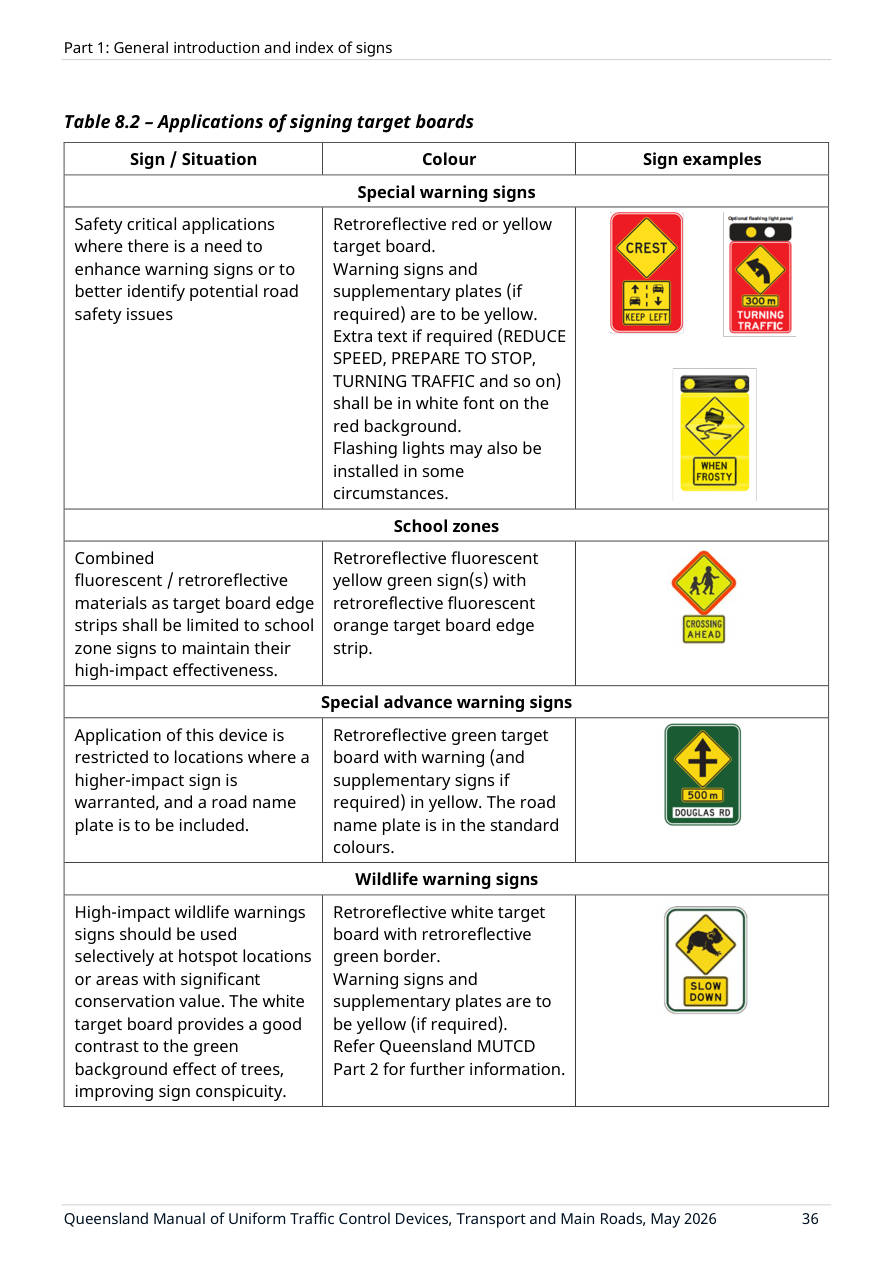
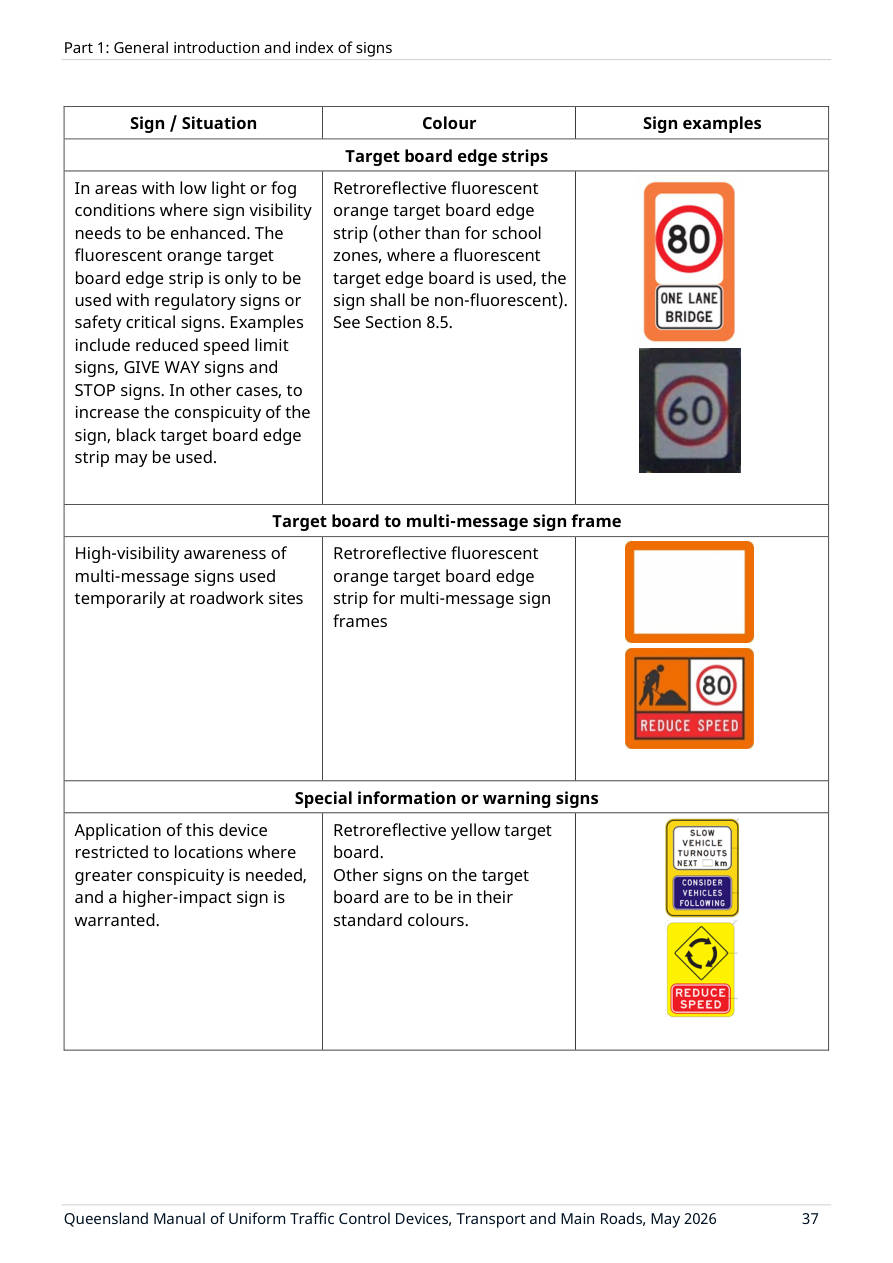
Table 8.2 identifies the appropriate use of different coloured target boards and target board edge strips for specific applications.
Target boards may be red, yellow, green or white. Target board edge strips may be fluorescent orange or black. Table 8.2 provides information on the colour of target board and target board edge strip.
| Sign / Situation | Colour | Sign examples |
|---|---|---|
| Special warning signs | ||
| Safety critical applications where there is a need to enhance warning signs or to better identify potential road safety issues | Retroreflective red or yellow target board. Warning signs and supplementary plates (if required) are to be yellow. Extra text if required (REDUCE SPEED, PREPARE TO STOP, TURNING TRAFFIC and so on) shall be in white font on the red background. Flashing lights may also be installed in some circumstances. | |
| School zones | ||
| Combined fluorescent / retroreflective materials as target board edge strips shall be limited to school zone signs to maintain their high-impact effectiveness. | Retroreflective fluorescent yellow green sign(s) with retroreflective fluorescent orange target board edge strip. | |
| Special advance warning signs | ||
| Application of this device is restricted to locations where a higher-impact sign is warranted, and a road name plate is to be included. | Retroreflective green target board with warning (and supplementary signs if required) in yellow. The road name plate is in the standard colours. | |
| Wildlife warning signs | ||
| High-impact wildlife warnings signs should be used selectively at hotspot locations or areas with significant conservation value. The white target board provides a good contrast to the green background effect of trees, improving sign conspicuity. | Retroreflective white target board with retroreflective green border. Warning signs and supplementary plates are to be yellow (if required). Refer Queensland MUTCD Part 2 for further information. |
| Sign / Situation | Colour | Sign examples |
|---|---|---|
| Target board edge strips | ||
| In areas with low light or fog conditions where sign visibility needs to be enhanced. The fluorescent orange target board edge strip is only to be used with regulatory signs or safety critical signs. Examples include reduced speed limit signs, GIVE WAY signs and STOP signs. In other cases, to increase the conspicuity of the sign, black target board edge strip may be used. | Retroreflective fluorescent orange target board edge strip (other than for school zones, where a fluorescent target edge board is used, the sign shall be non-fluorescent). See Section 8.5. | |
| Target board to multi-message sign frame | ||
| High-visibility awareness of multi-message signs used temporarily at roadwork sites | Retroreflective fluorescent orange target board edge strip for multi-message sign frames | |
| Special information or warning signs | ||
| Application of this device restricted to locations where greater conspicuity is needed, and a higher-impact sign is warranted. | Retroreflective yellow target board. Other signs on the target board are to be in their standard colours. |
8.3Installation of target boards#
The installation of target boards should be in the same manner as the installation of standard signs, in accordance with the Queensland Manual of Traffic Control Devices. The target board or edge strip may be affixed to the back of standard signs or manufactured as part of the sign.
8.4Removal of target boards#
If separately installed, target boards should be removed only when their presence does not improve the legibility or visibility of the standard traffic sign to which they are attached. Signs with integral target boards or edge strips should be removed and replaced with standard signs if the same conditions prevail.
8.5Approval of target boards for signs#
Approval of target boards and edge strips is not subject to the normal approval process that applies to official traffic signs. The target board and edge strip does not affect the functionality and meaning of the sign; it merely increases the sign's conspicuity.
Where target boards or edge strips may be considered necessary for installation on a regulatory sign to address a road safety deficiency, the Safer Roads Infrastructure team should be consulted. Contact SaferRoads@tmr.qld.gov.au.