4.6Signs and devices for work site approaches and departures#
4.6.2ROADWORK AHEAD (T1-1, TM1-1, T1-31, T1-Q06), ROADWORK X km AHEAD (T1-16)#
The ROAD WORK AHEAD T1-Q06 sign (600 x 900) sign may be used in Queensland, however T1-Q06 shall only be used on narrow medians and shoulders where the standard sign T1-1 or T1-31 would not fit and would be an obstruction to traffic.
Add the ROAD WORK AHEAD T1-Q06 sign (600 x 900) to row four in Table 4.1(A):
| Sign | Sign number | Size, mm |
|---|---|---|
| ROAD WORK AHEAD (Narrow format) | T1-Q06 | 600 x 900 |
Add the following image below Table 4.1(A):
T1-Q06
Replace:
The ROADWORK X km AHEAD sign should be used X km in advance of a road work site, where additional advance warning is necessary.
with:
Where additional advance warning is necessary, the ROADWORK X km AHEAD sign should be used X km in advance of the Primary PREPARE TO STOP sign (if traffic control is used), or the first cone in a taper (if a taper is used), or the start of the safety buffer area, and be at least two sign spacings in advance of the ROADWORK AHEAD sign.
4.6.7ROADWORK ON SIDE ROAD (T1-25, TM1-25), ROAD PLANT ON SIDE ROAD (T1-27, TM1-27)#
Replace:
The ROADWORK ON SIDE ROAD sign shall not be used on a side road to warn of relevant activities on the through road. The ROAD WORK AHEAD (TM1-1A) with a direction arrow (TM5-8A) should be used instead.
with:
The ROADWORK ON SIDE ROAD and ROAD PLANT ON SIDE ROAD signs shall not be used on the terminating leg of a T intersection to warn of relevant activities on the continuing leg of the T intersection. The ROAD WORK AHEAD (TM1-1A or TM1-1C) or ROAD PLANT AHEAD (TM1-3-1A or TM1-3-2C), with a direction arrow (TM5-8B) should be used instead.
The standard MMS Lane Status panel TM10-1A may be used with or without the ON SIDE ROAD message to indicate a direction where the long arrow TM5-8B is not suitable.
The ROADWORK ON SIDE road sign shall not be used where there is an impact for traffic on the through road. Impacts on the through road may include but not be limited to any need for reduced speed zones, additional delineation, changes to alignment or surface condition, use of traffic control or traffic queueing which extends onto the through road. Where there are impacts on the through road, the ROADWORK AHEAD sign (see Clause 4.6.2) should be used.
The ON SIDE ROAD message may be used to provide warning of an activity on another road which intersects with the road you are travelling on (this includes cross intersections and roundabouts but excludes the through / straight direction even if this is another road). However, the ON SIDE ROAD message shall not be used when you are travelling on the terminating leg of a T intersection to provide warning of an activity on the continuing leg of the T intersection. See Figure 4.6.7 below.
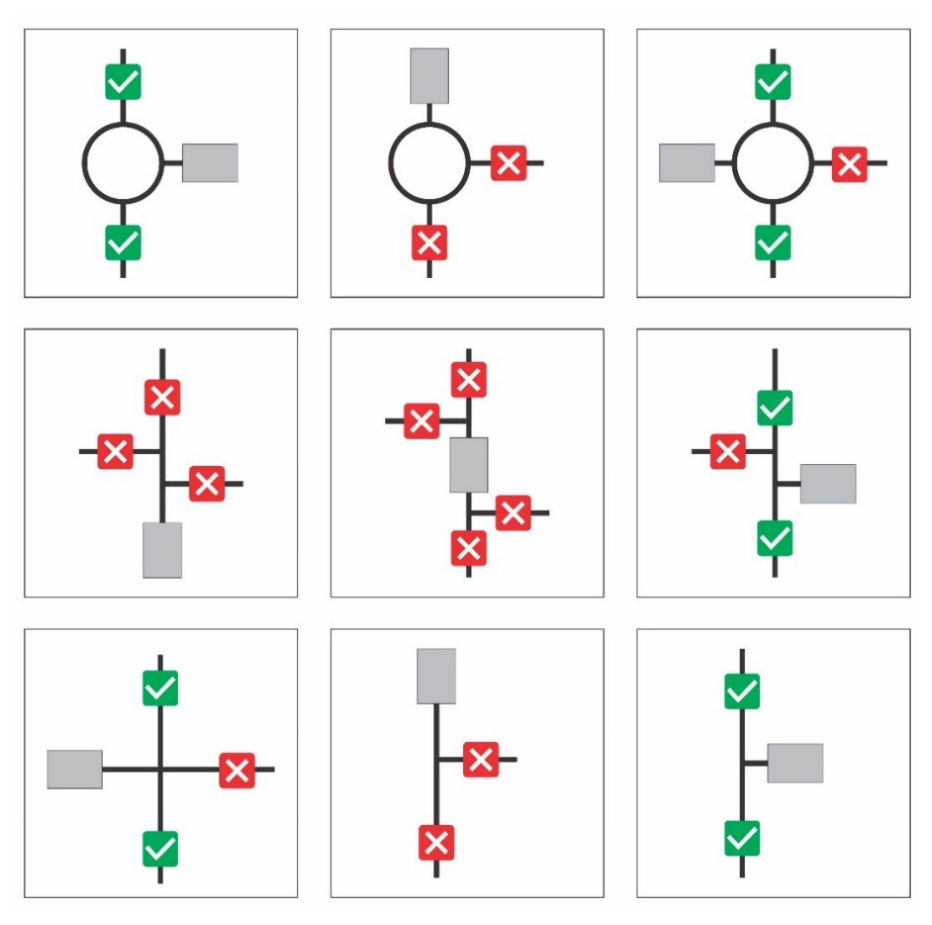
indicates the ON SIDE ROAD message shall not be used on this approach · indicates the ON SIDE ROAD message may be used on this approach · indicates the work / activity area.
4.6.9SIDE ROAD CLOSED (T1-32, TM1-32)#
Replace:
The SIDE ROAD CLOSED sign shall be used in advance of an intersection where the side road is closed to all traffic.
with:
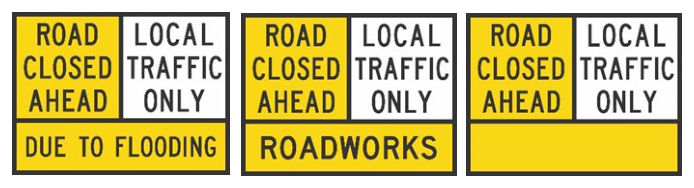
The SIDE ROAD CLOSED sign shall be used in advance of an intersection where the intersecting road is closed to all traffic. The SIDE ROAD CLOSED sign shall not be used on the terminating leg of a T intersection to indicate a closure on the continuing leg of the T intersection. In this case the ROAD CLOSED AHEAD (TM1-43A or TM1-43C) sign with a direction arrow (TM5-8B) should be used instead.
4.6.10END ROADWORK (T2-16, T2-17, TM2-17)#
Replace:
The END ROADWORK sign shall be used whenever there is a ROADWORK AHEAD or ROADWORK NEXT X km sign is used on the approach to the work site.
with:
The END ROADWORK sign shall be used whenever there is a ROADWORK AHEAD or ROADWORK NEXT X km sign is used on the approach to the work site, except where the requirements of Clause 4.6.11 would be applicable.
The END ROADWORK sign shall be used whenever a BRIDGEWORK AHEAD or BRIDGEWORK NEXT X km sign is used on the approach to the roadworks site.
The END ROADWORK sign may be used whenever a ROAD PLANT AHEAD or GRADER AHEAD, (with or without a NEXT X km sign) is used on the approach to the roadworks site.
4.6.11ROADWORK AHEAD, ROADWORK ON SIDE ROAD, and END ROADWORK signs#
This clause will outline with examples, the various requirements for advance warning signs (ROADWORK AHEAD, ROADWORK ON SIDE ROAD) and termination signs (END ROADWORK) for works on a ‘No Through Road’ or ‘Cul-de-sac’ or located partly or wholly on through or side roads.
This clause does not vary or alter the requirements or options in Clause 4.6.2 for when a ROADWORKS AHEAD or ROADWORKS X km AHEAD sign shall be or may be used. It also does not vary or alter the requirements in Clause 4.6.7 for the use of the ROADWORKS ON SIDE ROAD signs.
In accordance with the technical requirements, roads may require ROADWORK AHEAD signs or other signs warning of the works on another road, however this does not automatically mean that the END ROADWORK signs are required for traffic in the opposing direction. This clause will identify those locations or situations where the END ROADWORK sign may not be required.
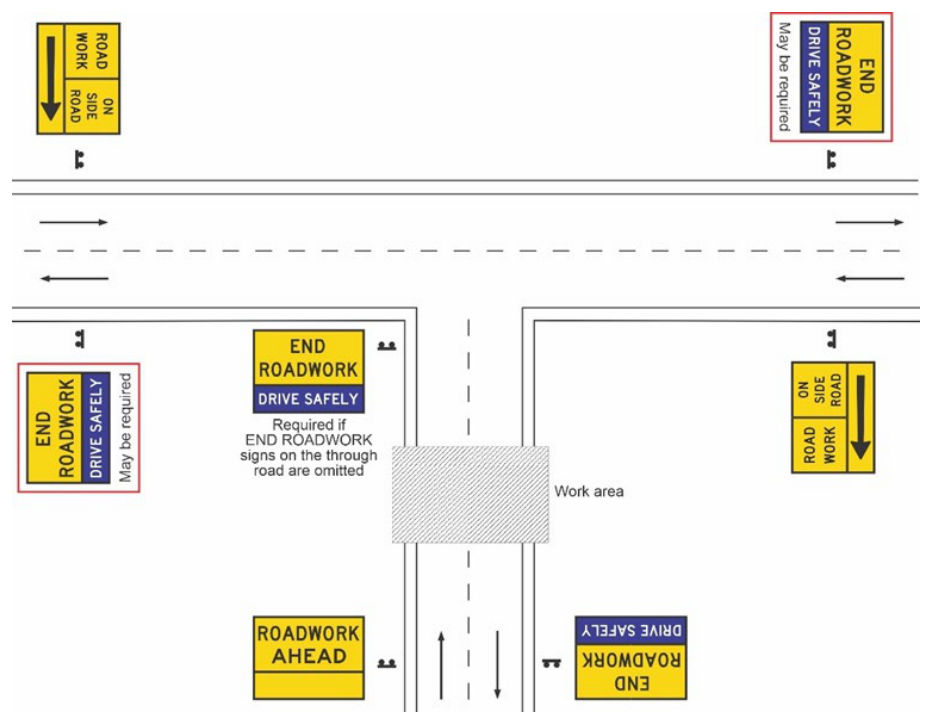
Where roadworks is located on a side road with no impact on the through road the ROADWORK ON SIDE ROAD advance warning sign is used on the through road, see example Figure 4.6.11(a). The END ROADWORK sign is not required on the through road, except where the END ROADWORK sign is not able to be installed prior to the end of the side road. Where the END ROADWOK signs are not installed on the through road, the END ROADWORKS sign shall be installed on the side road prior to exiting the side road onto the through road.
Impacts on the through road from works on a side road may include but not be limited to any need for reduced speed zones, additional delineation, changes to alignment or surface condition, use of traffic control or traffic queueing which extends onto the through road.
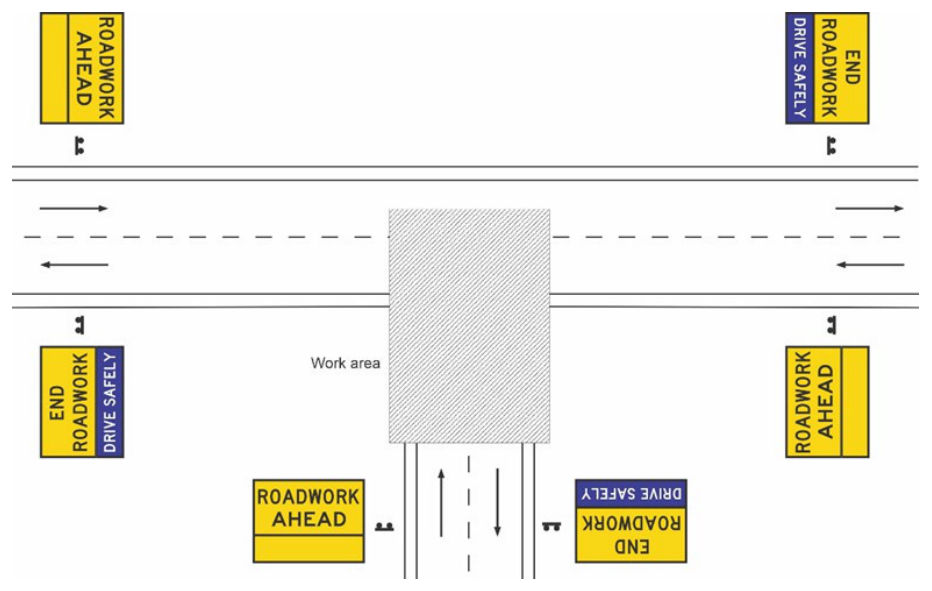
Where roadworks is located on a side road which impact the through road, the ROADWORK AHEAD and END ROADWORK signs shall be used on both the through road and the side road, see example Figure 4.6.11(b).
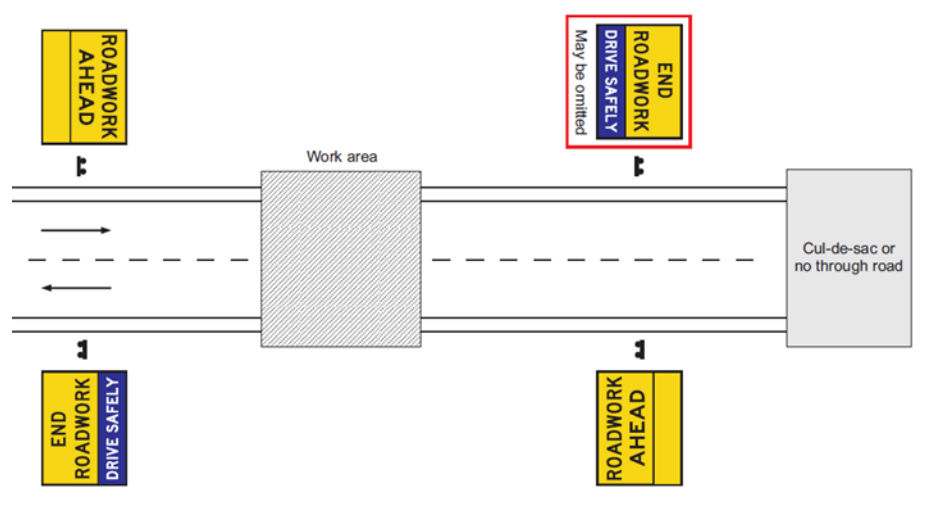
Where roadworks are located on a ‘No Through Road’ or ‘Cul-de-sac’ the END ROADWORK sign may be omitted on the departure from the work area when travelling towards the terminating end of the road or cul-de-sac where there are no intersections between the end of the works and the terminating end of the road, and the end of the road or cul-de-sac is either visible from or within 500 m of the end of the work area, see example in Figure 4.6.11(c).
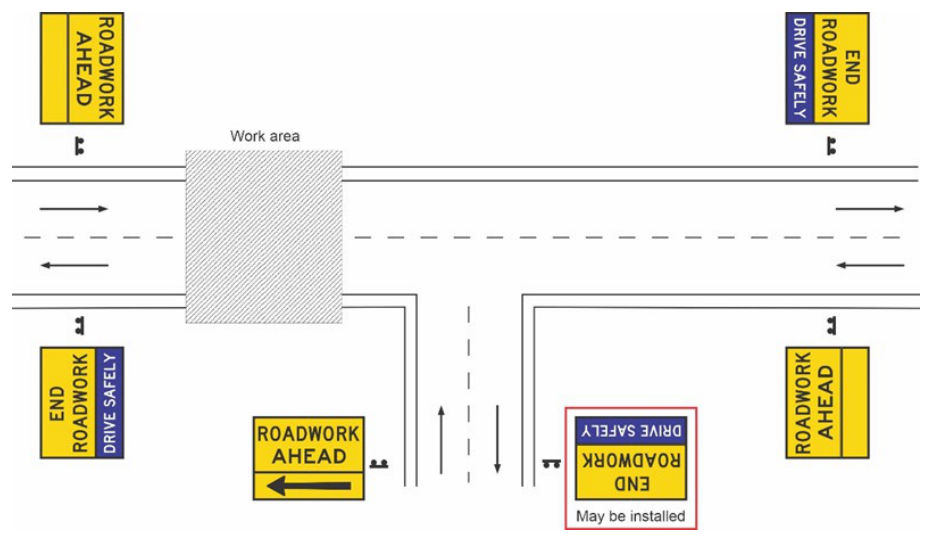
Where roadworks is located on a through road with no impact on a side road (located within the advance warning area), see example Figure 4.6.11(d), the ROADWORK AHEAD and END ROADWORK signs shall be installed on the through road. The ROADWORK AHEAD sign with a direction arrow shall be installed on the side road. On the side road, when departing the through road where road works are occurring via the side road (either before or after the road work area) and the road works have no impact on the side road or operation of the intersection with the side road, there is no requirement for an END ROADWORK sign on the side road, however it may be installed if desired.
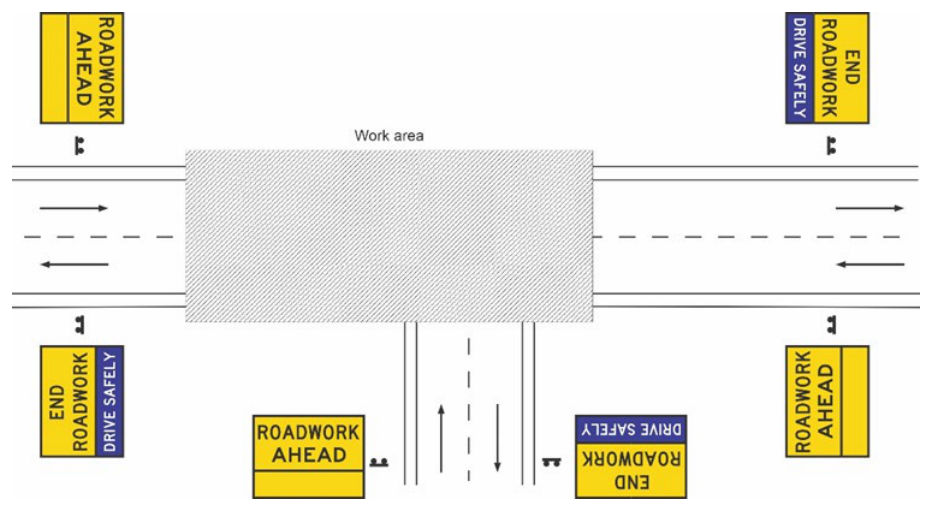
Where roadworks is located on a through road which impact a side road, see example Figure 4.6.11(e), the ROADWORK AHEAD and END ROADWORK signs shall be installed on both the through road and the side road.
Figures 4.6.11(a), (b), (c), (d) and (e) are examples showing ROADWORK AHEAD and END ROADWORK signs only and do not include all traffic control devices required.