2Bicycle provisions on arterial roads and local streets#
2.1General#
Item (f), replace 'Clause 4.1' with 'Clause 2.4.4(c)'.
2.2Signs#
Item (l) WATCH FOR Bicycles (G9-57), first paragraph, change 'shall be' to 'may' to read: The WATCH FOR Bicycles sign may be used at locations…
- Item (l) WATCH FOR Bicycles (G9-57), add last paragraph: For the cases in Items (iii), (iv) and (v), the sign may be mounted below any appropriate STOP, GIVE WAY or Roundabout regulatory sign.
- Item (m) Cyclists DISMOUNT (G9-58). add items (iii) STAIRCASE and (iv) PEDESTRIAN MALL.
2.2.1Bicycle activated warning signs#
Warning signs may be implemented as electronic bicycle-activated warning signs, refer Queensland Guide to Traffic Management Part 10 Transport control – types of devices Section 7.6.9 Vehicle activated intersection and road geometry signs.
2.3Pavement markings#
2.3.2Other pavement markings#
(c) Pavement arrow Pavement arrows may be used in conjunction with the bicycle symbol where a bicycle lane has been provided on the approach to traffic signals (see Figure 2.10) where some movements are restricted. The arrow is white in colour.
2.3.3Pavement colour#
For further information on the use of pavement surfacing in bicycle lanes, refer Queensland Guide to Traffic Management Part 10 Transport control – types of devices Section 8.6 Use of coloured pavements.
2.4Bicycle provisions mid-block#
2.4.1Bicycle lane (full time)#
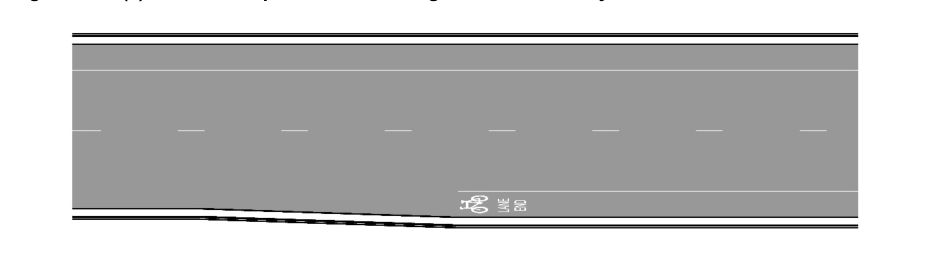
Bicycle lane terminations at mid-block should be pavement marked as per Figure 2.4.1(a). W6-Q04 and W8-Q11 SHARE THE ROAD warning sign and supplementary plate should be installed downstream of a mid-block bicycle lane termination. Additional advisory pavement markings should be provided at the bicycle lane departure points and merging point into the adjacent lane as per the Queensland Guide to Traffic Management Part 10 Transport control – types of devices, Section 8.5.9: Bicycle Awareness Zones in Queensland. Warning and awareness raising signage should also be installed, such as G9-57. In situations where a transition to an off-road bicycle facility can be provided, signage and pavement markings should be provided in accordance with W6-Q06 Narrowing Cycle Lane Layout.
2.4.4Advisory treatments#
Information on advisory treatments is contained in:
- the TRUM manual Volume 1 Part 8 Local area traffic management Section 8.12.1-1 Advisory Bicycle Lanes and Cycle Streets, and
- Queensland Guide to Traffic Management Part 10 Transport control – types of devices Section 8.5.9 Bicycle awareness zones in Queensland and the associated Bicycle awareness zones guideline.
2.5Bicycle lane treatments at intersections#
2.5.2Intersection at minor streets#
Refer to Figure 2.9(d). Where motor vehicles need to drive in a bicycle lane more than 50 metres in advance of the intersection, W6-Q05 sign SHARE BICYCLE LANE FOR LEFT TURN shall be installed.
2.6Bus stops#
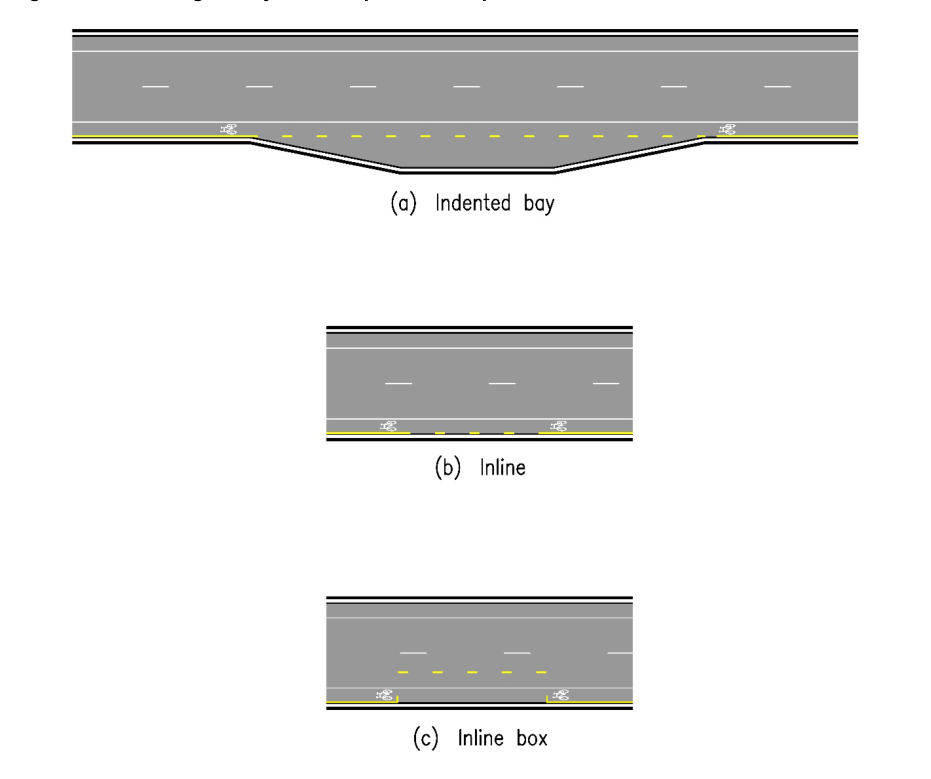
The bicycle lane should remain unbroken past the bus stop. An additional broken yellow line shall be used to define the parking restriction in the bus stop bay area, examples are shown in Figure 2.6.