3Bicycle path and footpath provisions#
3.2Signs#
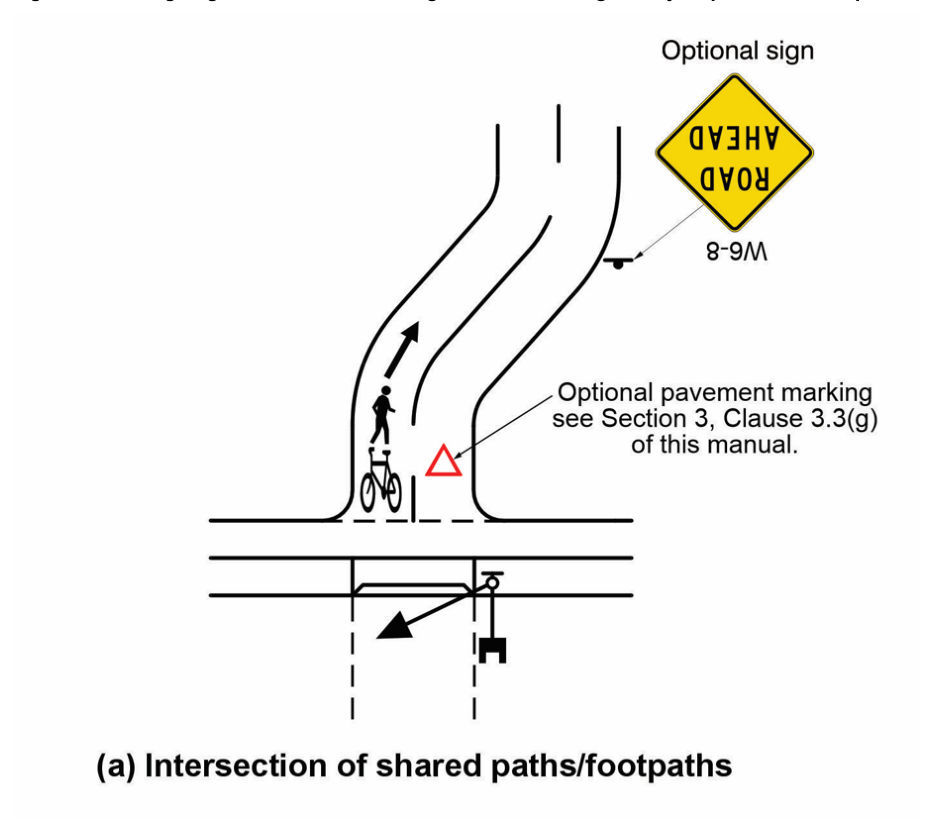
- Replace item (a) Give way (R1-2) with: (a) Give way (R1-2) This sign may need to be used on a bicycle path or shared path on the approach to a road crossing to reinforce the requirement that bicycle traffic needs to give way to road traffic. A give way line (see Clause 3.3(f)) shall be used in conjunction with this sign. A STOP sign may be needed in extreme circumstances (see Clause 3.7). A special reduced size sign is specified for path use (see Table 3.1). For added emphasis, the R1-2A size sign may be used. The give way pavement symbol may be used in lieu of this sign (see Clause 3.3(g)).
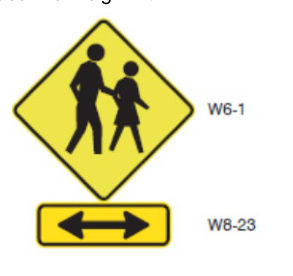
- Item (g) Pedestrian warning (W6-1), Bicycle warning (W6-7), Bicycle / pedestrian warning (W6-9), Crossing arrows (W8-23), replace W6-1 sign with:
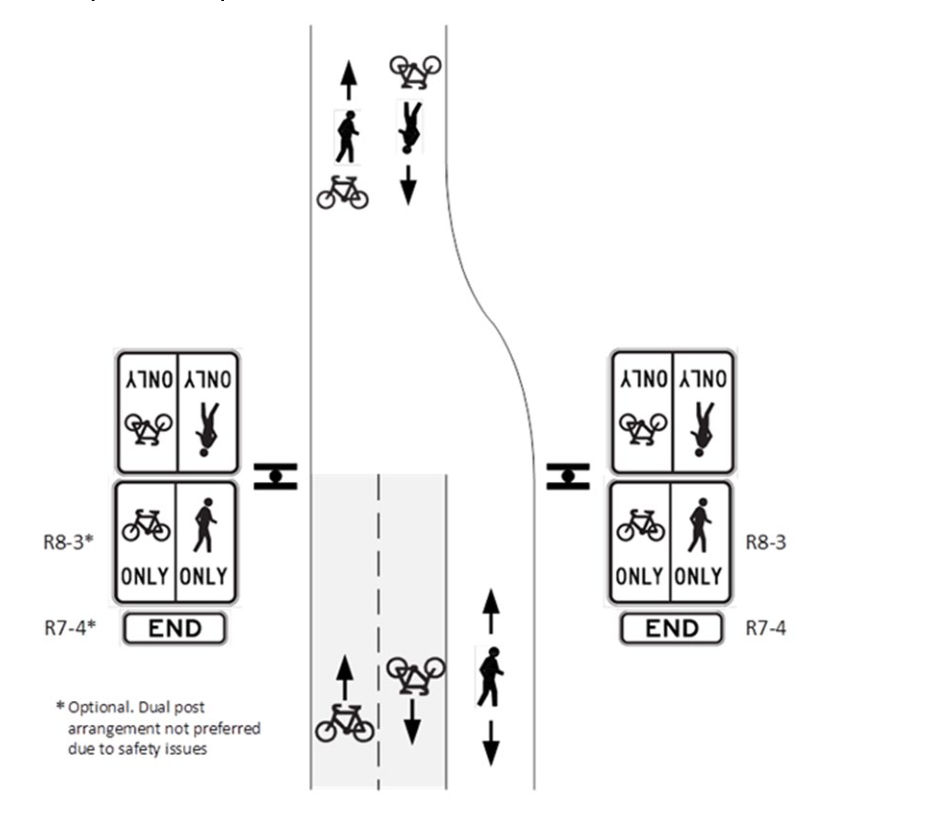
- Item (e) Shared path (R8-2), add: Unless signed otherwise, the Queensland Road Rules permit people of any age to ride wheeled recreational devices, personal mobility devices or bicycles on footpaths irrespective of the path being signed as a shared path. Hence the Shared Path (R8-2) sign is generally unnecessary in Queensland. The Shared Path (R8-2) + END (R7-4) sign combination shall not be used. Figure 3.2 shows the appropriate signing to signify a change in path designation between a separated path and a shared path / footpath. Shared path pavement markings may be used on any path intended for shared use operation even if R8-2 signs are not installed.
Item (k) Slippery for bicycles (W6-11), add:
It shall be limited for use as a temporary measure pending appropriate restoration of the pavement surface.
3.3Pavement markings#
Replace Item (g) Give way or stop pavement marking with:
(g) Give way or stop pavement marking In lieu of a give way or stop sign, a give way or stop pavement marking, respectively, may be marked on the path [see Figure 3.2(1)].
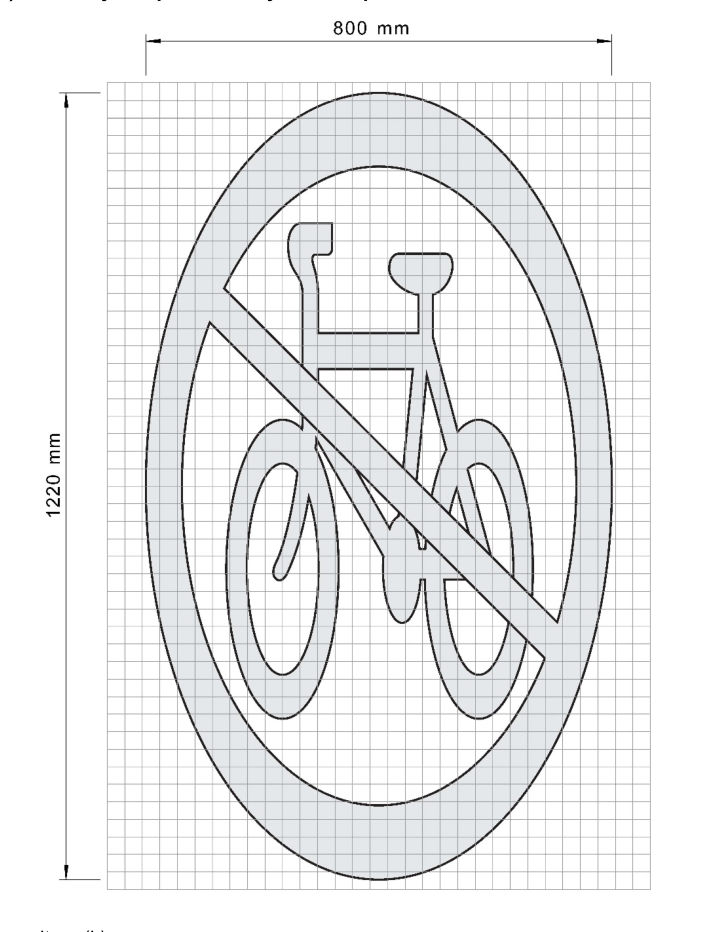
Item (h) No-bicycle symbol, replace reference to Figure 3.2(b) with Figure 3.3(b).
Replace Figure 3.2(2) No-bicycles pavement symbol for paths with Figure 3.3(b) No-bicycles pavement symbol for paths.
Addition, a new item (k)
(k) Any approved sign face may be implemented as a pavement marking symbol instead of or to supplement an equivalent pole mounted sign: limiting the number of poles near paths reduces potential for path user collisions with poles.
Where a pavement marking symbol is used instead of its pole mounted equivalent, then Approach Sight Distance shall be adequate to ensure visibility of the pavement marking symbol.
Using a pavement marking symbol to supplement a pole mounted equivalent should be limited to exceptional circumstances to limit unnecessary visual clutter.
The selection and application of a pavement marking symbol shall follow the requirements applicable to the relevant sign.
3.7Road crossings mid-block#
3.7.3Path traffic gives way#
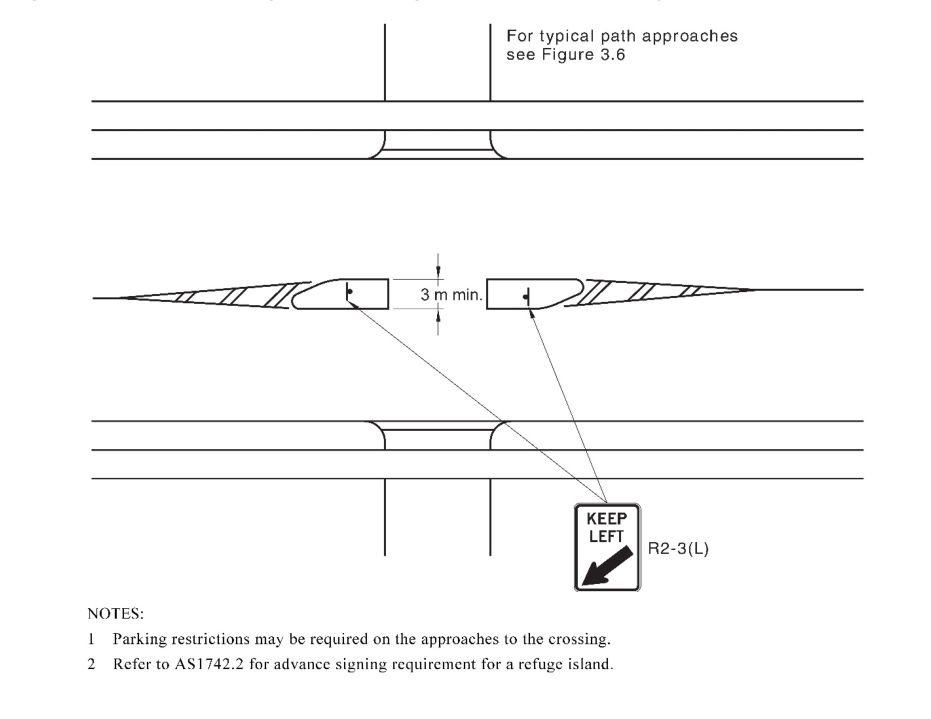
Replace Figure 3.8 Use of a refuge island to stage path traffic across a high-volume road with Figure 3.7.3 Use of a refuge island to stage path traffic across a high-volume road.
Addition to Item (b) At-grade intersection
With reference to AS 1742.2 Figure 2.2 Note 4, where the terminating road is a bicycle path or shared path, the dimension to the apex of the visibility triangle should be 1.0 m.
3.7.4Traffic signal control#
Delete Item (a) Road crossings, delete second paragraph.
3.8Road crossings at intersections#
3.8.2Signalized intersections#
Replace Figure 3.10 Use of mid-block pedestrian / cyclist operated traffic signals at a bicycle crossing or at a shared or separated crossing in AS 1742.9 with Figure 3.8.2 Signing of mid-block traffic signals at a crossing of bicycle path or shared path.