5Works outside of traffic lane#
5.1Shoulders, medians, verges and footpaths with workers on foot or small plant items only#
5.1.3Traffic control devices#
In the subsection 'Advance warning signs', add the following: The Worker (symbolic) may be omitted when workers on foot are either
- 1.not visible to traffic, or
- 2.visible and located greater than 6 m clear of traffic, or
- 3.located outside the road reserve.
In the subsection 'Vehicle mounted warning device', replace entire subsection with the following: Refer to Section 3.4 for vehicle-mounted warning device requirements.
5.1.4Pre-installation processes#
Replace 3rd dot point:
- Confirm TGS has been signed off by relevant personnel, with a copy of the TGS onsite at all times during the works.
with:
- If a TGS is provided, confirm TGS has been signed off by relevant personnel, with a copy of the TGS onsite at all times during the works.
5.1.5Installation (TGS instruction)#
In the subsection 'Set-out', replace:
All signs and devices must be placed as shown on the TGS. Advance signs are to be located a distance as per Table 2.3 from the start of the worksite or hazard. Vehicles used to install signage and equipment must have a yellow flashing lamp(s) that is visible to all approaching traffic. Before any equipment or materials are brought onto the work area, a drive through check of the work site traffic management set up should be made in all directions, including all side roads if required. This is to confirm that the work area is safe for all workers and road users, and signs and devices are placed as indicated on the TGS.
with:
A TGS is not required but may be developed for shoulders, medians, verges and footpaths with workers on foot or small plant items only activities. If provided, all signs and devices must be placed as shown on the TGS. Advance signs are to be located a distance as per Table 2.3 from the start of the worksite or hazard. Vehicles used to install signage and equipment must, at a minimum, have a yellow flashing lamp(s) visible to all approaching traffic. Before any equipment or materials are brought onto the work area, a visual check of the worksite traffic management set up (vehicle-mounted warning devices and signs are in place, and sight distance requirements are met) should be made in all directions, including all side roads and property accesses if required. This is to confirm that the work area is safe for workers and road users, and signs and devices are placed as required by this section, or as indicated on the TGS (if provided). This may require a drive-through check.
In the subsection 'Operation', replace: See AS 1742.3 for more information
with:
Guidance on the placement of signs is given in the QGTTM Part 6 Section 6.6.2 and Queensland MUTCD Part 3 Clause 4.3.2.
In the subsection 'Operation', replace: The preferred location of the work vehicle is parked adjacent to the works with the vehicle mounted warning device activated and parked clear of traffic lanes. with: The preferred location of the work vehicle is parked adjacent to the works with the vehicle mounted warning device activated and parked clear of traffic lanes or parked where parking would be legal, and the safety of other road users is not compromised.
5.2Shoulders, medians, verges and footpaths with large plant items only#
5.2.3Traffic control devices#
In the subsection 'Advance warning signs', add the following: The ROAD PLANT AHEAD sign may be omitted when all plant is either:
- 1.not visible to traffic, or
- 2.visible and located greater than 6 m clear of traffic, or
- 3.located outside the road reserve.
In the subsection 'Vehicle mounted warning device', replace entire subsection with the following: Refer to Section 3.4 for vehicle mounted warning device requirements.
5.2.4Pre-installation processes#
Replace 3rd dot point: Confirm TGS has been signed off by relevant personnel, with a copy of the TGS onsite at all times during the works. with: If a TGS is provided, confirm TGS has been signed off by relevant personnel, with a copy of the TGS onsite at all times during the works.
5.2.5Installation (TGS instruction)#
In the subsection 'Set-out', replace: All signs and devices must be placed as shown on the TGS. Advance signs are to be located a distance as per Table 2.3 from the start of the work site or hazard. Vehicles used to install signage and equipment must have a yellow flashing lamp(s) that is visible to all approaching traffic. Before any equipment or materials are brought onto the work area, it is recommended that a drive-through check of the worksite traffic management set up be made in all directions, including all side roads if required. This is to confirm that the work area is safe for all workers and road users, and signs and devices are placed as indicated on the TGS. with: A TGS is not required but may be developed for shoulders, medians, verges and footpaths with large plant item only activities. If provided, all signs and devices must be placed as shown on the TGS. Advance signs are to be located a distance as per Table 2.3 from the start of the worksite or hazard. Vehicles used to install signage and equipment must, at a minimum, have a yellow flashing lamp(s) visible to all approaching traffic. Before any equipment or materials are brought onto the work area, a visual check of the worksite traffic management set-up (vehicle-mounted warning devices and signs are in place, and sight distance requirements are met) should be made in all directions, including all side roads and property accesses if required. This is to confirm that the work area is safe for all workers and road users, and signs and devices are placed as required by this section, or as indicated on the TGS (if provided). This may require a drive-through check.
In the subsection 'Operation', replace: See AS 1742.3 for more information. with: Guidance on the placement of signs is given in the QGTTM Part 6 Section 6.6.2 and Queensland MUTCD Part 3 Clause 4.3.2.
5.3Frequently changing work area outside of a traffic lane#
5.3.1Description#
Replace: The preferred location of the work vehicle is adjacent to the work area with the vehicle mounted warning devices activated and parked clear of the traffic lane. with: The preferred location of the work vehicle is parked adjacent to the work area with the vehicle mounted warning device activated and parked clear of traffic lanes or parked where parking would be legal, and the safety of other road users is not compromised.
5.3.3Traffic control devices#
In the subsection 'Vehicle mounted warning device', replace entire subsection with the following: Refer to Section 3.4 for vehicle mounted warning device requirements.
5.3.4Pre-installation processes#
Replace 3rd dot point: Confirm TGS has been signed off by relevant personnel, with a copy of the TGS onsite at all times during the works. with: If a TGS is provided, confirm TGS has been signed off by relevant personnel, with a copy of the TGS onsite at all times during the works.
5.3.5Installation (TGS instruction)#
In the subsection 'Set-out', replace: All signs and devices must be placed as shown on the TGS. Advance signs are to be located a distance as per Table 2.3 from the start of the work site or hazard.
Vehicles used to install signage and equipment must have a yellow flashing lamp(s) that is visible to all approaching traffic. Before any equipment or materials are brought onto the work area, it is recommended that a drive through check of the work site traffic management set up be made in all directions, including all side roads if required. This is to confirm that the work area is safe for all workers and road users, and signs and devices are placed as indicated on the TGS. with: A TGS is not required but may be developed for frequently changing work area outside of a traffic lane activities. If provided, all signs and devices must be placed as shown on the TGS. Advance signs are to be located a distance as per Table 2.3 from the start of the worksite or hazard. Vehicles used to install signage and equipment must, at a minimum, have a yellow flashing lamp(s) visible to all approaching traffic. Before any equipment or materials are brought onto the work area, a visual check of the worksite traffic management set-up (vehicle-mounted warning devices and signs are in place, and sight distance requirements are met) should be made in all directions, including all side roads and property accesses if required. This is to confirm that the work area is safe for all workers and road users, and signs and devices are placed as required by this section, or as indicated on the TGS (if provided). This may require a drive-through check.
In the subsection 'Operation', replace: See AS 1742.3 for more information. with: Guidance on the placement of signs is given in the QGTTM Part 6 Section 6.6.2 and Queensland MUTCD Part 3 Clause 4.3.2.
5.4Short term works outside of a traffic lane#
5.4.1Description#
Workers may work near the road without the use of advance warning signs, provided that the criteria listed in Section 5.4.2 are met. Examples of this type of work include (but are not limited to):
- road signs or street furniture maintenance
- litter or graffiti removal
- garden maintenance
- minor tree clearing
- minor cleaning of culverts, pipes and pits, and/or
- footpath repair
Prior to undertaking these work activities, a risk assessment must be undertaken to ensure the works can be safely completed. Risk considerations are outlined in Section 2.2.1.
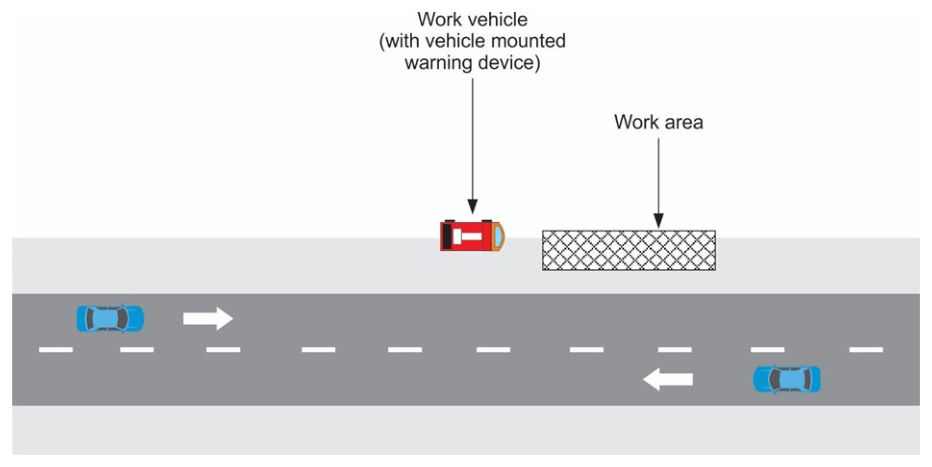
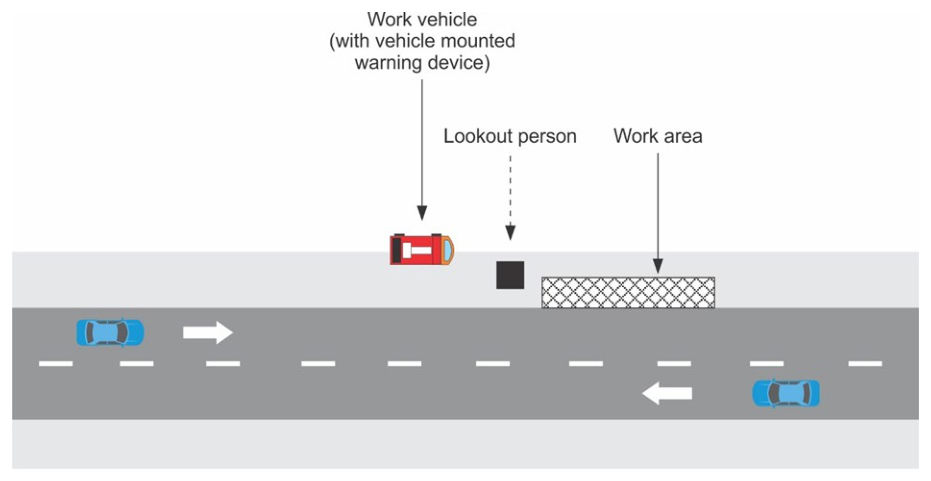
The typical TTM features of short term working outside a traffic lane include:
- a)a lookout person (for works within 1.2 m of a traffic lane) as per Section 5.4.5, and
- b)a works vehicle
- i.positioned as per Section 5.4.5, and
- ii.with a vehicle-mounted warning device as per Section 5.4.3.
Figure 5.4.1(a) illustrates an example of short-term works outside a traffic lane (for works within 1.2 m of a traffic lane) and Figure 5.4.1(b) illustrates an example of short-term works outside a traffic lane (for works greater than 1.2 m from a traffic lane). The works vehicle placement should consider the impact on vulnerable road users including people riding bikes and the road worker should always have a clear exit path from the road and ensure that this is not blocked by the placement of the work vehicle or other obstacles.
5.4.2Criteria#
This type of traffic management arrangement must only be used when the criteria outlined in Table 5.4.2(a) or Table 5.4.2(b) (as relevant) have been met.
| Criteria | Yes / No | |
|---|---|---|
| 1 | The work area is outside but within 1.2 m of a traffic lane. | |
| 2 | Works take 5 minutes or less. | |
| 3* | A lookout person is available to warn workers on foot to vacate the roadway before the arrival of approaching traffic and meets the sight distance requirements of Table 5.4.5(a). If there are no workers on foot answer 'Yes'. *If the requirements of Table 5.4.5(b) are met, answer 'Yes'. | |
| 4 | Work vehicles and equipment are parked adjacent to the worker location and parked clear of moving traffic lanes or parked where parking would be legal and the safety of other road users is not compromised. | |
| 5 | A vehicle-mounted warning device is displayed on the work vehicle and has a minimum sight distance (see Table 5.4.2(c)) for approaching road users. |
Table in words
- For criterion 1, the work area is outside but within 1.2 m of a traffic lane.
- For criterion 2, works take 5 minutes or less.
- For criterion 3*, a lookout person is available to warn workers on foot to vacate the roadway before the arrival of approaching traffic and meets the sight distance requirements of Table 5.4.5(a).
- For criterion 3*, if there are no workers on foot answer 'Yes'.
- For criterion 3*, if the requirements of Table 5.4.5(b) are met, answer 'Yes'.
- For criterion 4, work vehicles and equipment are parked adjacent to the worker location and parked clear of moving traffic lanes or parked where parking would be legal and the safety of other road users is not compromised.
- For criterion 5, a vehicle-mounted warning device is displayed on the work vehicle and has a minimum sight distance (see Table 5.4.2(c)) for approaching road users.
| Criteria | Yes / No | |
|---|---|---|
| 1 | The work area is greater than 1.2 m from a traffic lane. | |
| 2 | Works take 20 minutes or less. | |
| 3 | Work vehicles and equipment are parked adjacent to the worker location and parked clear of moving traffic lanes or parked where parking would be legal, and the safety of other road users is not compromised. | |
| 4 | A vehicle-mounted warning device is displayed on the work vehicle and has a minimum sight distance (see Table 5.4.2(c)) for approaching road users. |
If two or more locations within a space of 2 km or less require work to be undertaken, the methods of a frequently changing work area (see Section 5.3) must apply.
If work durations exceed the limits in Tables 5.4.2(a) or 5.4.2(b), consider the use of Sections 5.1 or 5.2 as appropriate.
If any of the criteria stated previously cannot be achieved or alternative treatments detailed in this Part cannot be used, the treatments of a fully protected static worksite (see QGTTM Part 3) or mobile works convoy (see QGTTM Part 4) must be applied.
| Speed (km/h) | Distance (m) |
|---|---|
| ≤ 45 | 80 |
| 46–55 | 100 |
| 56–65 | 120 |
| 66–75 | 140 |
| 76–85 | 160 |
| 86–95 | 180 |
| 96–105 | 200 |
| ≥ 106 | 220 |
5.4.3Traffic control devices#
Refer to Section 3.4 for vehicle mounted warning device requirements.
5.4.4Pre-installation processes#
Prior to works being conducted on site, the following checks must be undertaken:
- a)risk assessment must be conducted, to confirm that factors such as traffic volume and speed, road geometry and width, and the general behaviour of road users are considered when determining the appropriate traffic management arrangement
- b)work health and safety paperwork, such as job safety awareness forms, must be completed and signed off by the supervisor or relevant person
- c)if a TGS is provided, confirm TGS has been signed off by relevant personnel, with a copy of the TGS onsite at all times during the works
- d)appropriate personal protective equipment must be used
- e)all required devices / equipment must be checked and accounted for prior to leaving for site, and
- f)appropriate recordkeeping methods are in place.
5.4.5Installation (TGS instruction)#
Short-term works outside a traffic lane do not require a TGS diagram when the works are completed in accordance with this section; however, a TGS may be developed and included in a generic TGS selection system for short-term works outside of a traffic lane activities. If provided, all signs and devices must be placed as shown on the TGS.
Before any equipment or materials are brought onto the work area, a visual check of the worksite traffic management set-up (vehicle-mounted warning devices and lookout (if required) are in place, and sight distance requirements are met) should be made in all directions, including all side roads and property accesses if required. This is to confirm that the work area is safe for all workers and road users, and signs and devices are placed as required by this section, or as indicated on the TGS (if provided).
Operation#
Equipment or materials which are brought onto the work area should be unloaded from the non-traffic side of a stationary work vehicle.
The work vehicle must be located clear of traffic or parked where parking would be legal, and the safety of other road users is not compromised, and is adjacent to, or on approach (within 40 m), to the worksite in the primary direction of travel to the works if undertaking works in a single location. The works vehicle is the primary traffic management warning device for short-term works outside a traffic lane. If it is not possible to locate the work vehicle as described, for example due to inability to find an appropriate area to park the vehicle, then this works practice must not be used.
The vehicle-mounted warning device must be on at all times while work is in progress.
The lookout person (for works within 1.2 m of a traffic lane) must be positioned adjacent to the worker so that they can view approaching traffic in time to warn workers to vacate the roadway before arrival of traffic. The recommended sight distance at which the lookout person should be able to see approaching traffic is as per Table 5.4.5(a). This distance allows for the worker to respond to a warning and vacate the roadway. When using lookouts in Queensland, additional guidance and requirements for the Lookout Protection Method in the Guideline – Traffic Management at Works on Roads must be applied.
At all times when conducting these activities, the lookout person (for works within 1.2 m of a traffic lane) and worker must be within a reasonable proximity (no more than 40 m) of the vehicle with a vehicle-mounted warning device, which is parked clear of traffic lanes, and the safety of other road users is not compromised.
Variable message signs may be used for short-term works outside a traffic lane as a means of secondary protection to workers. The use of variable message signs must be within 40 m of workers. A distance of greater than 40 m between the variable message sign and workers may be misleading to approaching road users about the location of works.
| Speed (km/h) | Distance (m)* |
|---|---|
| ≤ 45 | 80 |
| 46–55 | 100 |
| 56–65 | 120 |
| 66–75 | 140 |
| 76–85 | 160 |
| 86–95 | 180 |
| 96–105 | 200 |
| ≥ 106 | 220 |
| Speed (km/h) | Distance (m) |
|---|---|
| ≤ 45 | 140 |
| 46–55 | 180 |
| 56–65 | 210 |
| 66–75 | 250 |
| 76–85 | 280 |
| 86–95 | 320 |
| 96–110 | 350 |
| > 110 | A lookout person is required |
5.4.6Close out process#
Daily records#
Daily records of the site layout including devices, risk assessments, sight distances, signs or TGS (if required), must be kept in a diary or in work sheets, which must be retrievable upon request.
Reference to the diagram number which generally applies to the layout used or to a documented procedure is usually sufficient. Any significant departures from, or additions to, the signs and devices included in the relevant diagram(s) should be noted and approved.
Incidents#
In the case of incidents (for example, crashes, collisions), either witnessed or reported, involving the public or from which legal proceedings might arise, the actual type, size and location of signs and devices in use at the time of the accident must be recorded with the site layout and sign arrangement photographed for subsequent reporting. Details of the actual width and condition of the travelled path and weather conditions should also be recorded.