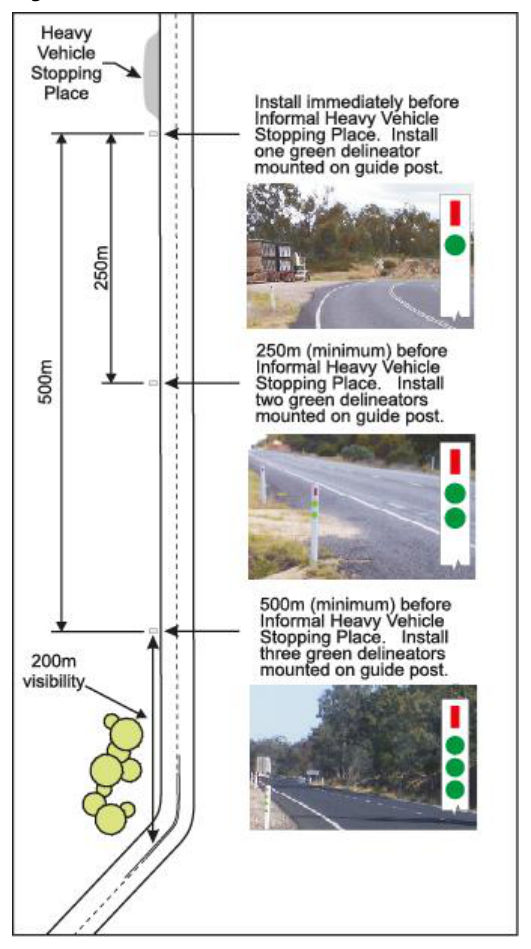
Appendix 2Introduction of 3-2-1 green delineator#
In 2007, Transport and Main Roads worked with industry to successfully introduce the ‘3-2-1 Blue Delineator’. These blue reflectors are used to identify informal heavy vehicle stopping places along state-controlled roads and have become an important supplement to Transport and Main Roads’ formal Rest Area network. After implementation, however, fire authorities expressed concerns about the use of blue reflectors as blue is the colour being used to identify the location of fire-fighting water sources. As a result, it has now been decided to change to a new national standard of green. In 2011, Transport and Main Roads ran a trial of green reflectors and, after industry consultation, they were found to be easy to see in all weather conditions. The purpose of green reflectors is to indicate to heavy vehicle drivers that a stopping place is a short distance ahead. They are intended to provide drivers with enough warning so they may stop safely if they wish to use the site. It is important to remember, however, that these sites are informal and not part of the Transport and Main Roads Rest Area or Stopping Bay network. While they may be suitable for some vehicles to stop, check loads or, if necessary, take short-term rests, they may not be suitable for all vehicle types, and are unsealed and, therefore, likely to be unavailable in wet weather. Green reflectors may be either circular or rectangular in shape, and will be placed on roadside guideposts underneath standard red reflectors. New green reflectors are currently located along the Cunningham Highway and will be rolled out across rural Queensland, gradually replacing existing blue reflector sites. Drivers are encouraged to use informal sites responsibly and, wherever possible, access formal Rest Areas or stopping places as a preference. For further information, email freight@tmr.qld.gov.au