
What were the findings?#
Figure 1 below shows the levels of compliance for each section of the assessment broken down by industry. Each bar represents the average rating for the items within a section based on the three point rating scale that inspectors used when completing the worksite assessments (2-Compliant; 1-Partially compliant; 0-Not compliant).
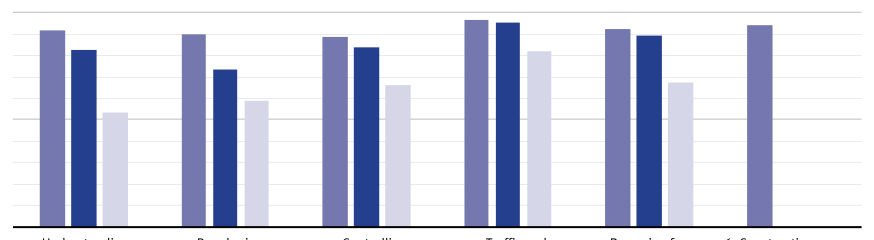
Average level of compliance · Ratings: 2-Compliant, 1-Partially compliant, 0-Not compliant · 1: Understanding the site’s traffic needs · 2: Developing a traffic management plan · 3: Controlling the risk · 4: Traffic and pedestrian behaviour · 5: Preparing for an emergency · 6: Construction-specific controls · Section of worksite assessment tool · Construction · Industrial · Agriculture
The findings are generally positive across each of the three industries. The average levels of compliance were between fully compliant and partially compliant. There is a slight difference in the levels of compliance between each industry, with construction workplaces tending to have higher levels of compliance than industrial or agriculture workplaces.
Average levels of compliance were lowest in section 1 (Understanding the site’s traffic needs) and section 2 (Developing a traffic management plan) of the assessment tool, indicating these are areas requiring continued improvement by industry.
Figure 2 provides a further breakdown of the types of control measures implemented by workplaces, based on the hierarchy of controls. It shows that workplaces tended to rely more on lower-level, less effective administrative control measures rather than eliminating or designing out risks.
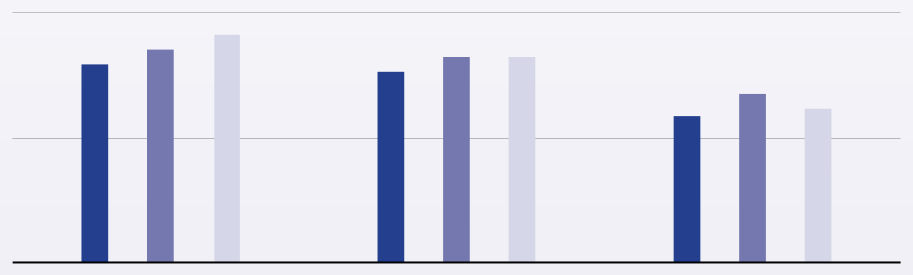
2 · 1 · 0 · Construction · Industrial · Agriculture · 3a: Controlling the risk (elimination) · 3b: Controlling the risk (substitution, isolation, engineering) · 3c: Controlling the risk (administrative)
One of the objectives of the first phase of this project was to identify good practice to share broadly with industry. Inspectors identified a wide range of examples of effective and innovative traffic management solutions. These examples typically involved elements of planning, design and consultation with workers and supply chain partners. A list of these examples of good practice can be found at Appendix 1.