
2.5Vehicle and equipment requirements#
All TIMS vehicles must be suited and equipped to safely undertake the activities they are intended for. Consideration needs to be made, but not limited to:
- safely undertake the tasks that will be required to be performed, especially access to equipment in high-speed environment
- meet the requirements of the tasks that they will be required to perform; and
- present a consistent image of the department.
All vehicles, plant and equipment must be serviced and maintained in accordance with the relevant Australian Standards and/or manufacturer’s specifications to fulfil the requirements of the provider. Accurate maintenance and service records must be maintained and provided upon request for all items of plant and equipment to be used. All equipment must comply with the MUTCD and any other legal requirements. Personnel providing TIMS must be adequately trained on all supplied equipment and possess the required certifications of licences.
2.5.1Vehicle modification#
The Queensland Road Vehicle Modification Handbook provides information for vehicle owners or vehicle modifiers wishing to modify light vehicles (gross vehicle mass of not more than 4.5 t) from the manufacturer's original specifications. For information about heavy vehicles (gross vehicle mass more than 4.5 t), including standards and guidelines for heavy vehicles, refer to the National Heavy Vehicle Regulator. This would include any requirements to attach non-standard equipment such as padded front bumper for push / shunt disabled vehicles.
2.5.2Livery and branding#
All dedicated and specifically-equipped vehicles for TIMS purposes should use the half-Battenberg livery and be clearly and easily identifiable as a Transport and Main Roads vehicle. This includes vehicles used for other purposes, but that are primarily used for incident response duties. The intention of this livery is to maximise visibility and safety on the road. The livery should also be consistent with existing TIMS already in operation within the department. Branding should include:
- blue and yellow (Battenberg) chequerboard pattern on front and side of vehicle (as illustrated in Figure 2.5.2(A)
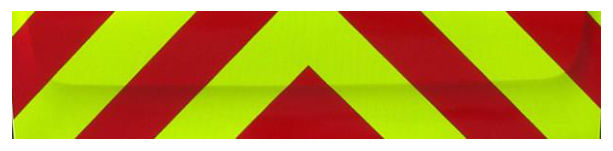
- red and yellow chevrons on back of vehicle (as illustrated in Figure 2.5.2(B)
- vehicle service type (for example, ‘Traffic Response Unit’) clearly printed on the vehicle
- Queensland Government logo
- QLDTraffic website and 13 19 40 phone details.
Regions that use standard departmental vehicles for providing TIMS in the absence of dedicated incident response vehicles should ensure that vehicles are branded and equipped adequately to operate safely within local network conditions. If a contracted vehicle is used exclusively for the department, any variation to vehicle branding as outlined here must be endorsed by the department. If a contracted vehicle is used for other business outside of contractual arrangements with the department, it is understood that the vehicle may remain in the colours / decals of the service provider, provided that, during contractual hours and acting under direction of the department, a Queensland Government logo is affixed (generally with magnetic decals). These logos must be removed while performing non-departmental business.
2.5.3Rotating lights#
TIMS vehicles are classed as a special use vehicle as per s114(6) of the Transport Operations (Road Use Management – Vehicle Standards and Safety) Regulation 2021, As a special use vehicle, s114(1)(b) states ‘a special use vehicle may be fitted with one or more flashing yellow lights’. This is reinforced in the MUTCD.
TIMS personnel acting under the exemptions of a SCP while in operational mode and proceeding to, or at, a scene of an incident, are required to travel in a vehicle with yellow flashing lights activated. Any vehicle that may be controlled by an officer under these circumstances must be equipped with yellow flashing lights. Other coloured lights are not permitted, unless classed as an exempt vehicle. Exempt vehicles are outlined in s114(1) of the Transport Operations (Road Use Management – Vehicle Standards and Safety) Regulation 2021.