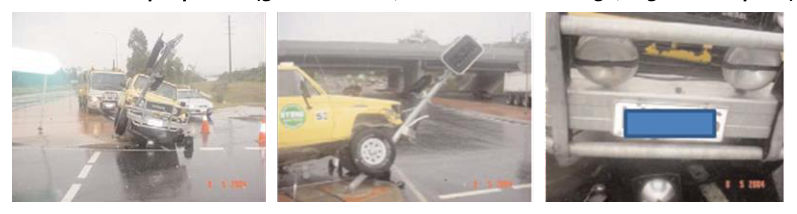
3.6Hazard priority assessment#
Hazards on the road network have the potential to create issues for both safety and traffic flow. For this reason, there may be instances where it is deemed preferable to have a hazard moved or removed from the network. In these situations, consideration should be given to regional resources and available legal delegations.
Hazards on the road network can generally be grouped into one of the following three types:
- vehicles
- debris
- spills.
Clearance (move / removal) priority should be assessed based on the type and position of the item and the prevailing environmental conditions and should dictate how urgently the item needs to be removed from the network.
The standard process by which priority is assessed is outlined following. Timeframes for the removal of obstructions are at regional discretion taking into account but not limited to:
- the type of move / removal
- access to scene (distance, notification)
- regional labour and funding resources
- HAZMAT issues
- potential safety risk
- Police availability where investigation is required.
These priorities, with associated timeframes, should be documented within each region / district, ideally as part of an interagency traffic incident management plan.
3.6.1Hazard position#
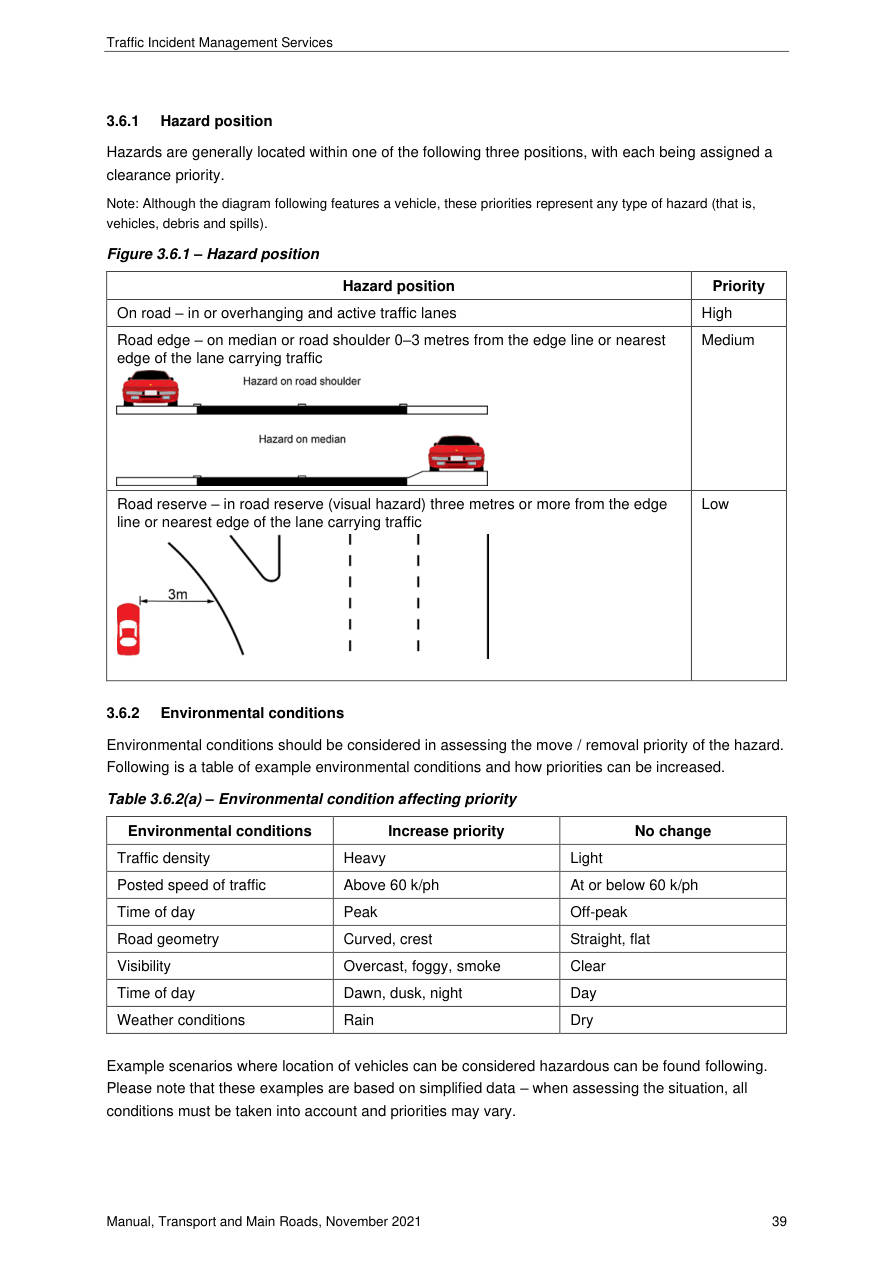
Hazards are generally located within one of the following three positions, with each being assigned a clearance priority.
| Hazard position | Priority |
|---|---|
| On road – in or overhanging and active traffic lanes | High |
| Road edge – on median or road shoulder 0–3 metres from the edge line or nearest edge of the lane carrying traffic | Medium |
| Road reserve – in road reserve (visual hazard) three metres or more from the edge line or nearest edge of the lane carrying traffic | Low |
3.6.2Environmental conditions#
Environmental conditions should be considered in assessing the move / removal priority of the hazard. Following is a table of example environmental conditions and how priorities can be increased.
| Environmental conditions | Increase priority | No change |
|---|---|---|
| Traffic density | Heavy | Light |
| Posted speed of traffic | Above 60 k/ph | At or below 60 k/ph |
| Time of day | Peak | Off-peak |
| Road geometry | Curved, crest | Straight, flat |
| Visibility | Overcast, foggy, smoke | Clear |
| Time of day | Dawn, dusk, night | Day |
| Weather conditions | Rain | Dry |
Example scenarios where location of vehicles can be considered hazardous can be found following. Please note that these examples are based on simplified data – when assessing the situation, all conditions must be taken into account and priorities may vary.
| Position | Conditions | Priority |
|---|---|---|
| On road | Under all conditions a vehicle on the road is a high priority | High |
| Road edge | Peak, low speed, day time | Medium |
| Road reserve | Peak, low speed, day time | Low |
| Peak, high speed, crest, curve, night, narrow road | Medium / high |