
3.3Call-out and operational considerations#
Following are the steps, considerations and check points of the generic call-out and operational considerations for TIMS. Depending on the incident (or activity), some or all the information is required when setting up contracts and work procedures.
3.3.1Incident call-out#
TMC operators and direct supervisors are the only persons normally authorised to call-out TIMS personnel or direct them to a particular incident, unless the TIMS personnel are operating in 'autonomous' mode (such as while out of phone / radio contact). In exceptional circumstances, TIMS personnel may respond directly to Police requests for attendance but must immediately inform a TMC operator or regional supervisor that he or she has been so directed. TIMS personnel on duty may stop to attend incidents that are detected during routine travel but should seek immediate approval from the TMC operator or regional supervisor to respond. All requests for departmental TIMS attendance must be made through the TMC or regional supervisor where possible in the first instance.
The TMC should provide as many details as possible to the TIMS personnel prior to attending the incident. These could include:
- incident location – road, suburb, nearest cross-street or other location identifier
- direction and affected lanes, changes to the road access
- description of incident and severity, number and type of vehicles
- if Police or Emergency Services are on route or at scene
- extent of injuries – particularly if a fatality is suspected (and Forensic Crash Unit is required).
3.3.2Travelling to incident scene#
While travelling / proceeding to the scene of the incident, the following must be adhered to:
- obey all traffic signals, signage and road markings
- activate SCP conditions if issued and appropriate
- plan approach route, allowing for location and traffic conditions
- TMC advice on best approach to the incident scene
- TMC supervisor to provide traffic and incident information using CCTV
- confirm estimated time of arrival to TMC.
These duties must be performed safely and with minimal interference to other road users.
3.3.3Arrival at incident scene#
3.3.3.1Positioning of Traffic Incident Management Services vehicles at incident scene#
Vehicles must be positioned safely and at a distance to allow a safe exit and entry for individuals and to avoid obstruction to traffic (unless intended) or other responders. The positioning of vehicles must consider:
- access and parking of Emergency Service vehicles and other response vehicles arriving and leaving the scene
- distance allowance for 'vehicle break-through' of the traffic cones in the event of emergency braking by an approaching vehicle.
3.3.3.2Use of Traffic Incident Management Services vehicle equipment#
If using vehicles fitted with a variable message sign and/or arrow board, an appropriate message and arrow should be displayed. Use of the variable message sign should be in accordance with the Queensland Guide to Traffic Management Part 10 Transport Control – Types of Devices and the Queensland MUTCD. If other equipment, such as emergency signage (including roll-out signage) is available, it should be placed in accordance with the Queensland MUTCD as appropriate, given the circumstances.
3.3.3.3Risk assessment#
Given the operating environment, the risks should be assessed continuously. This is to ensure the safety of TIMS personnel and others at the scene of an incident. Risk assessment and management includes analysing, evaluating, controlling, reviewing and monitoring the risk.
When at an incident scene, a TIMS officer shall:
- 1.before committing to any action, carefully assess the situation by using the risk assessment process (analyse, evaluate, control, review and monitor the risk) to ensure the safety of themselves and of third parties at the scene of an incident
- 2.reassess the risk continually throughout the response and adjust activities and set-up accordingly
- 3.complete the risk assessment report upon conclusion of the incident
- 4.have completed the mandatory risk assessment report by the end of the shift.
Any legislative requirements in relationship to risk and WH&S must be identified and complied with. Procedures cannot cover all eventualities and, therefore, careful consideration must be given to the varying circumstances, environment and others in attendance such as:
- the type, size and severity of the incident
- traffic conditions, such as heavy traffic or high speed
- weather conditions, such as heavy rain or fog
- road conditions, such as lack of access or no breakdown lanes
- visibility and sight distance
- topography
- Police in attendance
- electrical, chemical or other hazards (for example, smoke or debris)
- risk or level of danger to other road users and the public.
A risk assessment matrix that can be used to assist in determining the applicable action in line with the likelihood and consequences of the associated risk follows.
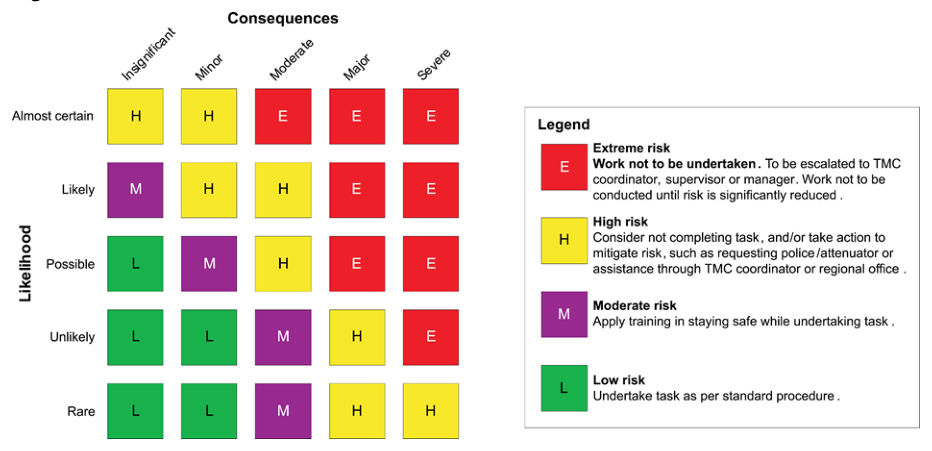
High and extreme risks should be recorded and direct contact with the TMC is mandatory for response and escalation assessment. Possible options for progressing under these circumstances include request for Police presence, closure of road and use of a bump truck. If, at any time, the risk to TIMS personnel is assessed as being unacceptable, request additional resources before proceeding or continuing activities: for example, request Police assistance through the TMC to slow traffic, divert and/or move it over. In all cases, TIMS personnel shall ensure their own personal safety before undertaking any activity.
3.3.4At incident scene#
3.3.4.1Arrival confirmation#
It is essential that up-to-date information is provided to the TMC throughout the incident. This information may be used for providing traffic and travel information (including variable message signs and variable speed limit signs / lane control signs), media releases, major incident advice and so on. At the incident scene, following the appropriate set-out of traffic control devices and any other urgent activity, the TMC shall be advised of the situation (including confirming location and incident details).
3.3.4.2Situation change#
TIMS personnel should advise the TMC of any changes to the situation, particularly expected duration, injury updates, arrival / departure of Police and Emergency Services, current traffic flow and any changes to the number of lanes closed. If senior Police or Fire Officers are onsite, TIMS personnel may request information from them to report back. This could be information such as Forensic Crash Unit on scene, expected resource upgrade requirements and so on. At this point, the TMC may need to take additional action, such as resource upgrades, or update traffic and travel information (including variable message signs).
3.3.4.3Resource upgrade#
Resource upgrades will typically be requested by the TIMS personnel via the TMC. Before requesting additional resources, TIMS personnel should carefully assess the situation to ensure that appropriate amounts of resources (and not an excessive amount) are requested. Extra resources are generally to be called by the TMC, unless other local arrangements are in place.
3.3.4.4Manoeuvring a Traffic Incident Management Services vehicle at an incident scene#
While manoeuvring at an incident scene:
- activate flashing yellow lights
- ensure safety of TIMS personnel and of emergency workers and the public
- understand and use only those exemptions as stipulated in a SCP
- be careful of the environment when entering and exiting the scene.
3.3.4.5Red light cameras#
In the event that Police give direction to enter an intersection equipped with a red-light camera to provide effective traffic management and the TIMS vehicle is flashed by the red-light camera, advise the Police Officer onsite that the camera was activated. For appropriate processing of possible infringement, advise Police Communications of:
- who you are
- the location and reasons for being there
- the circumstances leading to being photographed
- the registration number of the TIMS vehicle.
All details should be recorded in the incident log, including the name of the Police Officer who was onsite. These details should also be passed on to the TMC.
3.3.4.6Personal safety when alone#
Occasionally, an individual TIMS personnel may be the only responder to an incident. In these situations, the TIMS personnel should be aware of possible threats to their own personal safety, particularly at night when approaching vehicles. Under these circumstances, the following applies:
- ensure that the TMC knows your exact location
- report vehicle registration number(s) to the TMC before approaching the vehicle or motorist
- arrange for the TMC to call the TIMS personnel at a suitable interval as a welfare check
- the use of a pre-arranged code to signal distress is encouraged, such as a particular word during a radio conversation
- remain close to the pre-agreed location or advise the TMC of any movement away
- call Police (directly or via the TMC) if threatened or if there is a suspicion of criminal activity
- leave the scene immediately if concerned about personal safety.
3.3.4.7Approaching motorist(s)#
In a traffic incident, a motorist may be frightened, distressed or panicked. The first few seconds of contact are vital in establishing effective incident management. Gaining the confidence of a motorist is therefore essential and reduces the likelihood of impulsive actions.
It is recommended that TIMS personnel should:
- approach the vehicle from behind and park in a defensive position but avoid startling the motorist
- flash headlights or momentarily sound horn, to gain their attention (if considered appropriate)
- at night in particular, assess the motorist for any possible threat or dangers
- keep the TMC advised of your exact location
- ask TMC to monitor via CCTV camera (where available)
- communicate on the side of the vehicle that is furthest away from the traffic lane and greet motorist(s) positively; for example, ‘Hello, I’m (first name) from Transport and Main Roads, can I help you in any way?’
3.3.4.8Providing welfare check and assistance#
TIMS personnel may offer basic assistance, such as fuel and water to allow the motorists to proceed to a safer situation.
When providing assistance to motorists, unless trained and authorised, TIMS personnel should not:
- enable a vehicle such that it can proceed in an unroadworthy condition (for example, fitting a bald tyre to a car) – in such cases, the TMC should be advised and alternative arrangements made
- lend tools or equipment to motorists to enable them to carry out their own repairs
- provide advice relating to legal rights or position
- give directives to motorists or in any way imply authority to do so
- drive a motorist's vehicle
- provide recovery technique advice
- offer any departmental resources for post incident recovery of vehicles
- carry out mechanical repairs on vehicles beyond the provision of fluids.
3.3.4.9Considerations for operating on high-speed roads#
A prohibition notice is currently in place that prohibits departmental employees crossing a freeway as a pedestrian unless adequate traffic control measures that ensure their safety are in place. Failure to comply with the notice is a WH&S breach and will be addressed accordingly.
For the purposes of that notice, a freeway is defined as ‘any multi-lane highway where the posted speed is 100 km/hour or greater’.
TIMS personnel are prohibited from crossing an active high-speed, high-volume road as a pedestrian at any time unless an approved Safe Work Method Statement allows.
3.3.4.10Transporting motorists#
Where a motorist is stranded in an unsafe location and is unable to access a safe removal option, a TIMS officer may consider, if safe to do so, offering to transport the motorist and other vehicle occupants a short distance to a safe location such as a nearby service station.
Careful consideration must be given to the circumstances of the situation and whether adverse consequences could eventuate.
TIMS personnel shall not insist on or force any person to accept an offer of transport but must clearly explain the risks of the unsafe situation.
The TMC must be advised prior to taking such action and full details of the situation recorded.
3.3.4.11Providing first aid#
First aid training is recommended, and possibly deemed mandatory for certain roles, for TIMS personnel.
3.3.4.12Manual handling#
Most duties do not include any requirement to lift excessive loads; however, activities such as traffic control set-up may require lifting heavy objects. To avoid injury, undertake a risk assessment before any action is taken.
Remember, if an object cannot be lifted comfortably, do not attempt to move it.
3.3.4.13Fires#
Firefighting should only be undertaken in exceptional circumstances where life is at risk. In all cases, personal safety should be considered before any firefighting activity is undertaken.
TIMS personnel that have attended a HAZMAT training program should be fully aware of their responsibility in relation to small fires.
If there is an assessment that immediate action can prevent a small fire from expanding into a larger fire, a portable fire extinguisher may be used if available.
Fighting a larger fire should not be attempted, unless loss of life or injury will result from non-action.
3.3.4.14Handover and leaving the incident scene#
TIMS officer activities are generally complete when the incident is resolved, and the last Emergency Services vehicle has left the site of the incident.
When leaving the incident scene, ensure the following has occurred:
- if the works are continuing at the site after the incident is closed, ensure that there is a formal handover (note name and agency) and that replacement traffic control is available where required
- ensure equipment is stowed and that there are no remaining hazardous objects on the shoulder
- remove signage and traffic cones (if applicable)
- move the TIMS vehicle to shoulder area
- lower the arrow board (if fitted)
- cancel flashing light bar and vehicle hazard lights
- provide a situation report to the TMC prior to departure from the scene, if possible
- leave the incident scene with care – do not force your way into heavy traffic, wait until congestion has cleared.
Other agencies, such as maintenance providers, public utility companies, Councils, Rural Fire Brigade or National Parks, may remain onsite to complete other work. When the TIMS activities are complete, it should be confirmed with the site commander that TIMS are no longer required.
It is often assumed that TIMS personnel will remain onsite to provide traffic management. It is therefore essential to advise at the earliest opportunity that you will be leaving the site, so that alternative traffic management arrangements can be made by the relevant agency.