3Definitions#
3.1Advisory Bicycle Lanes#
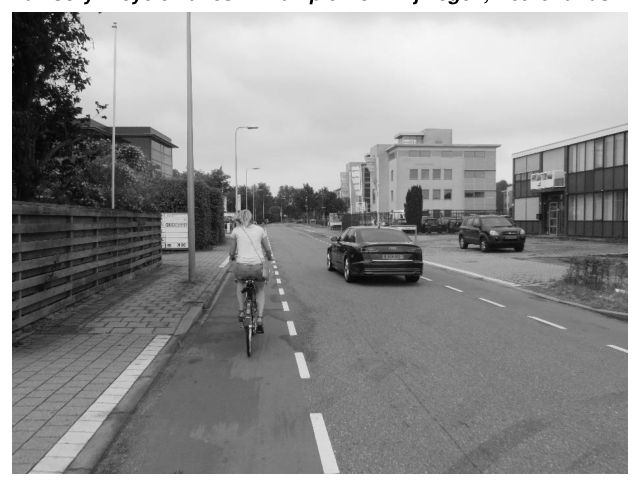
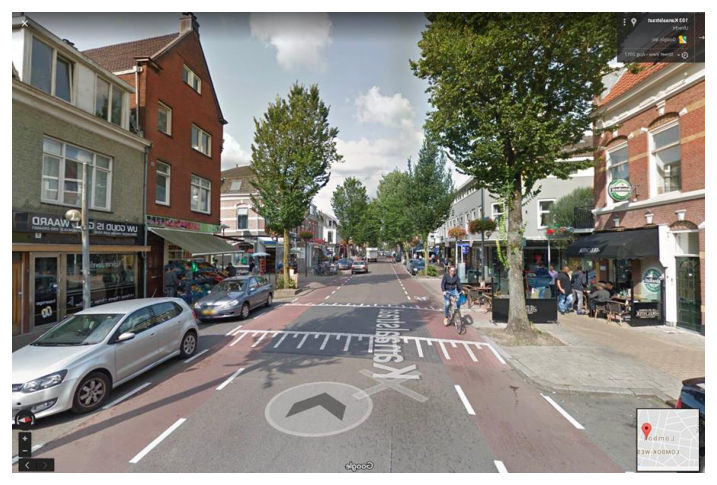
ABLs (also known as Suggestion Lanes) are commonly used in European and North American countries and are advisory bicycle facilities that indicate an area of the carriageway that is intended for the use by bicycle riders and is delineated from a central traffic lane by a 'dashed' longitudinal line with gaps. ABLs are not for exclusive use by bicycle riders; motor vehicle drivers can use them when no bicycle riders are present and when facing oncoming vehicle traffic. Parking must be indented beside ABLs and parking bays marked. Examples of ABLs are shown in Figures 3.1(a), (b) and (c).
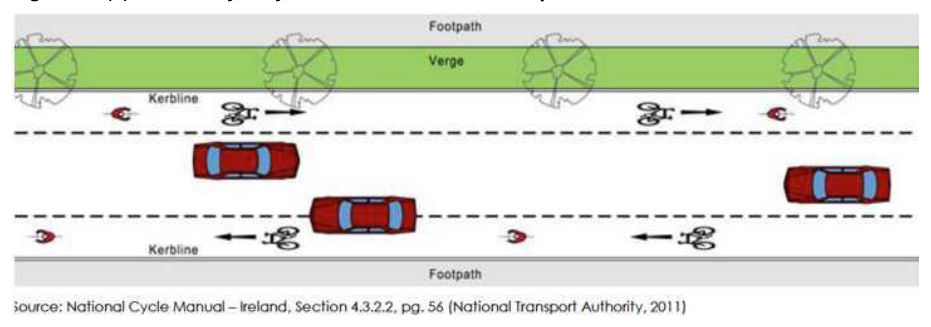
On roads with ABLs, no road centre line is provided. This results in vehicles travelling in the centre of the carriageway. When vehicles from opposing directions pass one another, they must enter the ABL where it is safe to do so. As such, ABLs are bicycle space that motor vehicle drivers may enter when there are no bicycle riders present. If there is a bicycle in the ABL, whoever is in front has the right of way; that is, the motor vehicle will travel behind the bicycle until it is safe to move back into the centre lane.
ABLs also give the perception that the carriageway is narrower than it is which, in turn, functions as a method of traffic calming by reducing vehicle speeds. Safe vehicle speeds should be reinforced with appropriate traffic calming such as humps designed for buses, speed cushions or slow points (see Figure 3.1(c)). Further traffic calming treatments are shown in Appendix A.
In terms of familiarity of similar potential treatments for Queensland drivers, attention is drawn to rural road environments. Many rural roads have posted speed limits of 80 km/h or above and typically have minimal sealed shoulders. Some of these roads consist of a single sealed lane with unsealed shoulders forming the two-way carriageway. Vehicle volumes on these roads are typically low and passing of oncoming vehicles occurs in the unsealed shoulder. The behaviour required is similar in nature to ABLs but more forgiving in this situation as ABLs are implemented in lower speed environments.
Source: Google Streetview
3.1.1Where can they be implemented?#
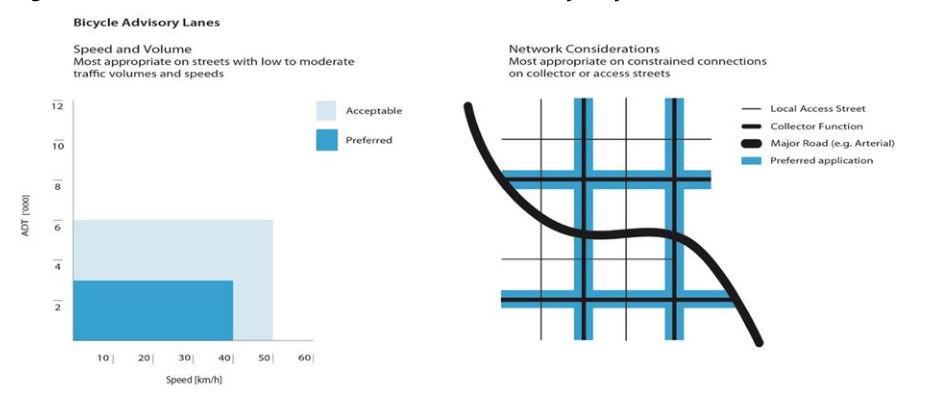
Recommended situations for the implementation of ABLs are detailed in Figure 3.1.1. Further explanation on the reasoning behind these conditions are discussed in Section 4.
3.2Cycle Street#
CSs (also called Safe Active Streets or Bicycle Boulevards in other jurisdictions) are local access roads that form part of the principal cycle network. CSs can also be considered as bicycle paths with limited vehicle access.
CSs are designed as a mixed traffic environment and encourage bicycle riders to use the centre of the road, as illustrated in Figure 3.2. When approaching or opposing motor vehicles, drivers must use the rough textured edges of the carriageway.
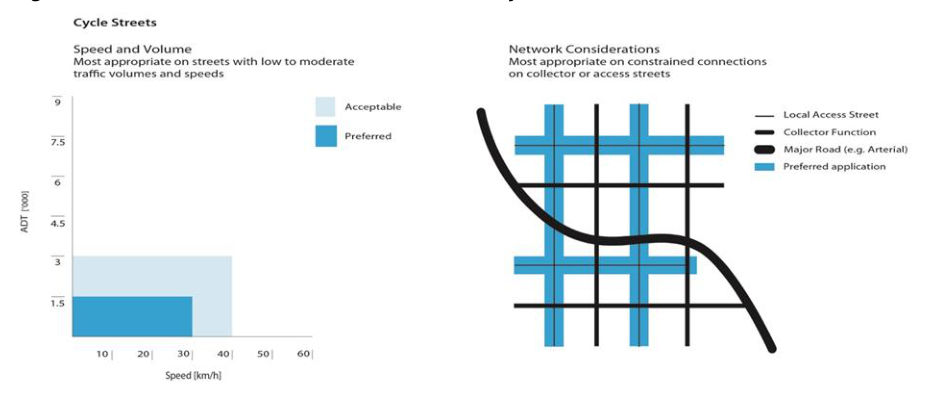
These treatments are typically adopted on low volume low speed environments, particularly on local residential streets.
A narrow service road along an arterial road is also ideal for design as a CS. The service road can accommodate access functions for motor vehicles (property access and parking), while performing the through function for bicycle traffic.
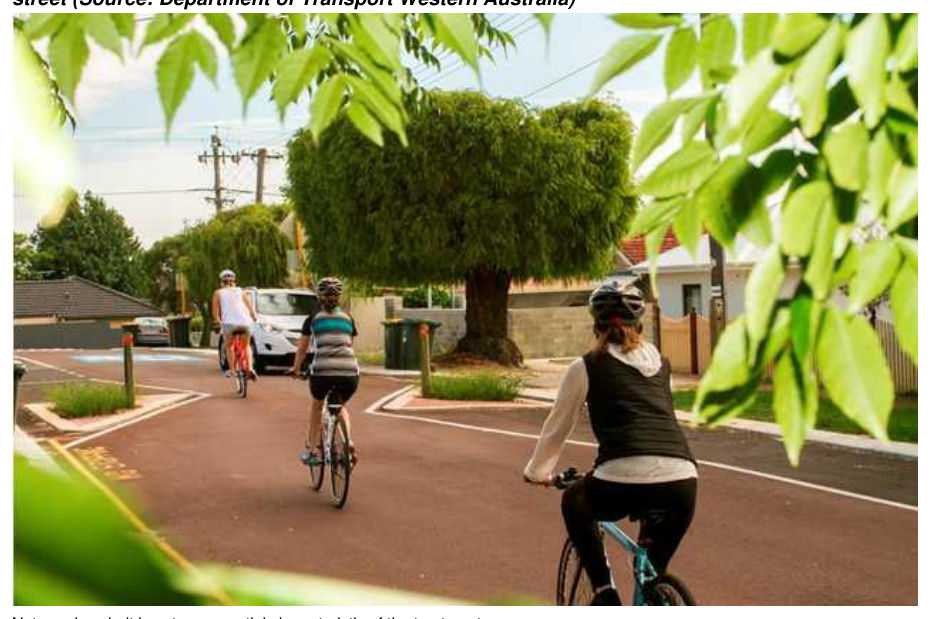
red asphalt is not an essential characteristic of the treatment
3.2.1Where can they be implemented?#
Recommended situations for the implementation of CSs are detailed in Figure 3.2.1. Further explanation on the reasoning behind these conditions are discussed in Section 4.