4Application#
Table 4 guides the selection of advisory bicycle infrastructure types within urban road corridors based on road function and speed. The table is not relevant for rural roads outside of main centres. ABLs and CSs are acceptable treatments in mixed traffic environments. These are typically local access streets and minor collector streets.
| Road function | Vehicle operating speed (km/h) | ABLs appropriate? | CSs appropriate? | Explanation |
|---|---|---|---|---|
| Access function for example, local access street (with or without parking) | Up to 30 km/h | No | Yes | These treatments are appropriate in mixed traffic, low speed environments. |
| Collector function for example, minor collector street (without parking) | Up to 50 km/h | Yes | No | Bicycle lanes / cycle tracks are preferred where space. If not enough space, ABLs are ideal <3000 vpd and acceptable <6000 vpd |
| Collector function for example, minor collector (with parking) | Up to 50 km/h | Yes | No | Bicycle lanes not ideal with parking, unless appropriate buffers / clearances can be provided |
| Through traffic function for example, arterial road | More than 50 km/h | No | No | High quality parallel off- road bicycle path or cycle tracks preferred due to high speed difference |
| Regional through traffic function for example, urban motorway | More than 70 km/h | No | No | High quality parallel off- road bicycle path with grade separated, signalised or priority crossings at intersections is appropriate |
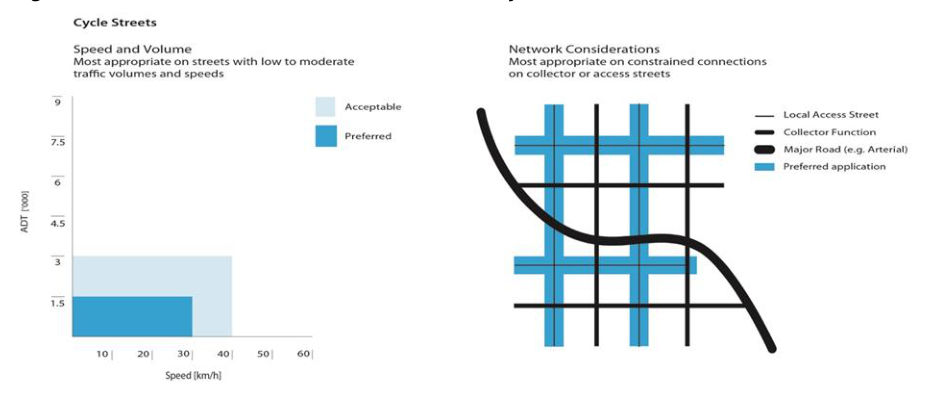
The table and Figures 3.1.1 and 3.2.1 show that mixed traffic environments are generally considered acceptable when vehicle operating speeds are below 50 km/h and vehicle volumes below 6000 vpd.
Best practice for cycling indicates that, to encourage riders of all ages and abilities, road design should achieve lower, safer, equitable speeds to ensure mixed traffic environments are acceptable and safe. As noted in Transport and Main Roads’ Technical Note TN128 Selection and Design of Cycle Tracks, a desirable equitable speed is 25 km/h, and a maximum equitable speed is 30 km/h.
In Queensland, the general default urban speed limit is 50 km/h. 30 km/h zones in residential areas have been proven to save lives and money. The Queensland MUTCD Part 4: Speed Limits permits 40 km/h and 30 km/h speed zones. Reduced speed limits together with appropriate road designs are important safety measures for bicycle riders. Creating reduced speed differentials are required to support safer speed limits. If the road design does not result in desired operating speeds, well-designed traffic calming must be an implicit measure to support cycling safety in these situations.
Similarly, vehicle volumes are also important for a successful mixed traffic environment. This particularly relates to the number of oncoming vehicle movements that are expected to occur. This has a direct impact on the number of times a vehicle would be required to move to the side into ABLs in order to pass another vehicle. Where motor vehicle volume is >4000 vpd, there are very few safe opportunities to overtake a bicycle rider. In this situation, the motor vehicle driver must drive at the speed of the bicycle rider ahead.
A review of current Queensland Road Rules indicates that there are no road rules that would prevent the implementation of ABLs; however, a road centre line must not be marked in a road with this treatment. The removal of the road centre line encourages drivers to track in the centre of the road and not along the edge. If a centre line is marked, it would make it illegal to track in the centre of the road. Transport for London's analysis on road centre line removals showed that there was a statistically significant reduction in vehicle speeds as a result of removing road centre line markings on the carriageway3. Removal of the road centre line therefore represents a road safety improvement for all users.
4.1Site selection#
The aim of ABLs and CSs are to enhance safety and awareness of bicycle riders in a mixed traffic environment, where exclusive bicycle lanes or cycle tracks cannot fit. It is always preferred to provide exclusive bicycle lanes where space permits (refer Figure 4.1 following). Exclusive facilities for cyclists are required on higher order roads, roads with bus routes and / or high heavy vehicles numbers.
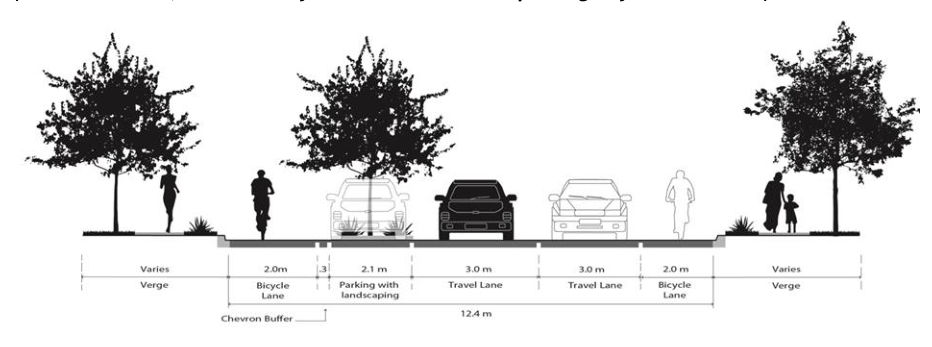
two traffic lanes, kerbside bicycle lanes and marked parking bays on one side.
There are a number of conditions that make the installation of these facility types more desirable including:
- A roadway width that is too narrow to support exclusive bicycle facilities without roadway widening or removal of other demand elements. Typical carriageway widths on access streets / minor collector streets are between 7.5–12.4 m and include on street parking, therefore provision of exclusive bicycle lanes cannot be provided unless road widening or changes to car parking occurs. These street types often have limited opportunities for a wide off-road separated path within the verge due to verge width, street trees and sometimes services. ABLs could also be implemented as an interim treatment before making required changes to introduce exclusive bicycle lanes.
- An improved alternative or replacement to the Bicycle Awareness Zone treatment.
- Potential to be provided in a variety of urban land uses (for example, residential and commercial) and community scenarios (for example, dense urban areas, regional towns).
- Along lower order streets with an access function that provide important connections between principal cycle network routes with dedicated bicycle facilities such as separated bicycle facilities.
- Can be a useful treatment for low volume service roads where there is insufficient room to provide exclusive bicycle lanes.
- Retrofit situations.
4.2Facility type selection#
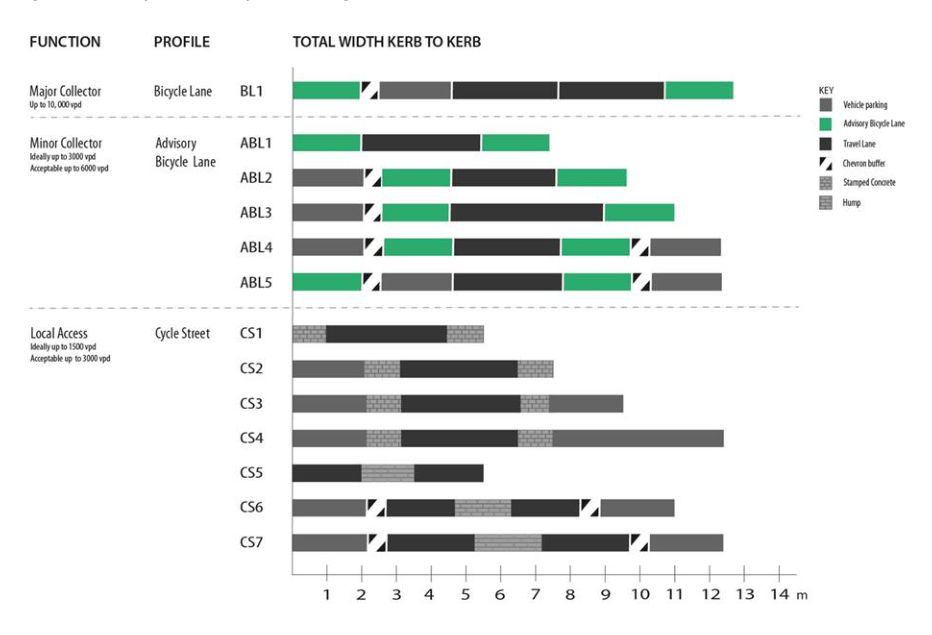
Sections 5 and 6 illustrate the cross section options available for ABLs and CSs. A summary of preferred facility type against road function, traffic volume and cross section width can be found in Figure 4.2 to assist in choosing the correct facility type to meet the specific site's characteristics.
4.3Advantages and disadvantages#
The advantages and disadvantages of implementing ABLs and CSs are:
| ABLs | CSs | |
|---|---|---|
| Advantages | Allow vehicles to overtake without having to cross a road centre line Lack of road centre line prompts driver negotiation and appropriate speeds Cost effective with narrow carriageways / easily retro-fitted Visual narrowing of the carriageway Provides predictable space for bicycle riders on a road otherwise too narrow for exclusive bicycle lanes Alternative to Bicycle Awareness Zones | Less use of space – a CS is open to vehicle traffic and requires less space than a bicycle lane or off road path. This makes a CS suitable for more locations and makes it cost-effective Improved accessibility – unlike full closure of a street or a route to motorised traffic. Increases comfort for cyclists by potentially reducing motor vehicle operating speeds and volumes. May reduce the incidence of serious injuries through reduced travel speeds. Improves quality of life for residents through calmer traffic and safer crossings. Better personal safety – a route through a residential district with a combined use of bicycle and car provides more social safety that a solitary off road path next to an urban main road Alternative to Bicycle Awareness Zones |
| Disadvantages | No exclusive dedicated bicycle space Not suitable for high volume or high speed roads Relies on motorists knowing how to navigate the road markings* | No exclusive dedicated bicycle space Relies on good driver behaviour* Not suitable for high volume or high speed roads |
Table in words
- For Advantages, ABLs: Allow vehicles to overtake without having to cross a road centre line Lack of road centre line prompts driver negotiation and appropriate speeds Cost effective with narrow carriageways / easily retro-fitted Visual narrowing of the carriageway Provides predictable space for bicycle riders on a road otherwise too narrow for exclusive bicycle lanes Alternative to Bicycle Awareness Zones.
- For Advantages, CSs: Less use of space – a CS is open to vehicle traffic and requires less space than a bicycle lane or off road path. This makes a CS suitable for more locations and makes it cost-effective Improved accessibility – unlike full closure of a street or a route to motorised traffic. Increases comfort for cyclists by potentially reducing motor vehicle operating speeds and volumes. May reduce the incidence of serious injuries through reduced travel speeds. Improves quality of life for residents through calmer traffic and safer crossings. Better personal safety – a route through a residential district with a combined use of bicycle and car provides more social safety that a solitary off road path next to an urban main road Alternative to Bicycle Awareness Zones.
- For Disadvantages, ABLs: No exclusive dedicated bicycle space Not suitable for high volume or high speed roads Relies on motorists knowing how to navigate the road markings*.
- For Disadvantages, CSs: No exclusive dedicated bicycle space Relies on good driver behaviour* Not suitable for high volume or high speed roads.