
3.3Separating participants and spectators from traffic#
As outlined in Section 2.6 of the ETMDG, the risks associated with the interaction between traffic and events are different to those for construction and maintenance activities. Therefore, the specific nature of the activities of the event that may lead to conflict with traffic or create risks to spectators or persons participating in the event should be considered.
3.3.1Risk factors#
Events on road may result in the risk of injury to event participants (for example, collision between an event participant and a vehicle) and members of the public (for example, a pedestrian or spectator could be hit by a cyclist participating in an event). When determining if and what measures should be implemented to manage these risks, the relevant input factors and how they influence the likelihood and consequence / severity of risk should be considered. Key input factors that may assist with evaluating event traffic management risks include:
- traffic volume
- traffic speed
- size of event (participant and spectator numbers)
- density and speed of event participants
- event duration
- length of event in proximity to traffic
- separation from traffic
- age of participants and spectators
- road geometry (lane width / alignment)
- weather conditions
- time of day, and
- static or non-static.
Figure 3.3.1 illustrates the input risk factors (in italics) and the control measures (that is, measures that can be used to control / manage risk, in bold) for the separation of event participants / spectators from general traffic.
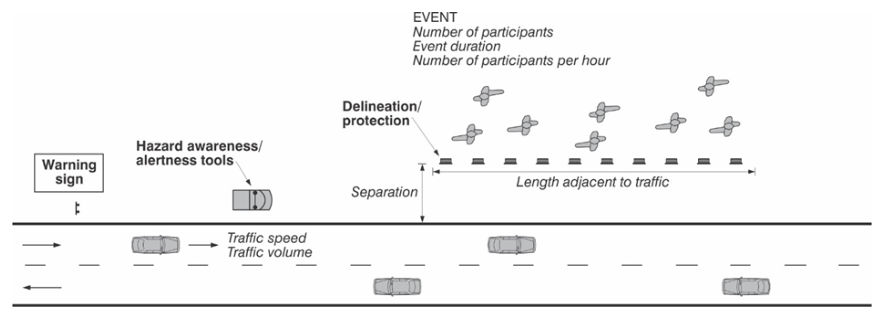
Higher traffic volumes, higher numbers of event participants, longer event durations and longer areas of events parallel to the roadway are all measures of exposure. In general, the higher the exposure, the greater the likelihood of an incident occurring. In addition to the increase in risk profile associated with the exposure to these factors, the specific nature of the event and location (for example, crash history) at which the event conflicts with traffic will have a bearing on the degree of associated risk. Due to the limited ability of the human body to withstand impact forces, higher traffic speeds increase the severity of collisions between event participants and vehicles. Higher speeds can also increase the likelihood of a collision, as they reduce the probability of an errant vehicle decelerating to a stop between the normal travel path and the event area.
3.3.2Control measures#
Some of the control measures available for managing the risk of events near traffic include:
- hazard elimination (detour)
- hazard separation (event is separated from moving traffic)
- hazard control (engineering treatment)
- warning signs
- hazard awareness / alertness tools
- police vehicles
- flashing arrow board
- VMS, and/or
- traffic controller with STOP / SLOW bat
- posted speed limit reduction
- delineation
- longitudinal channelising barricades, and
- temporary safety barrier systems.
These control methods can be used individually or in various combinations to achieve the desired level of risk management. The advantages and disadvantages of these control methods are discussed in Table 3.3.2.
| Control options | Advantages | Disadvantages |
|---|---|---|
| Hazard elimination (for example, design event areas and courses to avoid or minimise interaction with traffic areas) | • Eliminates or significantly reduces the risk of conflicts between event participants and road users | • May have a greater impact on road network performance (for example, travel times as a result of detours) and property access |
| Warning signage | • Increases awareness of event participants / spectators in proximity to roadway • Low cost • Erected and removed quickly for a non-static event | • Does not provide physical protection • Requires regular checks (during longer or multi-day events) for correct placement and visibility |
| Hazard awareness / alertness tools: • police vehicle • flashing arrow board • VMS • traffic controller or ETM with STOP / SLOW bat | • Improves driver alertness of events in locations where extra stimuli are competing for driver attention • Police presence improves event credibility and speed compliance • May assist in reducing vehicle speeds | • Does not provide physical protection • Exposes traffic management personnel to traffic risks • Increased labour / equipment costs |
| Speed limit reduction | • Reduces the speed differential between vulnerable event participants / spectators (for example, runners or cyclists) and general traffic, and therefore crash severities • Makes navigation of changed traffic conditions easier | • Does not provide physical protection • May require supporting traffic control devices / measures to achieve the desired level of compliance (refer to the Queensland MUTCD Part 3, QGTTM and the Guideline – Traffic Management At Works on Roads for guidance on the use of supplementary devices to reduce speed) • Increased travel time for general traffic, particularly for long event courses |
| Delineation • participants to traffic • spectators to participants • participants to traffic | • Provides visual separation cues to road users in order to separate vulnerable road users from vehicles • Can provide directional cues for event participants • Closely spaced delineation provides improved cues for both motorists and participants • Spacing can be varied depending on situation / risk • Inexpensive relative to other physical protection devices such as temporary barriers | • Does not provide physical protection • Devices could become a hazard if knocked over and may be hazardous to event participants / spectators / road users • Reducing delineation spacing increases installation / removal time • Costs associated with installing and maintaining standard delineation devices, particularly for long-event courses |
| Control options | Advantages | Disadvantages |
|---|---|---|
| Longitudinal channelising barricades (not safety barrier) | • Reduces the risk of participants / spectators encroaching into the path of general traffic • Provides visual separation cues to motorists in order to separate vulnerable road users from vehicles | • Set up / removal time may be greater than for delineation • Does not provide physical protection from errant vehicles • May provide false confidence – to participants (who may be less cautious) and to drivers (who may increase speeds) • Cost likely to be greater than for delineation |
| Temporary safety barrier system | • Reduces the collision risk of errant vehicles encroaching into the space used by participants / spectators • Reduces the collision risk of general traffic encroaching into the path of participants / spectators • Reduces the separation width required between traffic and vulnerable road users, potentially allowing for additional lanes of traffic to remain open • Sight screens can be installed to minimise traffic impacts and protect participants from objects thrown from moving vehicles | • May be a hazard to occupants of errant vehicles • Significant set up / removal time • May require ongoing maintenance over the course of a longer event (for example, water filled barriers require topping up) • High cost to purchase or hire • Traffic speeds may increase |