
5.11Traffic control station operation#
Traffic controllers are responsible for ensuring that traffic control stations are operated in a safe and orderly manner. The traffic control station must be operated in accordance with this Approved Procedure. Traffic controllers must remain at the traffic control station until directed by their supervisor to leave, or until they are relieved by another traffic controller. Where more than one traffic controller is working at a particular location, the decision to change the direction of traffic flow rests with the traffic controller who is the next to stop the traffic (this being the traffic controller who has the SLOW sign facing the traffic). It is recommended traffic controllers avoid stopping large vehicles at the front of the queue and ensure vehicles have a safe braking distance.
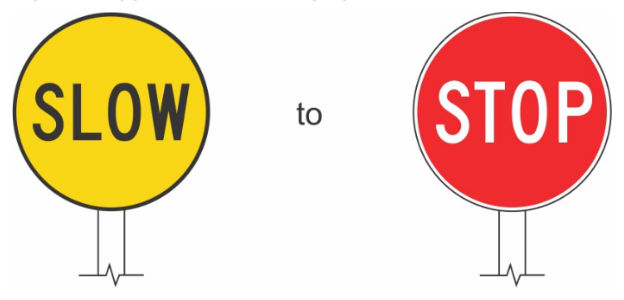
When changing the bat from SLOW to STOP, the traffic controller must:
- stand facing the traffic, but just outside the path of vehicles
- wait for a safe break in the traffic
- turn the sign to 'STOP', signal with the free hand raised up, with the palm facing the traffic – see Figure 5.12(a)
- give the next approaching vehicle enough time so the driver does not have to brake suddenly to stop. Where possible, avoid stopping large vehicles at the front of the queue.
- only after the traffic has stopped (and where it is safe to do so), change position as necessary to be clearly visible to drivers as they arrive at the end of the queue:
- a good practice is to move to a position adjacent to the driver's side headlight of the first vehicle after two or three vehicles have stopped and it is safe to do so (while standing in that position, the traffic controller may turn their body at a slight angle to assist them to view approaching traffic from the rear while ensuring that the bat's STOP sign remains facing the stationary traffic)
- continue to monitor the stationary vehicles and vehicle approaches from the opposite direction (be cautious of vehicles approaching from both directions)
- make sure that there is still an escape route available, and
- communicate to the traffic controller at the other end of the worksite as required.
When holding vehicles, the traffic controller must:
- ensure that the bat's STOP sign faces the stationary traffic
- position themselves so that they can continue to watch for traffic approaching in both directions, and
- communicate with other traffic controller/s as required.
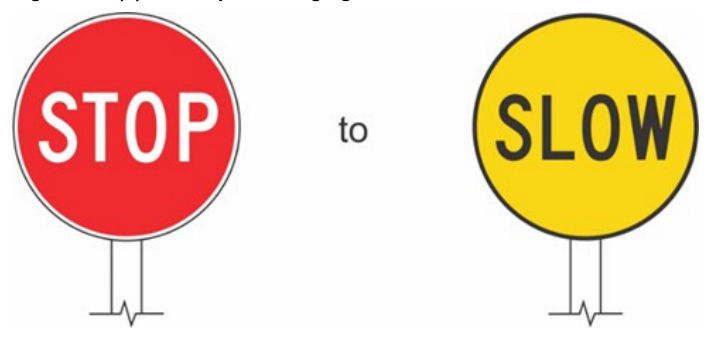
When changing the bat from STOP to SLOW, the traffic controller must:
- check the other traffic controller is showing 'STOP' to their traffic
- check that the last vehicle has come through from the opposite direction (as has been communicated by the other traffic controller)
- check the work zone is clear to send traffic (including checking that no machinery or trucks are about to enter or turn into the traffic lane)
- move back to the side of the road, and stand clear of traffic
- recheck behind to ensure the work zone area is clear
- turn the sign to 'SLOW' and signal the traffic 'TO GO' with the free hand – see Figure 5.12(a), and
- communicate to the traffic controller at the other end of the worksite as required.