6Incident management – when things do not go to plan#
6.1Incidents including near misses#
An incident is an occurrence that, in the opinion of the traffic controller, affects the operational safety and/or effectiveness of a traffic controller at a worksite and could be caused by anyone interacting with the worksite, including road users, pedestrians and construction workers. An incident can involve actual damage occurring, or no actual damage, such as a near miss.
Examples of incidents include:
- accidents / crashes occurring within the designated worksite or roadworks
- physical contact or impact with a traffic controller, worker or other road user, or impact with equipment or vehicles
- physical assault directed towards a traffic controller by road users
- unsafe or dangerous actions of road users within a worksite, or at roadworks causing impact or injury
- difficulties experienced with stopping certain vehicle types where damage or impact is caused
- other actions that result in physical contact or injury to a traffic controller
- abusive / insulting / threatening language directed towards a traffic controller, and
- road users disobeying a direction or signal given by a traffic controller.
Examples of incidents that are near misses include:
- potentially unsafe actions of road users which only narrowly avoid resulting in a crash
- difficulties experienced with stopping certain vehicle types where no damage results, but could have, and
- vehicles speeding through a worksite or past a traffic controller.
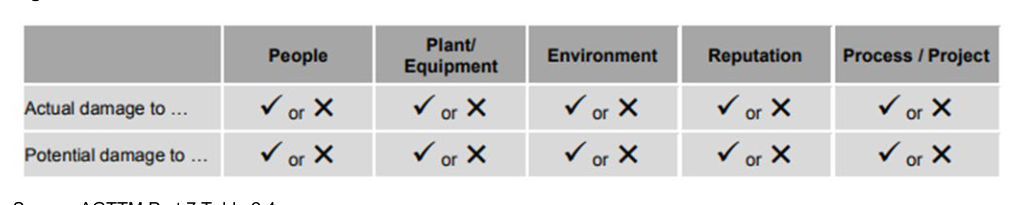
Incident or near miss reports can include a matrix showing the actual and potential impacts. An incident can be a combination of incidents, as illustrated in Figure 6.1 following.
Source: AGTTM Part 7 Table 2.4.
6.2Incident management#
If a driver disobeys a traffic controller's instruction, a traffic controller must:
- prioritise personal safety
- use the pre-determined escape route, if necessary, and
- warn other members at the worksite as early as possible.
A warning system must be agreed upon beforehand. It may include shouting, use of a whistle, use of the two-way radio to communicate with other traffic controllers.
The following actions must be taken if a minor incident occurs within the traffic controller’s operational area:
- call for assistance if needed
- notify the worksite supervisor or team leader
- maintain effective traffic control
- if necessary, move the traffic control station to a suitable location that includes the accident site, within the traffic control operational area, and
- record sufficient notes of the incident, including observations, and complete an incident report.
If the incident is more serious or poses further risk of injury to persons or damage to property, the traffic controller must:
- contact, or ensure another person contacts the relevant emergency service (by calling 000 or 112 (mobile phones only))
- notify the worksite supervisor immediately and act on instructions
- if necessary, relocate the traffic control station to a safe position, clear of any real or potential danger, and
- record sufficient notes of the incident, including observations, and complete an incident report.
6.3Incident details#
When completing incident reports, at a minimum, it is important to consider the following information:
- time, date, and location of incident
- type of incident, and
- incident identification, including:
- ― vehicle type and colour
- ― vehicle registration number, including registered state or territory
- ― direction of travel
- ― description of driver, other road users and occupants
- ― full and accurate description of the incident, and
- ― witness details.
Traffic controllers must ensure that details of incidents requiring further investigation or attention by a police officer are reported and forwarded to their supervisor or employer.
It is expected that these incidents are reported immediately. Other types of incidents (including near misses) can be reported before the end of the shift.
6.4Incidents involving hazardous loads#
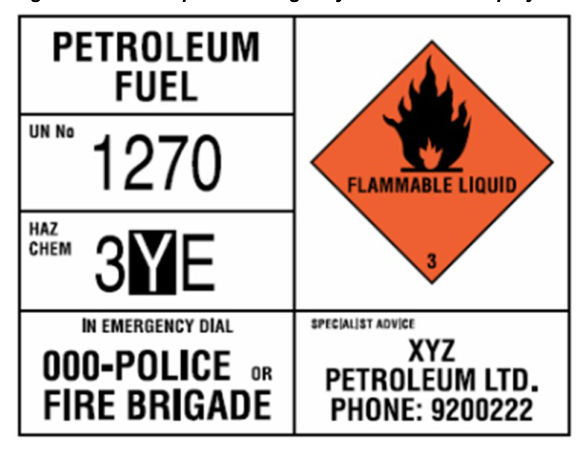
All hazardous or explosive loads are required by law to display the emergency information panel on the vehicle, as illustrated in Figure 6.4.
The traffic controller must take extra care in an incident involving a vehicle carrying a hazardous load.
The traffic controller must determine the type of load and relay the details to the site supervisor as soon as possible, so that appropriate emergency action plans can be implemented.
The traffic controller acts on directives given by the site supervisor and/or emergency services personnel.