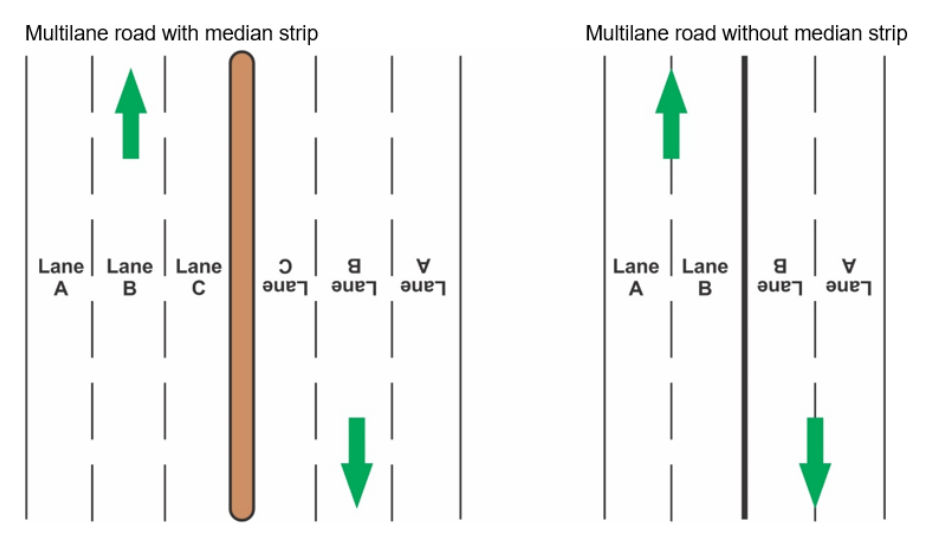
5.14Multilane roads#
Multilane roads are constructed with two or more lanes in one direction. Multilane roads that require traffic control, must always have one traffic controller allocated for each lane that is open to traffic. In some situations, lane closures can be implemented in advance of the traffic control point, to reduce traffic to one lane for the traffic controller to manage. Where there is a concrete barrier dividing the road, there may be no escape route for the traffic controller, so extra caution must be taken when operating on such roads. Careful planning should first seek to mitigate these circumstances so traffic controllers are not placed on a worksite without there being a clear escape route.

The following method must be used by traffic controllers to control traffic on multilane roads:
- Changing from SLOW to STOP in LANE A
- ― to stop vehicles in LANE A, the first traffic controller must turn the bat to show the STOP sign and, while remaining outside the travel path (on shoulder, closed lane(s), or footpath), face the oncoming traffic, and
- ― the first traffic controller must raise their free hand into the STOP signal position, with the palm towards the traffic.
- Holding vehicles in LANE A
- ― the first traffic controller must keep facing the stationary vehicles and, where possible, allow two to three vehicles to stop before stepping in front of the stationary vehicles in LANE A
- ― the first traffic controller must be positioned approximately 6 m in front of the first stationary vehicle in LANE A, and
- ― the first traffic controller must ensure that the bat’s STOP sign continues to face the stationary traffic in LANE A.
- Stopping vehicles in LANE B
- ― the second traffic controller must move to a position alongside the first traffic controller who is situated in front of the traffic in LANE A
- ― the second traffic controller must be nearer to the lane to be stopped next
- ― the second traffic controller must ensure that the bat is indicating STOP to the stationary traffic in LANE A, and
- ― while remaining outside the travel path of vehicles in LANE B, the second traffic controller raises their free hand into the STOP signal position, with the palm facing towards the traffic in LANES A and B.
- Holding vehicles in LANE B
- ― where possible, the second traffic controller allows two to three vehicles to stop before stepping in front of the stationary vehicles in LANE B
- ― the second traffic controller must keep facing the stationary vehicles with the bat displaying the STOP sign to the stationary vehicles in LANE B
- ― the second traffic controller must be positioned approximately 6 m in front of the first stationary vehicle in LANE B, and
- ― the second traffic controller must ensure that the bat’s STOP sign continues to face the stationary traffic.
- Stopping vehicles in LANE C (if required)
- the third traffic controller must move to a position alongside the second traffic controller, who is situated in front of the traffic in LANE B – the third traffic controller must be nearer to the lane to be stopped next
- the third traffic controller must ensure that the bat is indicating STOP to the stationary traffic in LANE B, and
- while remaining outside the travel path of vehicles in LANE C, the third traffic controller raises their free hand into the STOP signal position, with the palm facing towards the traffic in LANES B and C.
- Holding vehicles in LANE C (if required)
- where possible, the third traffic controller allows two to three vehicles to stop before stepping in front of the stationary vehicles in LANE C
- the third traffic controller must keep facing the stationary vehicles with the bat displaying the STOP sign to the stationary vehicles in LANE C
- the third traffic controller must be positioned approximately 6 m in front of the first stationary vehicle in LANE C, and
- the third traffic controller must ensure that the bat’s STOP sign continues to face the stationary traffic.
- Changing from STOP to SLOW
- Each traffic controller must check that the work area is clear behind them and that no vehicles or persons are turning into or approaching the respective lanes.
- While keeping the STOP sign facing the stationary vehicles:
- if relevant, the traffic controller in LANE C then moves to a position outside the travelled path and positions the bat so that the drivers cannot see the STOP / SLOW bat
- the traffic controller in LANE B then moves to a position outside the travelled path and positions the bat so that the drivers cannot see the STOP / SLOW bat, and
- the traffic controller in LANE A then moves to a position outside the travelled path and, facing the traffic, the traffic controller turns the bat to the SLOW sign and gives the TO GO signal, thus indicating to the drivers that the vehicles in all LANES may proceed slowly.