
5.8Traffic controllers at the road worksite#
Traffic controllers have responsibility for setting up and removing the designated traffic control signs and devices.
The traffic control station set-up and positioning must be undertaken in accordance with this Approved Procedure and the traffic guidance scheme (which has been designed to meet guidelines specified in Part 3 of the QGTTM).
If traffic control duties are taken over part-way through a shift, the incoming traffic controller must check that all signs and devices are properly set up before they commence controlling traffic.
It is the traffic controller's responsibility to set up the PREPARE TO STOP and the Traffic Control (symbolic) signs prior to works and remove them at the end of works.
5.8.1Daily pre-start meetings#
The site supervisor and/or the traffic management company must organise a pre-start meeting, to be attended by the traffic controllers before commencing traffic control duties. The meeting is vital to ensure traffic controllers and other on-site workers understand activities that are planned to occur. The pre-start meeting clarifies the responsibilities and roles of each person working on the site prior to work commencing.
Matters to cover off with traffic controllers during the pre-start meeting include:
- details of traffic guidance scheme, including traffic controller escape routes
- contact numbers and details of relevant people
- breaks (for example, toilet, water)
- traffic monitoring instructions
- details of the works being undertaken
- locations where workers are on foot
- site specific risks
- consideration of an exclusion zone, and
- incident management procedures specific to the site.
5.8.2Risk management#
Risk management entails identifying and analysing the safety risks likely to arise during works on roads.
Risks are taken into consideration by the traffic management designer in the development of the traffic management plan and traffic guidance scheme.
Risk factors for traffic control operations occur during site set up, implementation, operation and dismantling a traffic guidance scheme. Risk factors can change with varying road, traffic, and climatic conditions.
Traffic controllers should be aware of the importance of effective risk management. They should communicate any concerns they have to the site supervisor and other traffic controllers so that any new risk issues at the site can be assessed and managed.
On-site risk assessments must be documented. They include:
- description of the risk
- probability / likelihood of the risk occurring
- the consequences of the risk
- determining the appropriate measures to mitigate those risks and how they will be used, and
- how the effectiveness of the selected measures will be monitored.
5.8.3Station set-up and positioning#
The traffic control station position is established after the traffic controller determines that the location is safe, having regard to the following factors:
- the station must be clear of the travelled path
- the speed limit on approach to the traffic control station is 60 km/h or less
- the traffic controller has an escape route:
- there must be a clear escape route to a non-trafficked (closed) section of the roadway, shoulder, footpath or median
- an area around the traffic control station must be kept clear in advance, behind and along the escape route
- the traffic controller has the required line of sight of approaching traffic
- the traffic controller is visible to approaching traffic
- the traffic controller must not be partially hidden by signs and/or devices and the traffic controller must not obstruct a road user's view of such signs and/or devices
- the station is positioned to allow effective communication to other traffic controllers (and to other site workers if applicable)
- the station allows the traffic controller to easily identify the last vehicles and their registration numbers, and
- the station allows the traffic controller good vision of all PTCDs in use and any traffic queues.
Once the traffic control station position is established, a traffic controller must ensure that their signs are set up correctly and (if used) the PTCD is set up correctly and operating properly.
The signs include:
- Traffic Controller (symbolic) or Signals Ahead (symbolic) and/or Boom Barrier Ahead (symbolic)
- PREPARE TO STOP
- STOP HERE ON RED SIGNAL, and
- STOP HERE WHEN DIRECTED.
When traffic controllers are not performing on-site traffic control duties, the abovementioned signs must be removed or covered.
5.8.4Placement of sign and cones#
- The STOP HERE ON RED SIGNAL or STOP HERE WHEN DIRECTED sign is placed where indicated on the traffic guidance scheme and, when used, is generally located 6 m in advance of the PTCD, unless otherwise determined by a site-specific risk assessment.
- Four traffic cones are to be placed on the centreline and spaced 4 m apart, starting adjacent to the STOP HERE ON RED SIGNAL or STOP HERE WHEN DIRECTED sign.
- Traffic cones are used to highlight the traffic control position, where vehicles are to stop and for traffic management purposes.
- A temporary hazard marker or KEEP LEFT DELINEATOR sign may be installed at the start of the row of four cones, to direct traffic to the correct travel path if needed.
- The requirement for the four cones is not applicable if the traffic guidance scheme specifies otherwise, following a site-specific risk assessment.
- A PREPARE TO STOP sign, in conjunction with the Traffic Controller (symbolic) / Signals Ahead / Boom Barrier Ahead sign is installed at minimum distance from the predicted end of traffic queue (not the PTCD / traffic controller position). This distance is determined by the traffic management designer and is shown on the TGS for the site.
The table that is used by the traffic management designer to determine the relevant distances when preparing the TGS, is Table 2.3 in AGTTM Part 7. The table is reprinted in this document as Figure 5.8.4 for information purposes, as the distances are denoted on the TGS and not normally determined by the traffic controller.
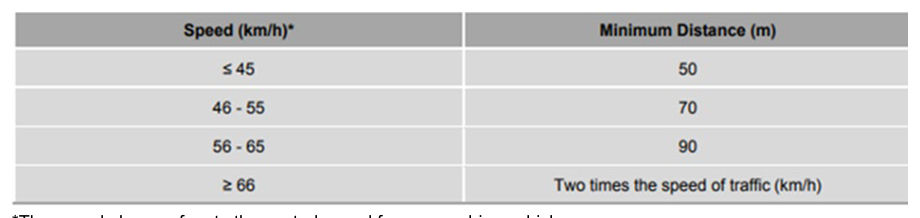
*The speed above refers to the posted speed for approaching vehicles.
5.8.5Sight distance considerations for traffic management designers#
Traffic management designers will give consideration to sign locations and sign distances. Suitable sight distances enable road users enough time to perceive and react to a hazardous situation on the road ahead, resulting in safe and more efficient traffic management.
Sight distances are best when designed to be as long as practicable, but are often restricted by the following:
- curves in road
- crests in road
- obstructions (for example, safety fences, boundary fences, barriers, parked cars, street furniture, landscaping, signs)
- railway crossings
- bridges
- traffic queues
- weather (for example, line marking visibility in the rain, fog, smoke, dust)
- time of day (for example, night visibility, glare)
- sealed or unsealed roads
- type of road users at the site (for example, over-dimensional vehicles, motorcyclists), and
- other local site features.
The minimum sight distance for traffic approaching a PTSS, which is operating under vehicle-actuated, or fixed-time operation (no traffic controller) shall be 150 m as per QGTTM Part 7, Section 2.6.2.