
4.1.1National / International guidance – literature review#
The guidance within this section relating to lane widths may be considered for lanes used by motor vehicles and trucks up to and including semi-trailers only. The guidance within this section relating to shoulder widths and barrier edge clearances should be considered only in situations where the shoulder is not used by cyclists. The information in this section is therefore unlikely to be applicable for situations where:
- Larger heavy vehicles are present within the traffic flow. At sites where B-doubles, road trains and oversize loads are present, additional lane width is generally required to accommodate the tracking path of these vehicles. In these cases, contract specifications currently tend to specify NDD / EDD minimum lane widths for temporary alignments. Narrower widths should only be considered in specific circumstances where the risks can be managed through other means.
- On-road cyclists are present at the site. There is no design exception guidance considered in this technical note for the treatment of on-road cycle facilities. Hence where there are on-road cycle facilities present, or where an existing road shoulder experiences regular cyclist usage, NDD / EDD parameters for cycle facilities should continue to be applied.
In considering potential design exception criteria for lane and shoulder widths for temporary roads documented guidance has been reviewed and considered from Transport and Main Roads (existing guidelines and the adopted Austroads Guide to Road Design), Main Roads WA, USA and UK. Shoulder widths and barrier edge clearances are typically considered separately in the development of design parameters but due to their inter-relationship at road work sites, they are addressed together in this technical note.
4.1.1.1Queensland#
4.1.1.1.1Lane widths#
Lane widths for the design of roads are described in the Transport and Main Roads Road Planning and Design Manual Supplement to Austroads Guide to Road Design Part 3: Geometric Design (RPDM Part 3) and the Austroads Guide to Road Design Part 3 – Geometric Design (AGRD03). The RPDM Part 3 currently does not detail any supplemental guidance for lane widths relevant to the construction of temporary roads for road works. Hence all relevant current guidance for lane widths for temporary roads is typically based on the information with AGRD03.
AGRD03 Section 4.2.4 provides guidance generally for lane widths. This states that a “standard lane widths of 3.5 m allows for large vehicles to pass or overtake, without either vehicle having to move sideways towards the outer edge of the lane.”
It is further stated that “narrower lanes (down to 3.3 m – Austroads 2009b) may be considered where any of the following apply:
- The road reserve or existing development form stringent controls preventing wider lanes.
- The road is in a low speed environment.
- There is little or no truck traffic.
- The alignment and safety records are satisfactory in the case of a reconstructed arterial.”
AGRD03 Section 4.2.5 provides guidance for lane widths on urban roads with Table 4.3 identifying that lane widths as low as 3.0 m may be used “for use on low speed roads with low truck volumes”. RPDM Part 3 describes that “lane widths narrower than 3.3 m should only be used in circumstances described in Table 4.3 of Austroads Guide to Road Design – Part 3”.
The Austroads Guide to Temporary Traffic Management, Part 3 – Static Work Sites (AGTTM03 as adopted by Transport and Main Roads) identifies minimum lane widths applicable to roadworks in Table 2.5 (reproduced below as Table 4.1.1.1.1) but “where lanes on the approach to the work site are less than 3.0 m in width, the approach lane width may be adopted”. The AGTTM03 does not provide any additional guidance for lane widths required for larger vehicles.
| Posted speed limit during roadworks km/h | Minimum lane width (m) |
|---|---|
| 60 or less | 3.0 |
| greater than 60 | 3.5 |
The Austroads Guideline AGRD03 notes that on urban roads, “within the range of practical lane widths (say 2.75 to 3.75 m), lane width itself has only a small effect on crash rates for urban arterial roads.”
4.1.1.1.2Shoulder widths / edge clearances#
Both shoulder widths and edge clearances are applicable in cases where kerbed roads are not applicable.
Typical shoulder widths for application in road design are described in the Transport and Main Roads RPDM Part 3 and Austroads AGRD03. The RPDM Part 3 currently does not detail any variation to shoulder widths relevant to the construction of temporary roads for road works. Hence all relevant current guidance for shoulder widths for temporary roads is typically based on the information with AGRD03.
AGRD03 Section 4.3 provides guidance generally for shoulders and identifies a minimum shoulder width of 0.5 m for the lateral support of the pavement. There is no discussion with regards to shoulders applicable for roadworks and whether the sealed shoulder may be omitted for temporary roads required only for a short duration.
The Transport and Main Roads Guideline for Road Design on Brownfield Sites identifies that default minimum shoulder widths of 0.5 m for roads with low volumes of heavy vehicles and 1.0 m for roads with high volumes of heavy vehicles.
The department's Queensland MUTCD Part 3, QGTTM03 and AGTTM03 detail offsets between the edge of a lane and the nearest traffic management devices as follows:
- 1.Edge of traffic lane to line of traffic cones, bollards or longitudinal channelising devices:
- a.Posted speed limit during roadworks up to 60 km/h – 0.3 m.
- b.Posted speed limit during roadworks above 60 km/h – 0.5 m.
- 2.Edge of traffic lane to roadworks delineators or temporary hazard markers – 1.0 m.
- 3.Edge of traffic lane to road safety barrier system:
- a.Posted speed limit during roadworks 40 km/h or less – 0.3 m.
- b.Posted speed limit during roadworks 50 to 60 km/h – 0.5 m.
- c.Posted speed limit during roadworks 70 to 80 km/h – 0.5 m.
- d.Posted speed limit during roadworks greater than 80 km/h – 1.0 m.
The guidance in the QGTTM allows for narrower offsets than that described in AGTTM03, recognising that the wider offsets encourage traffic speeds higher than the posted limits.
4.1.1.2Western Australia#
4.1.1.2.1Lane Widths#
Guidance for temporary road lane widths in Western Australia states that a reduced cross section width may be appropriate when designing temporary alignments to minimise cost and the earthworks footprint. Lane widths for short term temporary alignments may be reduced but design checks shall be made in reference to pavement widening on horizontal curves where applicable. The geometry must enable the design vehicle to remain lane correct through the entire length of the temporary alignment. Lane widths of 3.2 m are allowed for roads with speeds of 61-80 km/h. As an exception a minimum lane width of 3.3 m is required for B Double/Road Trains for design speed less than 60 km/h.
4.1.1.2.2Shoulder widths / edge clearances#
The Main Roads WA Code of Practice notes that “it has been found to be impractical to follow the clearances given in AS 1742.3 - 2009. This is particularly evident when used in conjunction with the required lane widths in Clause 4.13.3 of AS 1742.3”. Following a site specific risk assessment that supports the reduced clearance, the below widths are permitted:
- 1.Edge of traffic lane to line of traffic cones, bollards or longitudinal channelizing barricades:
- a.traffic speed up to 60 km/h—0.3 m, and
- b.traffic speed above 60 km/h—0.5 m.
- 2.Edge of traffic lane to roadworks delineators or temporary hazard markers:
- a.traffic speed up to 80 km/h – 0.5 m, and
- b.traffic speed above 80 km/h – 1.0 m.
- 3.Edge of traffic lane to road safety barrier system:
- a.traffic speed 40 km/h or less—0.2 m
- b.traffic speed 41 to 60 km/h—0.3 m
- c.traffic speed 61 to 80 km/h—0.5 m, and
- d.traffic speed greater than 80 km/h—1.0 m.
4.1.1.3USA#
4.1.1.3.1Lane Widths#
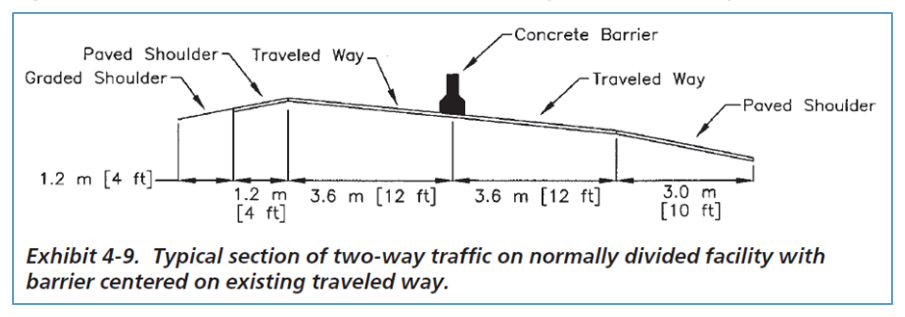
Design guidance in the USA recognises that it is often not reasonable or practicable to apply cross section parameters as they apply to permanent road design [However, it is noted that lane widths recommended for works in the USA typically exceed those applied in Australia]. Typical cross section diagrams show a lane width of 3.3 m for temporary alignments.
4.1.1.3.2Shoulder widths / edge clearances#
Design guidance in the USA does not explicitly provide design guidance for road shoulders or barrier offsets for temporary roads, however, a number of the examples shown in NCHRP 581 detail cross section options with no offset from the traffic and a road safety barrier [However, it should be noted that the associated lane widths recommended for works in the USA exceed those applied in Australia].
4.1.1.4UK#
The UK Traffic Signs Manual – CHAPTER 8, Traffic Safety Measures and Signs for Road Works and Temporary Situations identifies a range of parameters with regards to lane width guidance for temporary roads.
- To provide the required lateral clearance, the running lane width may be reduced according to the expected type of usage. Where heavy vehicles, including public service vehicles, caravans etc. are expected, the lane width may be reduced to 3.25 m (desirable minimum) or 3.0 m (absolute minimum). Where two lanes are required for HGVs the near side lane should be 3.25 m (absolute minimum). [Note that HGVs in UK guidance typically relate to 19 m semi-trailers].
- On single carriageway roads, two-way operation of traffic should be maintained. This normally requires an unobstructed (sealed) width of carriageway of 5.5 m, but with other considerations relating to bus routes, and cyclists. Widths narrower than 5.5 m are not supported for maintaining continuous two-way traffic flow and the requirement is to reduce the width further and implement alternate one-way traffic (shuttle working). The minimum width lane for shuttle working is 3.0 m, but, car-only traffic can be maintained with a minimum of 2.5 m. However, where the traffic is expected to consist only of cars and other light vehicles the lane width may be reduced to 2.75 m (desirable minimum) or 2.5 m (absolute minimum).
- For works on minor roads where traffic speeds are restricted to 30 mph (48 km/h) or less, the width of a single lane may be reduced to an absolute minimum of 2.5 m, for cars and light vehicles.
- Works on dual carriageway roads may require some traffic lanes to be reduced in width to less than 3.0 m. Whenever this situation arises, advance warning of the narrow lanes should be given. In most situations it will be necessary to re-mark the carriageway showing the new lanes. If the lane width is less than 3.0 m the symbol indicating a temporary width restriction, should be included for the appropriate lane or lanes.