4.7Temporary Road Safety Barrier Warrants#
Temporary road safety barriers are regularly used at many sites, particularly those in place for longer periods of time. However, the use of temporary road safety barriers for shorter term works (weeks instead of months) or for sites where the works move progressively along the length of the road such as in pavement reconstruction on rural roads, can lead to issues in both the costs of the construction of the temporary road and on the constructability of the works in constrained sites. Transport and Main Roads project managers identified that the requirements for road safety barriers can be onerous and can result in large cross section widths allowing for offset from the face of the barrier, barrier width and deflection zones.
It has been identified that there is relatively little guidance relating to temporary road safety barriers other than the material currently contained within the Queensland MUTCD Part 3.
4.7.1National / International guidance – literature review#
In considering potential design exception criteria for temporary road safety barriers adjacent to temporary roads documented Transport and Main Roads (existing guidelines and the adopted Austroads Guide to Road Design) guidance for permanent road safety barriers and case examples are presented from projects in Queensland.
4.7.1.1Queensland#
Requirements for temporary road safety barriers within the department's Queensland MUTCD Part 3 typically require barriers for the following situations:
- to provide a physical barrier between the travelled path and the work area, and/or
- between traffic and a severe hazard such as a deep excavation, a bridge pier or a hazardous stockpile, and/or
- for the protection of workers and non-vehicular road users in vulnerable situations, and/or
- to separate opposing traffic.
The Queensland MUTCD Part 3 requirements for the protection of excavations were originally developed by Main Roads WA in 2001 in response to a request for guidance on the matter from industry as water filled and other temporary road safety barrier systems became more commonplace. The guidance was developed as interim guidance only and was intended to be reviewed following a 12-24 month period following application by industry. This research review was not completed due to competing priorities and the guidance was subsequently adopted in AS 1742.3 (2002) and the subsequent Queensland MUTCD Part 3 and has remained unchanged since. This guidance from Table E1 in the Queensland MUTCD Part 3 is reproduced in Table 4.7.2.2.
| Speed of traffic km/h | Traffic volume vpd | Clearance to excavation m | Depth of excavation, mm | ||
|---|---|---|---|---|---|
| < 70 | All | < 2.5 | Standard delineation | Close delineation | Safety barrier |
| 2.5 to 5.0 | Standard delineation | Standard delineation | Close delineation | ||
| > 5.0 | None | None | None | ||
| ≥ 70 | ≤ 1500 | ≤ 5.0 | Standard delineation | Close delineation | Safety barrier |
| > 5.0 | None | None | None | ||
| > 1500 | ≤ 6.0 | Standard delineation | Close delineation | Safety barrier | |
| > 6.0 | None | None | None |
It is noted from this guidance that any excavation of more than 500 mm in depth therefore requires protection with a temporary road safety barrier when the traffic volume and separation requirements dictate.
4.7.1.2Australia – National guidance (AGRD)#
To assist in consideration of options for temporary road safety barrier warrants, the existing guidance for the lateral location of permanent road safety barriers as detailed in AGRD06 should be considered. AGRD06 describes that protection of a 1.0 m high embankment with a road safety barrier introduces more hazards than the unprotected excavation as detailed in Figure 4.7.1.2.
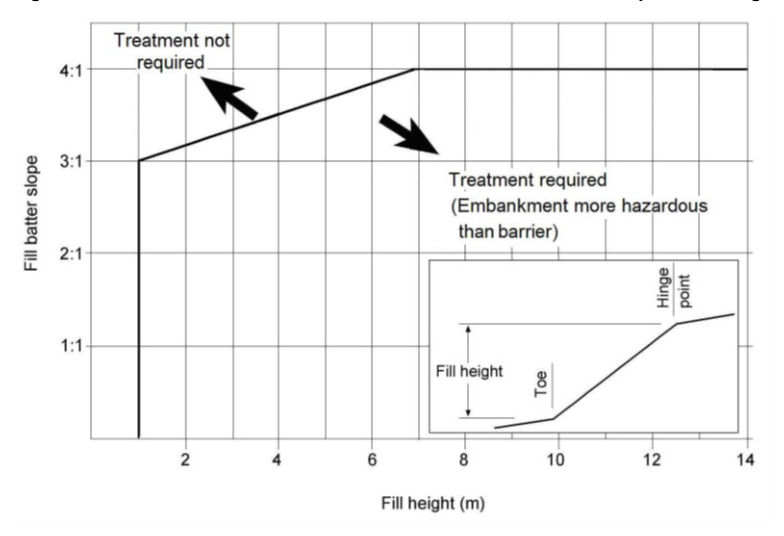
For excavations between 500 mm and 1.0 m in depth therefore, the requirements for road safety barriers for the protection requirements of a temporary alignment appear more onerous than for a permanent situation.
4.7.1.3US#
Roadside safety needs to consider the risks associated with any hazardous features and the benefit cost assessment for each of the proposed treatment options. Factors considered for determining roadside protection include:
- duration of construction activity
- traffic volumes
- nature of hazard
- length and depth of drop-offs
- work zone design speed
- length of hazard
- proximity of traffic to construction workers and equipment, and
- adverse geometrics.
A risk assessment process is recommended for assessment of proposed treatment options which may result in a lower level of protection compared with permanent roadside features.
Barrier offset - A range of design scenarios are also presented for shoulder or lane closure which depicts barriers located at the edge of the 3.6 m wide lane with no offset. It is noted that the AASHTO Roadside Design Guide indicates that the minimum desirable offset from the edge of the travel lane to the temporary concrete barrier is 0.6 m, but that a number of agencies use lower minimum values.
4.7.2Case Examples#
On the Bruce Highway Benaraby to Calliope River, pavement subgrade reconstruction required a section of the existing pavement to be boxed out to a depth of 900 mm for parts of the project. Given the proximity of these works to traffic, and the posted 60 km/h limit, compliance with the MUTCD required temporary road safety barriers for any excavation of more than 500 mm vertical depth within 2.5 metres of the nearest lane of traffic. The cross-section requirements allowing for barrier width and offset from the face of the barrier would have required that traffic be reduced to a single lane with reversible traffic flow for the duration that the excavation was open.
In comparison it was noted that the requirements for a permanent road safety barrier as outlined in AGRD06 identifies that the relative severity of the embankment versus a w-beam barrier and consequently for vertical drops of 1 m or less, the presence of the road safety barrier results in larger overall safety risks compared to the unprotected drop off.
Hence, by applying permanent barrier guidelines, a significant reduction in works cross section was required enabling two way traffic flow to be maintained for the duration of the works. This in turn reduced the risks associated with end-of-queue collisions associated with operating shuttle traffic flow for the duration of the works.
Other project managers also identified issues with the current guidelines as applied in the design of temporary roads. In many cases it was reported that the requirements for the design of the temporary alignment exceeded the standards of the existing road alignment that was being reconstructed. In addition to being onerous to apply this was also reported as resulting in difficulties in achieving speed compliance through the work site.
4.7.3Design Exception opportunities – temporary road safety barriers#
Barriers are often specified at long term sites for the separation of the work site and workers from adjacent traffic. In highly constrained urban environments, it is considered unlikely that these requirements will change.
However, barriers are also required in the MUTCD to protect short term hazards, and most explicitly excavations as outlined in Appendix E of the Queensland MUTCD Part 3. For excavations that may only be open for short duration of time, these requirements can create additional costs for the works, and also increase the cross-sectional width required to maintain traffic and separate the worksite from the nearest lane of traffic.
A design exception in this case therefore involves a design which does not include a temporary road safety barrier in accordance with the Queensland MUTCD Part 3. As has been approved in a past case example, a design exception was developed on the basis that the warrants for barriers next to shallow excavations, less than 1.0 m, appear to be more onerous than the requirements for permanent road design.
On this basis it may be considered that the following design exception may be considered to Table E1 in Appendix E of the Queensland MUTCD Part 3.
It is considered that the requirements for barriers could be modified to align with the requirements for permanent road barriers as detailed in Table 4.7.3.
| Speed of traffic km/h | Traffic volume vpd | Clearance to excavation m | Depth of excavation, mm | |||
|---|---|---|---|---|---|---|
| < 70 | All | < 2.5 | Standard delineation | Close delineation | Close delineation | Safety barrier |
| 2.5 to 5.0 | Standard delineation | Standard delineation | Close delineation | Close delineation | ||
| > 5.0 | None | None | None | None | ||
| ≥ 70 | ≤ 1500 | 5.0 | Standard delineation | Close delineation | Close delineation | Safety barrier |
| > 5.0 | None | None | None | None | ||
| > 1500 | ≤ 6.0 | Standard delineation | Close delineation | Close delineation | Safety barrier | |
| > 6.0 | None | None | None | None |
4.7.4Mitigating measures – temporary road safety barriers#
A design exception may also be considered for situations where either these modified warrants are met or where not using barriers could be suitable on the basis of a risk assessment considering:
- Duration of exposure – an excavation which is only open for a short period of time (eg a few days).
- The length of excavation – a short length excavation may pose less of a risk than the placement of a barrier adjacent to traffic. In particular, excavations which run perpendicular to the direction of traffic (e.g. a trench for services crossing the road reserve) may only have an exposed length of 1.0 m to traffic.
- The depth of excavation and ability to trap or overturn a vehicle.
- The ability to protect the excavation through other means (e.g. road plates).
- Speed limit compliance – to ensure that the majority of traffic is travelling at or below the posted speed limit.
- The angle of approach of traffic – an excavation located opposite right hand bend may be directly in the path of approaching vehicles, while an excavation on the inside of a left hand curve may have relatively little direct exposure.
- Lighting of the alignment – to ensure that drivers can see the trench and any delineation devices.