4.6Site Access – deceleration & acceleration lanes#
A key element regularly reported to lead to difficulties for temporary road alignments relates to the acceleration and deceleration profiles for vehicles entering and exiting a worksite and the typical requirements for extended lanes to comply with permanent road design standards. Extended lengths of acceleration and deceleration lanes can have a significant impact on both the costs of the construction of the temporary road and on the constructability of the works in constrained sites.
A number of past projects have identified the requirements for deceleration and acceleration lanes as a significant issue where there is little impact on the operation of the through lanes. In many cases it was noted that despite reduced speed limits on the through road, speed compliance was generally low and consequently designers were reluctant to consider reductions. The extended lengths required for these acceleration and deceleration lanes consequently result in high costs and additional traffic impacts in comparison with shorter access and egress arrangements.
4.6.1National / International guidance – literature review#
In considering potential design exception criteria for acceleration and deceleration lanes documented guidance has been reviewed and considered from Austroads and from existing case studies.
4.6.1.1Australia – National guidance (AGRD)#
AGRD04A Section 5.2, notes that “it is generally accepted that a design based on the performance of trucks would not be cost-effective and that it is generally acceptable for trucks to commence deceleration in the through lane”.
AGRD04A Sections 5.3 and 5.4 notes that “the speed of heavy vehicles needs to be considered when designing acceleration lanes” and that “it is preferable that the design heavy vehicle has sufficient length to accelerate to a speed no less than 20 km/h below the mean free speed of the through road”. However it is further noted that it can remain difficult in many permanent situation to provide a sufficient length of acceleration lane to allow truck to accelerate to a sufficient speed.
The difficulty in achieving the required lengths for deceleration of vehicles entering the site and vehicles accelerating as they exit the site is a common issue. Parameters for these auxiliary lanes are however well defined.
4.6.1.2US guidance#
Guidance in the USA recognises the difficulties associated with provision of full length acceleration and deceleration lanes and therefore describes that:
- Entrance ramps – recognises that accelerations lanes in work zones can often not practicably meet design criteria for permanent facilities. “Rule of thumb” practices described include use of a minimum 90 m acceleration lane, or alternatively 70% of the length required for a permanent design. Appropriate traffic control devices are required to mitigate the risks associated with speed differential between entering and through traffic.
- Exit ramps – while it is desirable to meet the criteria for permanent exit ramps, deceleration should be determined based on critical design features. Hence some deceleration may be required on the through road prior to exiting.
4.6.2Existing case examples#
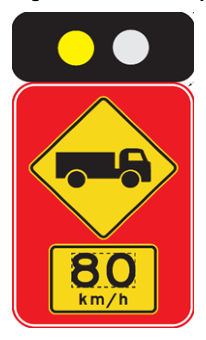
On several projects (Pacific Motorway and Bruce Highway) an acceleration lane and right to left lane merge shorter than that required by the RPDM was approved on the basis of low departing vehicle numbers (only 10 semi-trailer movements per day) and all departing vehicles being unloaded within the site. A VEHSIM analysis for a lightly loaded semi-trailer determined a shorter distance required for these vehicles to accelerate to the required entry speed. Additional mitigation was introduced with the flashing truck warning sign as developed in the supplement to the Queensland MUTCD Part 3.
4.6.3Design opportunities – deceleration and acceleration lanes#
4.6.3.1Deceleration lanes#
Existing Austroads guidance identifies that it is acceptable for decelerating vehicles to begin decelerating while still in the through lane approaching the entry to the deceleration lane.
It is therefore considered that this does not represent a design exception for deceleration lanes into a worksite. However, it represents less than desirable design and the risks associated with site vehicles decelerating prior to entering the deceleration lane include increased potential for crashes:
- Involving vehicles running into the rear of the decelerating site vehicle.
- Involving vehicles side swiping vehicles in the other lane or delineation / barriers on the outside of the lane as drivers manoeuvre to avoid the decelerating site vehicle.
- Should the site vehicle enter the site at a speed too high to stop in sufficient distance within the site.
It is not identified how much it is permissible for site vehicles to slow down prior to entering the deceleration lane but any deceleration lane should aim to be as long as possible to ensure the minimum risks of crashes with through traffic. Other mitigating measures are detailed below.
4.6.3.2Design opportunities – Acceleration lanes#
Existing Austroads guidance identifies that while it is desirable that entering vehicles accelerate to within 20 km/h of the mean free speed, that this is often difficult to achieve for heavy vehicles. Further guidance on acceptable speeds that heavy vehicles achieve is not provided and hence a risk assessment and design exception should be documented for all situations where site vehicles entering the traffic cannot accelerate to the required speed. Where vehicles cannot accelerate to the required speeds, there is an increased potential for crashes:
- Involving vehicles running into the rear of the accelerating site vehicle after it has merged into the through lane.
- In the merge area between the site vehicle and vehicles in the through lane or between the site vehicle and delineation / barriers on the outside of the lane.
Similar to above, it is not identified how much it is permissible for site vehicles to still be accelerating prior to end of the acceleration lane but any lane should aim to be as long as possible to ensure the minimum risks of crashes with through traffic. Other mitigating measures are detailed below.
4.6.4Mitigating measures – deceleration and acceleration lanes#
To consider deceleration or acceleration lanes less than NDD parameters, mitigating measures are required to form part of the assessment for the design exception:
- Speed limit compliance – to ensure that the majority of traffic is travelling at or below the posted speed limit.
- Number of vehicles entering and exiting the site per day – a risk based assessment for sites with only a low number of vehicles may indicate that a full length deceleration and / or acceleration lane is not required.
- Volume of through traffic – will determine the level of interaction between site traffic and through vehicles. At sites where traffic volumes are low and sufficient gaps exist in the traffic stream, the potential for incidents is reduced. It should also be considered if vehicles entering or exiting the site can do so:
- in low flow conditions, or alternatively
- if the through road experiences regular congestion at defined periods of the day, it may be safer for site vehicles to enter the site during these periods of congestion when traffic speeds are lower.
- Ability to time site vehicle movements in traffic gaps introduced by traffic control features. At sites where traffic on the approaches is controlled by traffic signals, either at an intersection or temporary roadworks traffic signals, or by manual traffic control, site traffic can be assisted to enter (decelerate into) and exit (accelerate out of) the site during gaps in the traffic stream.
- Ability to assist site vehicles with shadow and tail vehicles (may include truck mounted attenuators) to reduce the speed of through traffic on approach to the site entry / egress. This may take the form of a rolling blockade or a mobile works convoy.
- The loading profile of vehicles exiting the site. Typically, acceleration lanes designed for truck entry speeds are based on the acceleration profile for fully laden trucks. However, where heavy vehicles are delivering materials to a site, they will then typically be departing with little or no load. In these circumstances, the vehicles typically can accelerate at rates faster than those used in the calculation of acceleration lane lengths. Use of VEHSIM or similar tools can be used to establish more realistic acceleration profiles which may support the proposed design exception.
- The use of active warning signs on the approaches to the site entry and exit that are triggered either automatically or manually as vehicles are accessing the site. Sign TC2063 was previously developed by Transport and Main Roads for this purpose.