4.2Sight Distance#
Sight distance requirements for a temporary road have significant impacts on issues associated with the alignment of the road. Most particularly maintaining sight distance around horizontal curves can lead to substantial carriageway widening or requirements for larger radius horizontal curves. Both of these solutions to maintain sight distance can have a significant impact on both the costs of the construction of the temporary road and on the constructability of the works in constrained sites. The following guidance relating to sight distance may be applicable to temporary road alignments.
4.2.1National / International guidance – literature review#
In considering potential design exception criteria for sight distance for temporary roads documented guidance has been reviewed and considered from Transport and Main Roads (existing guidelines and the adopted Austroads Guide to Road Design) and the USA. Case examples in the application of reduced sight distance are presented from projects in Queensland.
4.2.1.1Queensland#
RPDM Part 3 identifies that exceptions may be considered for sight distance at crest curves so long as the application of manoeuvre capability (manoeuvre width and manoeuvre sight distance) is maintained as opposed to stopping sight distance.
Millar & Lennie (2010) noted that for the Ipswich Motorway project sight distance was determined on the following basis:
- Perception Reaction time (1.5s), could be justified on the temporary roadways as the constrained cross section and the provision of barriers/ anti gawk screens were expected to help keep motorists alert.
- Deceleration Rate – EDD deceleration rates for wet conditions were applied due to project extending across a number of years.
- Horizontal Alignment:
- Sight Distance calculated to an object at a horizontal offset of 0.5 m from the centre of the lane (to allow a driver to see one of the taillights on a car)
Vertical Alignment:
- In areas that are lit, car stopping in the wet (d = 0.46) was permitted to a 1.25 m object (which is representative of seeing to the top of a stopped car). No manoeuvre width provided for evasive action around smaller objects, and
- For unlit areas, car stopping in the wet (d = 0.46) was permitted to a 0.8 m object height (which is representative of seeing to the illuminated taillights of a stopped car). No manoeuvre width provided for evasive action around smaller objects.
4.2.1.2Australia – National guidance (AGRD)#
Stopping sight distance is the parameter considered most critical within a temporary road alignment.
The key parameters in the determination of stopping sight distance include:
- Object height (refer AGRD03 Table 5.1):
- 0.2 m Normal stopping sight distance for cars and trucks to hazard on roadway.
- 0.8 m Stopping sight distance to hazards over roadside safety barriers in constrained locations.
- 1.25 m Stopping sight distance to hazards over roadside safety barriers on a horizontally curved bridge with road lighting.
- Driver reaction time (refer AGRD03 Table 5.2):
- 2.0 to 2.5s is used in most circumstances.
- 1.5s Absolute minimum value. Only used in very constrained situations where drivers will be alert.
- Longitudinal deceleration ((refer AGRD03 Table 5.3):
- 0.26 Comfortable deceleration on sealed roads for cars.
- 0.29 Maximum value for calculating truck stopping sight distance for most urban and rural road types.
- 0.36 Desirable value for calculating minimum stopping sight distance for cars for most urban and rural road types.
- 0.46 Maximum value for calculating absolute minimum stopping sight distance for cars. Only to be used in constrained locations.
- 0.61 Specific applications where the normal stopping sight distance criteria for cars applied to horizontal curves produce excessive lateral offsets to roadside barriers/structures.
As identified in Section 4.2.2 of this technical note, existing temporary road alignments have been approved as a design exceptions on the basis of stopping sight distance based on a reaction time of 1.5s, an object height of 0.8 m and longitudinal deceleration factor of 0.46.
4.2.1.3USA#
Sight Distance - For work zone design speeds less than 60 km/h, the stopping sight distance values tabulated in the Green Book and corresponding to work zone design speed are recommended. For work zone design speeds of 60 km/h and greater, the Green Book design speed-corresponding values do not necessarily represent the minimums that can be accepted, and a minimum sight distance of 90 m [300 ft] is recommended using a driver eye height of 1,080 mm and an object height of 600 mm.
4.2.2Case Examples#
Pacific Motorway upgrade - The horizontal alignment of the temporary road and the presence of temporary road safety barriers immediately (0.5 m) adjacent to the edge of lane resulted in stopping sight distance, in accordance with the RPDM, not being achieved to an object 0.2 m high. The reduced sight distance was accepted as a design exception on the basis of mitigating factors which included lighting of the site, regularly monitoring and patrol of the site by contractor staff. A design exception was developed with sight distance provided to a 0.8 m high object (vehicle tail light). To support the design exception, surveys which demonstrated a high levels of speed compliance. The stopping sight distance was calculated on the basis of a driver reaction time of 1.5s, and a deceleration coefficient of 0.46 in accordance with AGRD Table 5.3. Additional manoeuvring width was not provided.
4.2.3Design Exception opportunities – sight distance#
The evidence provided in the previous sections, suggest the following design exception opportunities may be potentially available for consideration for sight distance.
In each of these scenarios a risk assessment will need to consider the higher potential for potential rear end crashes, crashes with objects on the road, and side swipe crashes with vehicles in adjacent lanes or nuisance impacts with temporary road safety barriers adjacent to the lane as drivers manoeuvre to avoid an object in lane. The risk assessment would need to consider a range of parameters including:
- speed limit compliance
- road alignment, horizontal and vertical
- length of reduced sight distance
- duration of the works, and
- percentage of heavy vehicles.
The three key parameters relating to stopping sight distance that have previously been the focus of approved design exceptions are object height, reaction time and coefficient of deceleration. Based on AGRD03 Table 5.5, the minimum Stopping Sight Distance reduction can be achieved as shown in Table 4.2.3.
4.2.3Table 4.2.3 – NDD and absolute minimum sight distance requirements#
| Roadworks Posted Speed km/h | Design Speed km/h | NDD Stopping SD D=0.36 RT = 2.0 (m) | Minimum Stopping SD D=0.46 RT = 1.5 (m) |
|---|---|---|---|
| 40 | 50 | 55 | 42 |
| 60 | 70 | 92 | 71 |
| 80 | 90 | 139 | 107 |
Application of these sight distance requirements would typically be considered an EDD design. Applying these minima together with using an object height of 0.8 m / 1.25 m would therefore represent a design exception if manoeuvre capability is not provided. Additional consideration of the risks associated with this combination of minima would be required.
In these circumstances, the use of object height greater than 0.2 m would typically require the provision of manoeuvring sight distance and additional carriageway width to allow a driver to manoeuvre around an object on the road. However, in most temporary road situations, the site constraints will typically not permit this to be provided.
Hence a design exception applying absolute minimum sight distance and an object height of 0.8 m or 1.25 m would therefore need to consider the additional risks associated combination. These risks typically will relate to increased probability of a vehicle either colliding with the object / vehicle in the lane, colliding with a vehicle in the adjacent lane as they manoeuvre to avoid the object, or colliding with a temporary road safety barrier or roadside delineation as they manoeuvre to avoid the object.
It is particularly noted that use of an object height greater than 0.2 m in combination with EDD parameters requires full evaluation and justification from the designer to ensure that unacceptable safety risks do not arise. It should also be noted that these sight distance design exceptions would not be suitable on the approach to the worksite or within the queuing zones within the project as many historic crashes occur at these locations. The application of these sight distance design exceptions should only apply once the temporary road alignment within the site has been established and a high level of speed compliance has been achieved.
4.2.4Mitigating measures – sight distance#
The design exception would require consideration of the following elements and potential mitigating factors:
- Speed limit compliance – to ensure that the majority of traffic is travelling at or below the posted speed limit.
- Lighting of the alignment – to ensure that drivers can see objects ahead as opposed to relying on headlight sight distance (typically low beam).
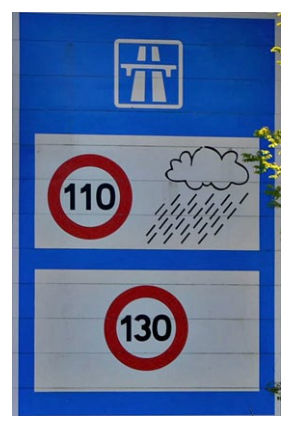
- Wet weather conditions – Stopping sight distance for dry pavement conditions (d=0.61) reduces to 37 m, 61 m and 90 m respectively for Design speeds of 50, 70 and 90 km/h. Some jurisdictions sign speed limits to be dependent of weather conditions (Figure 8) with permanent and variable speed limit signs displaying wet weather speed limits. Consider the use of variable speed limit signs with rain / wet road surface sensors to apply reduced speed limits in wet weather conditions.
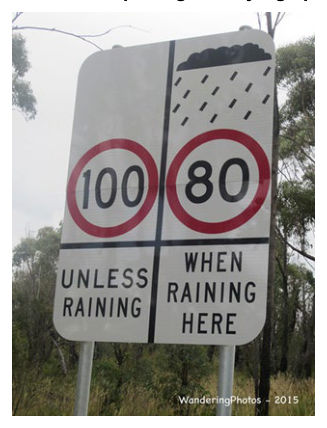
a) Victoria – Australia · b) France
- Crash records and near incidents – should be assessed regularly to establish if a lower speed limit needs to be implemented on a permanent basis with additional design measures introduced to address vehicle speeds should crash records be unacceptable.
- Ongoing monitoring, vehicle breakdown and debris removal – to ensure that any debris greater than 0.2 m height is identified and removed promptly including towing facilities to remove disabled vehicles. This requirement would need to be agreed to and committed to within the project contract.
- Variable message signs to alert drivers to the presence of hazards ahead when they are identified.
- High skid resistance pavement to reduce stopping distances for braking vehicles in wet conditions.
- Changes in alignment, high visibility visual cues and delineation close to the alignment should all be considered to increase the awareness of drivers to the site and to assist in accepting reductions in driver reaction time.
- Removal of anti-gawk screens on the insides of curves with reduced sight distance to improve visibility to rear of vehicles ahead over the top of the temporary road safety barrier.