4.1.3Design Exception opportunities – cross section#
4.1.3.1Lane Widths#
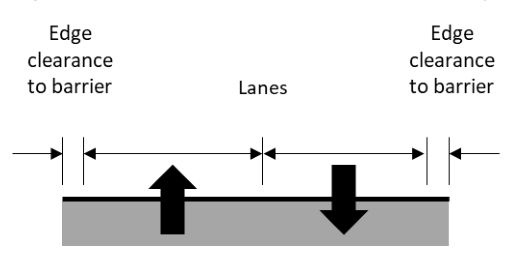
The practices described in the UK guidance, and depicted in the example in Germany demonstrate that lane widths as narrow as 2.5 m can be maintained where the lane is not used by heavy vehicles and is limited to cars and motorcycles. There may therefore be the opportunity on projects in Queensland, for lane widths as narrow as 2.5 m be considered for temporary road alignments in specific circumstances. Importantly, all the international examples with narrow lane widths preclude the use of these lanes for heavy vehicles. For road projects with significant portion of heavy vehicles, at least one lane in each direction should be maintained with a width sufficient to accommodate those vehicles. In addition, a range of mitigating factors will be required to support the use of narrow lanes to ensure their use is restricted to cars and motorcycles only. A particularly critical mitigating factor in consideration of narrow lane widths is achieving speed limit compliance at the site. While the narrow lanes themselves potentially assist in reinforcing the posted speed limits, measures are required to ensure that vehicles are travelling at suitable speeds prior to entering any section with narrow lanes. It is noted again that in the examples provided above, no allowance has been made for on-road cycle facilities. Where cyclists are present on the road, the further restrictions in lane width are not supported unless a suitable alternative facility for cyclists using the road can be provided. Lane widths should only be considered in conjunction with shoulder widths as described in the following section. A summary of potential lane width design exceptions are therefore presented at the completion of the following section considering shoulder widths.
4.1.3.2Shoulder widths / edge clearances#
Existing permanent road design practices appear to support barriers at an edge clearance of 0.2 m or less in constrained locations such as bridges, tunnels and near piers for overhead structures. Further examples on German Autobahns also appears to support barrier edge clearances of 0.2 m or less for temporary alignments in conjunction with narrow lanes being used by cars and motorcycles only. There may therefore be the opportunity on projects in Queensland, for shoulder widths / barrier offsets as narrow as 0.2 m be considered for temporary road alignments in specific circumstances. For road projects with significant portion of heavy vehicles, narrow shoulder widths / barrier offsets should not be used together with narrow lanes to avoid repeated nuisance impacts on the barrier. A particularly critical mitigating factor in consideration of narrow shoulder widths / barrier offsets again is achieving speed limit compliance at the site. While the narrow shoulder widths / barrier offsets themselves potentially assist in reinforcing the posted speed limits, measures are required to ensure that vehicles are travelling at suitable speeds prior to entering any narrow section. It is noted again that in the examples provided above, no allowance has been made for on-road cycle facilities. Where cyclists are present on the road, the further restrictions in shoulder widths / barrier offsets are not supported unless a suitable alternative facility for cyclists using the road can be provided.
Shoulder widths / barrier offsets should only be considered in conjunction with lane widths as described previously. A summary of potential shoulder widths / barrier offsets design exceptions are therefore presented in the following sections. The evidence provided in the previous sections, suggest the following design exception opportunities may be potentially available for consideration for road cross section. In each of these scenarios a risk assessment will need to consider the higher potential for side swipe type crashes and for nuisance impacts with temporary road safety barriers adjacent to the lane. The risk assessment would need to consider a range of parameters including:
- road alignment, horizontal and vertical
- length of narrow section
- duration of the works, and
- percentage of heavy vehicles.