
4.8Turn treatment warrants for unsignalised intersections with short periods of higher traffic volumes#
Intersections in regional areas across Queensland are at times subject to a limited period of heavier traffic due to construction or mining activities. During these periods the traffic volumes may be substantially higher than the base traffic conditions. However, in many cases it is not considered appropriate to upgrade the intersection just for the short period of high use.
Sullivan & Arndt (2014) used a balanced design life assessment of the Crash Reduction potential of the upgraded intersection treatment, to develop a set of warrants for a shorter period of high turn volumes. The resultant warrants for these situations are presented in Figures 4.8(a) to 4.8(c) and describe the boundary between a BAR/BAL and a CHR(s)/AUL(s) intersection type.
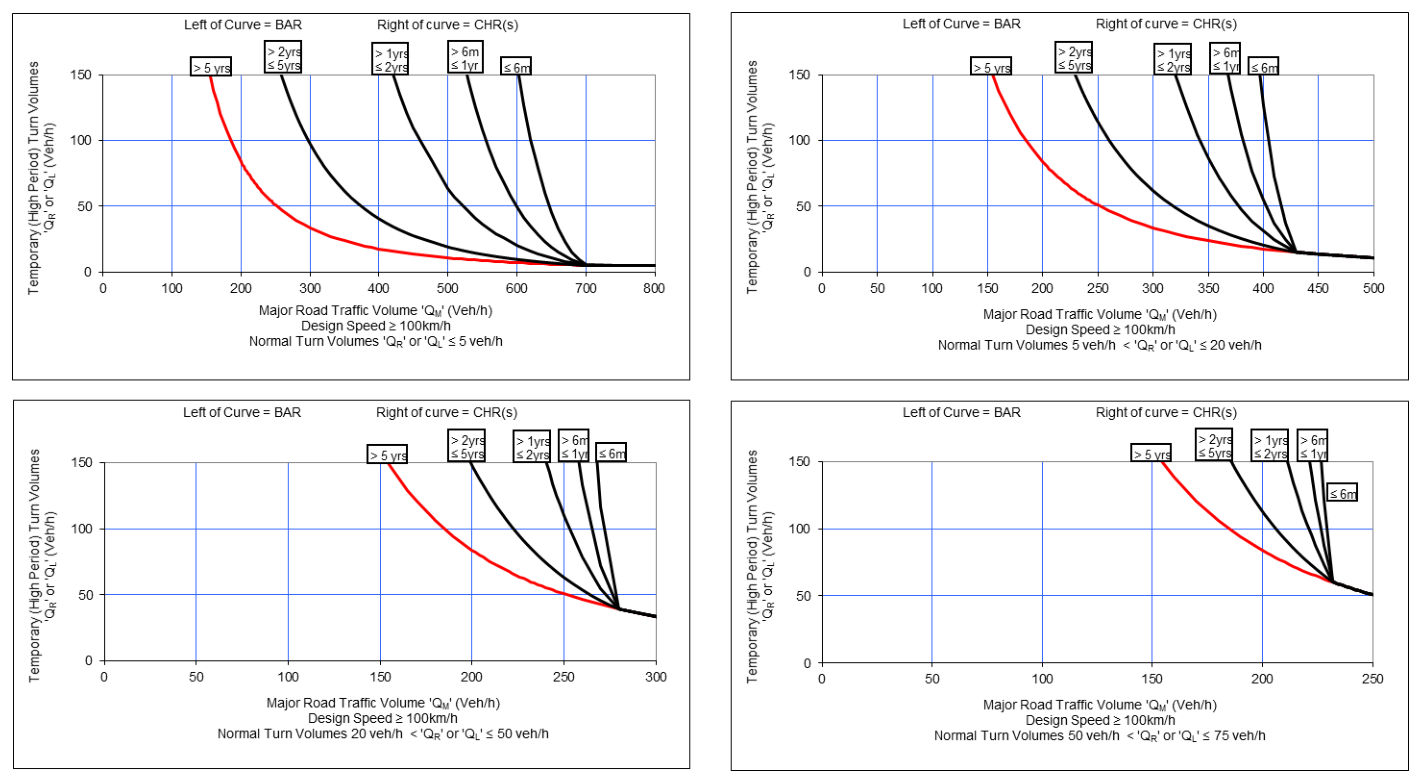
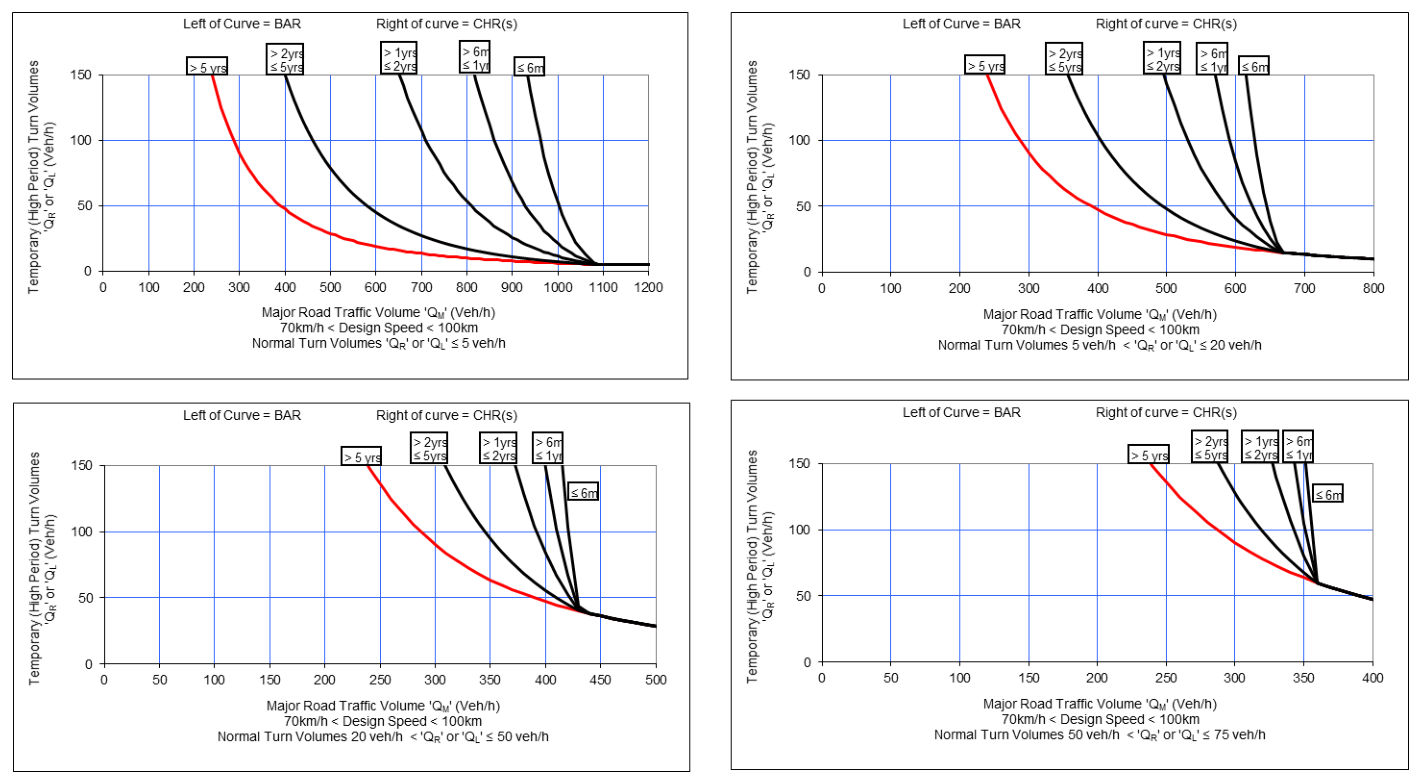
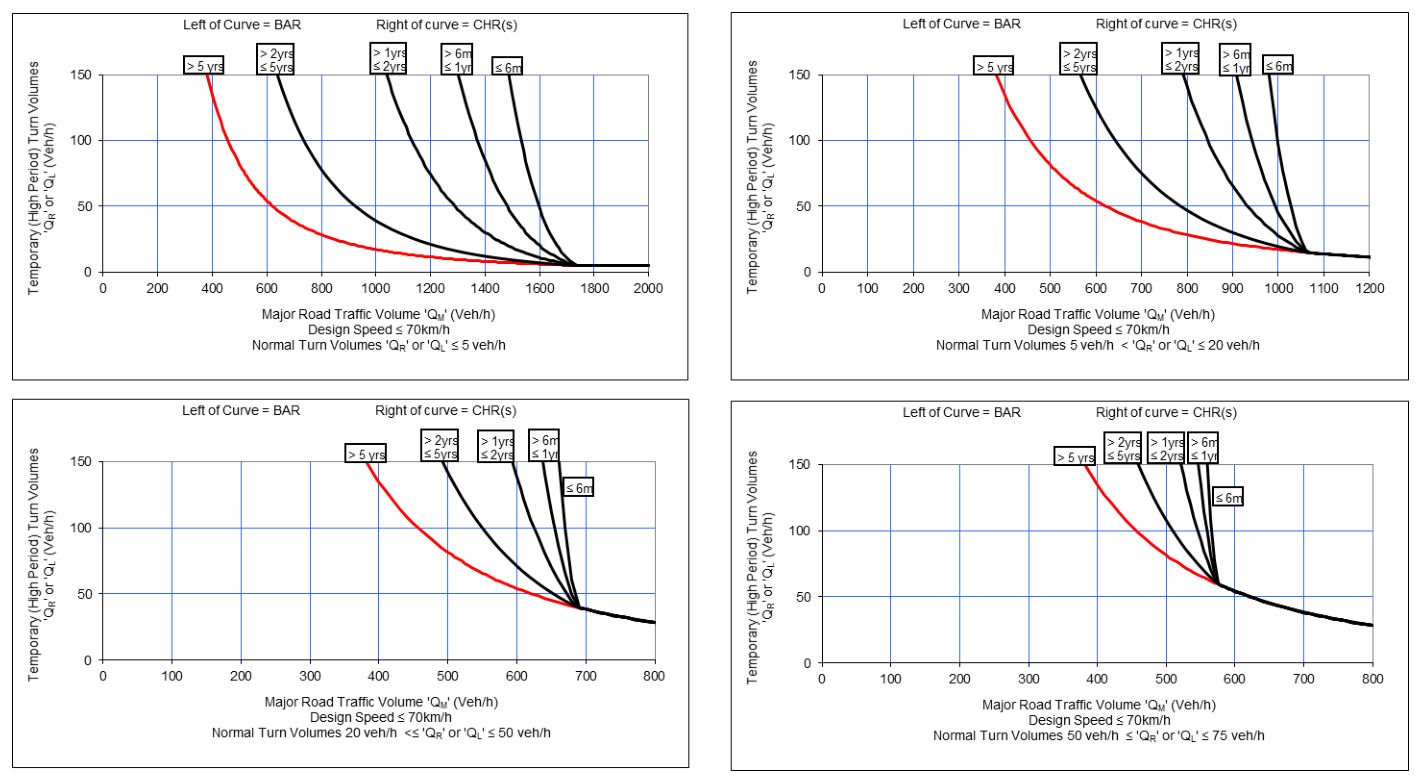
The following notes apply to Figures 4.8(a) to 4.8(c):
- 1.The warrants apply to 2-lane, 2-way roads only.
- 2.The warrants apply to turning movements from the major road only (the road with priority). For turns from the minor road, turn treatments are determined through an operational performance evaluation applying gap acceptance analysis and an evaluation of acceptable delays and queues.
- 3.Figure 4.8(d) is to be used to calculate the value of the major road traffic volume parameter (QM) and is the total through traffic flow in both directions (QT1 + QT2).
- 4.Traffic flows applicable to the warrants are peak hour flows, with each vehicle counted as one unit (i.e. do not use equivalent passenger car units [pcus]). Where peak hour volumes or peak hour percentages are not available, assume that the design peak hour volume equals.
- 5.Transport and Main Roads – 15% of the AADT for 500 hours each year, use 5% of the AADT for the rest of the year.
- 6.Austroads – 8% to 10% of the AADT for urban situations and 11% to 16% of AADT for rural situations.
- 7.If a turn is associated with other geometric minima, consideration should be given to the adoption of a turn treatment of a higher order than that indicated by the warrants.
- 8.Consideration must also be given to the operational performance of the intersection which may require a higher-level turn treatment, or alternative intersection control, particularly for higher traffic volumes.
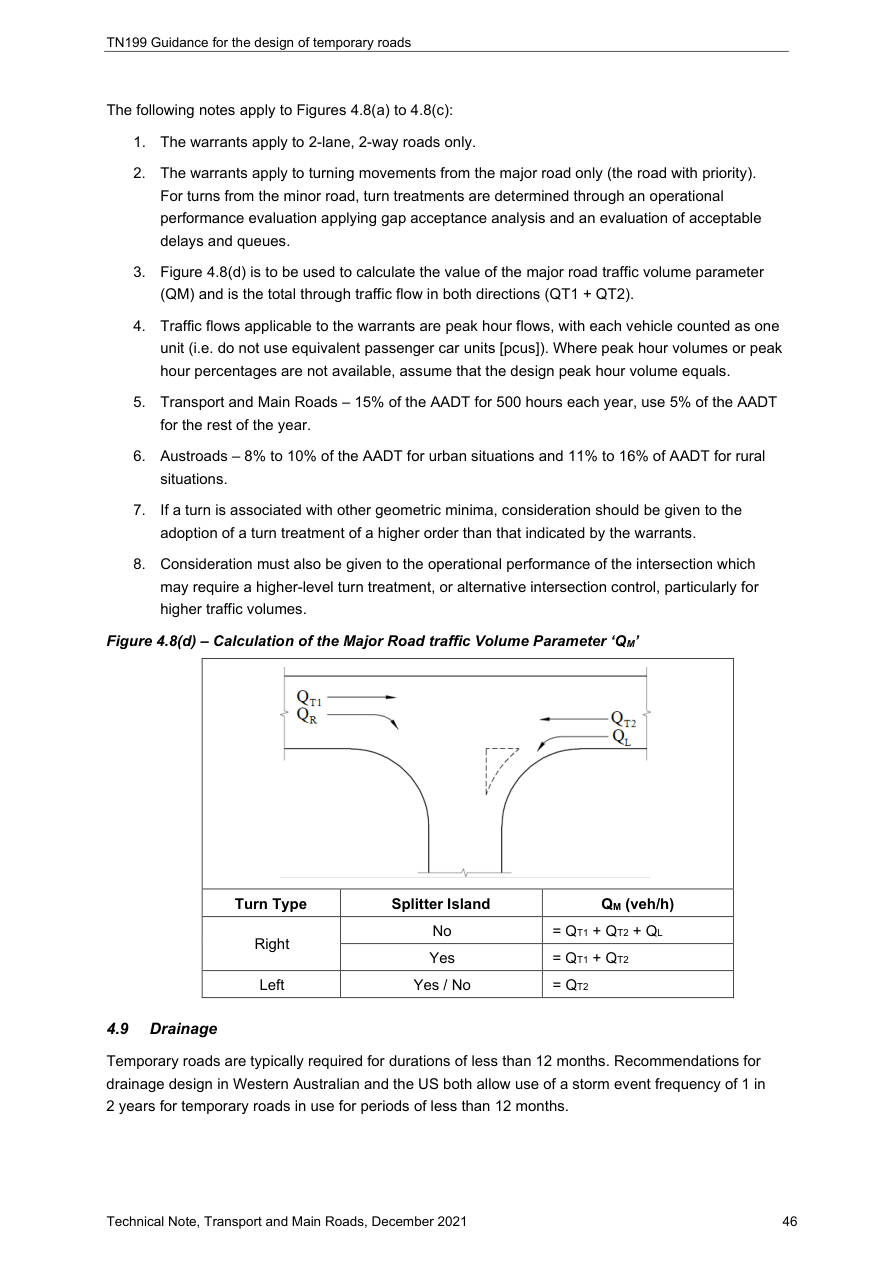
| Turn Type | Splitter Island | QM (veh/h) |
|---|---|---|
| Right | No | = QT1 + QT2 + QL |
| Yes | = QT1 + QT2 | |
| Left | Yes / No | = QT2 |