Appendix EDesign of sight boards and other signs at T-intersections#
E1Background#
Appendix E provides design and installation details for sight boards and other signs at T-intersections, parallel to the continuous carriageway. The MUTCD Part 2 Section 2.11 specifies the requirements and sets out the way sight boards and hazard markers are installed at intersections. In many cases, intersection direction signs are installed above the sight board and generally provide sufficient delineation of the T-intersection without the need for a supplementary sight board.
E2Risk characteristic#
Sight boards and other signs installed parallel to the roadway that include sign stiffeners present a spearing risk to vehicles that impact them end on. Sign spearing occurs when a vehicle impacts the post and the weak connection of the post to the rail fails and leaves the rail cantilevered from the trailing posts at windscreen height.
E3Sign design for sight boards and other signs to prevent sign spearing#
Standard Drawing SD1452 was developed and tested to mitigate the risk of sign spearing. The design concept is that the sign end must be prevented from impacting the windscreen. This is achieved by strengthening of the post connections to ensure the sign is pulled down with the post to prevent the spearing effect.
The new design incorporates:
- heavy duty clamps bolted through the stiffener rails and sign face (refer to Standard Drawing SD1452 Sheets 2 and 3)
- splice plate connection bolted through the stiffener rail and sign face (refer to Standard Drawing SD1452 Sheets 2 and 3)
- a maximum cantilever distance from the end post centreline to the end of the sign is 500 mm (refer to Standard Drawing SD1452 Sheet 2)
- the use of Type 1 stiffener rails only.
Sight boards shall comprise two x D4-1-1-Q03 hazard markers with Type 1 stiffener rails only. Other signs installed parallel to the roadway shall only use Type 1 stiffener rails and heavy-duty clamps if installed within the windscreen envelope (1.5–1.9 m height). Where intersection direction signs are outside the windscreen envelope, heavy duty clamps may not be required.
E4Guidelines to the installation of new sightboards#
E4.1Provision to install a sign board#
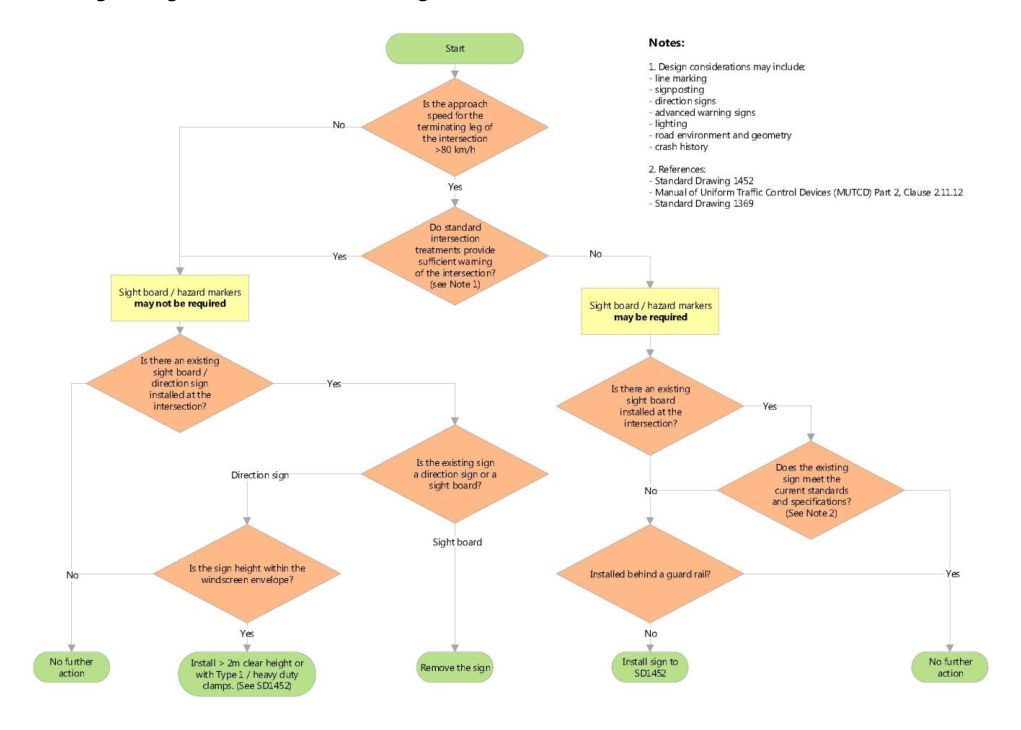
To remove the risk of sign spearing, consideration should be given if a sightboard is required under MUTCD Part 2 Section 2.11.2 (see following). Sight boards comprising two Unidirectional Hazard markers (D4-1-1) end-to-end may be erected to face the stem of a T-intersection where approach speeds are high on the terminating leg of the intersection, and where standard intersection signposting would not provide sufficient warning of the intersection. Sizes may be varied if necessary to suit visibility requirements. The Bi-directional Hazard marker (D4-2-3) (see Section 4.6.7.2(b)) may be more appropriate where a sight board is required at a low-speed approach.
E4.2Treatment type selection#
The following flow chart details the design process for firstly determining whether a sight board is required and then, if so, determining what treatment type to use.