
13Supply of road sign faces#
13.1General#
Clause 13 describes the work to be carried out for the supply of regulatory, warning, direction and information sign faces under the Contract. For the purposes of this Technical Specification, the term 'sign face' shall include the sheet metal substrate, attached stiffeners and colour and/or reflective sheetings and/or coatings but not support frames or posts.
13.2Sign face layout#
All legend elements, including letters, numerals, symbols, colours and borders in all sign faces shall conform to the MUTCD and the Drawings. Dimensional tolerances shall conform to the requirements detailed in AS 1743. Legends and lettering shall conform to AS 1744.
13.3Material requirements#
13.3.1Sign substrate#
13.3.1.1General#
The sign substrate shall be manufactured from aluminium except that regulatory parking signs (see Clause 13.3.1.6) may be manufactured from zinc / aluminium coated steel and temporary signs (see Clause 13.3.1.7) may be manufactured from zinc / aluminium coated steel, colorbond steel, corflute, or flexible material.
Other materials may be considered but evidence of the full approval of the department will be provided to the Administrator prior to their use. Hold Point 3 The sign substrate shall be free of cracks, tears and other surface blemishes and the edges shall be true and smooth. Tolerances on the overall dimensions of the sign substrate for signs other than guide signs and signs that are individually designed shall be ± 3 mm or 0.25% of the largest dimension, whichever is the greater. For guide signs and other signs that are individually designed refer to Clause 13.4.1. The maximum allowable warp, twist or other departure from flatness of the sign substrate shall be 2.5 mm/m in any direction.
13.3.1.2Aluminium sheet#
Aluminium sheet sign substrate shall be fabricated from 1.6 mm thick aluminium alloy sheeting, alloy type 5251, temper H38, or similar in accordance with the requirements of AS/NZS 1734 and stiffened where required in accordance with Clause 13.3.2.
13.3.1.3Aluminium blade section#
Fingerboards, geographical feature and street name signs which use the 200 mm aluminium blade section shall be fabricated from alloy type 6063, temper T5, or similar. Signs which require single-sided section either 200 mm or 300 mm deep may be constructed from aluminium plank boards.
13.3.1.4Aluminium plank boards#
Aluminium plank boards (200 mm and 300 mm deep sections) shall be manufactured from an extruded aluminium section, alloy type 6060, temper T5 or similar.
13.3.1.5Flood depth indicators#
Flood depth indicators shall be manufactured from an extruded aluminium rectangular hollow section, nominal size 200 mm x 38 mm x 3 mm, alloy type 6063, temper T5 or similar.
13.3.1.6Regulatory parking signs#
Regulatory parking signs may be fabricated from 1.2 mm thick zinc/aluminium coated steel complying with the requirements of AS 1397 and stiffened in accordance with Clause 13.3.2.
13.3.1.7Temporary signs#
Signs classified as temporary signs in the MUTCD may be manufactured from 1.0 mm thick hot-dipped zinc coated, aluminium / zinc coated or colour bonded steel complying with the requirements of AS 1397. Temporary signs used at roadworks may be manufactured using 6 mm corflute that has been UV treated for external use. Where specifically documented as part of the sign design (in the Queensland MUTCD, TC sign or MUTCD Q series sign design file), temporary signs used at roadworks may be manufactured using flexible material (printed onto or sheeting attached to a flexible substate). Where flexible material is used as the sign substrate, the sign must perform and function to the equivalent of a non-flexible (metal or corflute substate) sign. The sign size, colour, retroreflectivity and design must match the non-flexible sign. The design of the flexible sign must include provisions to ensure it is easily and effectively mounted and hangs such that the flexibility of the sign does not distort the message or move in the wind.
13.3.2Stiffener rails#
Stiffener rails shall be manufactured from an extruded aluminium section, alloy type 6061 or 6063, temper T6 to the dimensions shown on Standard Drawing 1369. The section properties of stiffener rails shall be equal to or greater than those stated on Standard Drawing 1369. The section type shall be as shown on the drawings.
13.3.3Coatings#
13.3.3.1General#
The class of sign material for the legend and the background shall comply with the minimum standards stated in Clause 13.3.3.2 of this Technical Specification. All signs of a similar type shall be manufactured from the same materials and the finish coating density shall be consistent.
13.3.3.2Retroreflective sheeting#
13.3.3.2.1Requirements#
Retroreflective sheetings shall comply with AS/NZS 1906.1 and be either Class 1100, Class 400 or Class 400T. Product categories shall only be used as specified in Table 13.3.3.2.1 following.
| Sign Type | Sign Number | Class of Sign Face Materials | |
|---|---|---|---|
| Legend | Background | ||
| Regulatory Signs STOP GIVE WAY Roundabout Pedestrian Crossing All other Regulatory Signs | (R1-1) (R1-2) (R1-3) (R3-1) | Class 400 Black non reflective Black non reflective Black non reflective Class 400 | Screened Class 400 Class 400 Class 400 (fluorescent yellow-green) Class 400 |
| Warning Signs All Warning Signs | Class 400 | Class 400 | |
| Roadworks | Black non reflective | Class 400 | |
| Special Purpose Signs | Black non reflective | Class 400 | |
| Hazard Markers | Black non reflective | Class 400 | |
| Flood Gauge Markers | Black non reflective | Class 400 | |
| Guide Signs | |||
| Advance, Intersection, Reassurance Direction Signs and Advance Lane Signs | Class 400 | Class 400 | |
| Tourist and Service Signs | Class 400 | Class 400 | |
| Geographical Feature and Street Name Signs | N/A | Class 400 | |
| Freeway Signs (white on standard green background; black on white background; white on blue background; black on yellow background; white on red background) | |||
| General application Overhead and gantry application Traffic Instruction Signs | Class 400 Class 1100 Class 400 | Class 400 Class 1100 Class 400 |
Table in words
- For Regulatory Signs STOP GIVE WAY Roundabout Pedestrian Crossing All other Regulatory Signs, the sign number is (R1-1) (R1-2) (R1-3) (R3-1), the class of sign face materials for legend is Class 400 Black non reflective Black non reflective Black non reflective Class 400, and the class of sign face materials for background is Screened Class 400 Class 400 Class 400 (fluorescent yellow-green) Class 400.
- For Warning Signs All Warning Signs, the class of sign face materials for legend is Class 400 and the class of sign face materials for background is Class 400.
- For Roadworks, the class of sign face materials for legend is Black non reflective and the class of sign face materials for background is Class 400.
- For Special Purpose Signs, the class of sign face materials for legend is Black non reflective and the class of sign face materials for background is Class 400.
- For Hazard Markers, the class of sign face materials for legend is Black non reflective and the class of sign face materials for background is Class 400.
- For Flood Gauge Markers, the class of sign face materials for legend is Black non reflective and the class of sign face materials for background is Class 400.
- For Advance, Intersection, Reassurance Direction Signs and Advance Lane Signs, the class of sign face materials for legend is Class 400 and the class of sign face materials for background is Class 400.
- For Tourist and Service Signs, the class of sign face materials for legend is Class 400 and the class of sign face materials for background is Class 400.
- For Geographical Feature and Street Name Signs, the class of sign face materials for legend is N/A and the class of sign face materials for background is Class 400.
- For General application Overhead and gantry application Traffic Instruction Signs, the class of sign face materials for legend is Class 400 Class 1100 Class 400 and the class of sign face materials for background is Class 400 Class 1100 Class 400.
The sheeting surface shall be compatible with transparent and opaque screening inks and show no loss of the colour coat with normal handling, cutting and application. The class and manufacturer of retroreflective sheeting shall be able to be determined by inspection using unaided sight.
A certificate, issued by the manufacturer of the retroreflective sheeting and endorsed by the sign face fabricator, stating that the retroreflective material complies in all respects with the requirements of AS/NZS 1906.1 (including the service life requirements) shall be included in the quality records.
13.3.3.2.2Rotational sensitivity#
Sheeting shall be tested for rotational sensitivity as per AS/NZS 1906.1.
13.3.3.2.3Durability tests#
The test procedures for durability assessment are set out in AS/NZS 1906.1. Outdoor accelerated weathering testing shall be located at a site near the coast of North Queensland within 40 km of latitude 19°30’S and longitude 146°50’E or a location that has similar atmospheric conditions.
13.3.3.3Non-reflective coatings#
13.3.3.3.1Non-reflective sheeting#
Non-reflective material used for figures, letters, symbols and borders shall be of uniform density and compatible with the background material, both in application and durability, and shall be compatible with both the sign substrate material onto which it is applied and with any retroreflective sheeting applied over the top of the material.
13.3.3.3.2Paint#
All paints used on signs shall be of premium quality from a reputable manufacturer. Paints shall be approved by the manufacturer for the relevant application and exposure conditions.
Pre-primed and pre-painted material, such as colour bonded steel or aluminium, yellow in colour as specified in AS 1743, shall be used for temporary signs. Alternatively, temporary signs shall receive at least one coat of yellow full gloss enamel paint applied in accordance with the paint manufacturer’s recommendations.
13.3.3.3.3Screening inks and electro-cut films#
Screening inks and electro-cut films shall be of an approved brand and shall be compatible with the substrate surface and the retroreflective sheeting, non-reflective sheeting or paint, whichever has been used. The screening ink or electro-cut film shall be applied using materials and techniques recommended by the sheeting manufacturer, where appropriate.
13.3.3.4Security branding#
As an optional security measure, a transparent screen-printed brand (customer logo or lettering) that has minimum impact on the retroreflective performance of the sign may be added (typically 1.4% black ink and 98.6% toner). It shall not exceed 75 mm square and have a minimum spacing of 350 mm.
Other security branding methods such as laser cutting of the aluminium substrate are also permitted, provided sign integrity is maintained. Laser cutting of the substrate shall not exceed 75 mm square, and shall be limited to a single location adjacent the sign edge.
13.3.3.5Sign face material properties#
The sign face or sheeting shall remain in good condition except for accidental damage or vandalism for the period specified in Clause 13.4.12.2, or if not stated there refer to AS/NZS 1906.1:
- a) no evidence of cracking; crazing; peeling; lifting from the substrate; delamination blistering; chalking; wrinkling; bubbling; or edge shrinkage greater than 2 mm
- b) no evidence of colour change or fading when compared to the supplied manufacturer’s samples or new materials within the period compatible with the class or type of material
- c) the sign is effective for its intended purpose when viewed from a moving vehicle under normal day or night driving conditions by a driver with normal vision.
13.4Fabrication#
13.4.1General#
Sign faces shall be fabricated in accordance with the requirements of Traffic and Road Use Management Manual (TRUM) Volume 3, Part 5: Design Guide for Roadside Signs.
Signs shall be constructed to the size specified in the Contract.
For guide signs and other signs that are individually designed, the tolerance on dimensions shall be:
- a) ± 50 mm for signs less than 2.44 square metres in area
- b) ± 100 mm for signs larger than 2.44 square metres in area.
13.4.2Message, shape, size, layout, colours#
The sign message (including spelling), shape, size, layout and colours shall be as indicated by the Drawings in conjunction with the latest issue of the MUTCD.
13.4.3Substrate preparation#
13.4.3.1General#
After completion of the substrate sheet metal works and before the application of retroreflective sheeting, non-reflective sheeting or paint, the sign panel shall undergo one of the pre-treatments detailed in Clauses 13.4.3.2 and 13.4.3.3.
13.4.3.2Aluminium panels#
The aluminium panel shall be thoroughly cleaned and degreased and shall be mechanically abraded in accordance with the sheeting manufacturer’s recommendations. Chemical treatment shall not be used.
13.4.3.3Zinc / Aluminium coated steel panels#
The zinc / aluminium coated steel panel shall be thoroughly cleaned and degreased and shall be primed with an approved primer in accordance with the paint manufacturer’s recommendations. Alternatively, if the zinc / aluminium steel sheeting material has been shop primed by the sheeting manufacturer, the panel shall be thoroughly cleaned and degreased.
13.4.3.4Corflute panels#
The corflute panel shall be prepared in accordance with the sheeting manufacturer’s recommendations.
13.4.4Sheeting application#
Retroreflective and non-reflective sheeting shall be applied to the face of the sign panel in a manner specified by the sheeting manufacturer. All letters, arrows, symbols and borders shall be applied by:
- a) a silk screening process
- b) pre-cut retroreflective or non-reflective material
- c) electro-cut translucent film, or
- d) digital printing.
Silk screening may be accomplished either before or after application of the sheeting to the sign blank. If required, retroreflectorised signs shall be clear coated in accordance with the retroreflective sheeting and/or ink manufacturer’s recommendations.
13.4.4.1Digital printing#
Digital printing technologies may be used for manufacture of signs. If using digital printing, only matched component inks and printer devices recommended by the retroreflective sheeting manufacturer shall be used. The ink and any protective coating shall be compatible with the background material, both in application and durability.
13.4.5Sign panel size and joints#
In general, signs panels of size up to 2400 mm x 1200 mm shall be manufactured from one sheet of substrate material. Larger sign panels shall be manufactured either:
- a) as modular panels which can be erected as separate sections and joined together without the need for on-site riveting, or
- b) by joining a number of panels together in accordance with the provisions of Clause 13.4.9.
Modular panel signs shall be constructed in accordance with the typical details contained in the TRUM Volume 3, Part 5: Design Guide for Roadside Signs. Plank boards shall have the planks in the horizontal direction.
13.4.6Provision for mounting signs#
In general, sign faces shall be manufactured with stiffener rails for support and for mounting purposes. Stiffener rails shall comply with the requirements of Clause 13.4.7 Signs up to both 950 mm in width (measured horizontally) and 1,000 mm in depth shall be provided with square holes for mounting instead of stiffener rails. Square holes shall comply with the requirements of Clause 13.4.8.
13.4.7Stiffener rails#
13.4.7.1Location of stiffener rails#
Stiffener rails shall be mounted horizontally and spaced equally. Signs up to both 950 mm in width (measured horizontally) and 1000 mm in depth do not require stiffener rails unless specified. Signs that are wider than 950 mm measured horizontally and less than 1000 mm in depth require a minimum of two stiffener rails. Signs narrower than 950 mm in width measured horizontally and greater than 1000 mm in depth require stiffeners spaced as per Table 13.4.7.1. Warning signs that are equal to and greater than 750 mm x 750 mm, shall include a minimum of three stiffener rails. Stiffener rails shall be mounted horizontally and spaced equidistant (normally multiples of 25 mm). Type 1 and Type 2A stiffener rails (Standard Drawing 1369) or equivalent shall be used for signs greater than 1200 mm in depth as specified. Signs less than 1200 mm in depth, where the stiffener is non-structural, can use Type 1 stiffeners or any stiffener that is compatible with the standard fittings. The maximum stiffener spacing for single panel signs shall be 500 mm and that for modular panel signs shall be 575 mm. The maximum panel overhang between stiffener and the top or bottom of the sign shall be 150 mm. The maximum distance between the end of the stiffener rail and the edge of the sign shall be 50 mm. Information on stiffener rails for sight boards is given in Standard Drawing 1452.
| Signs of Normal Construction | Signs of Modular Construction | ||
|---|---|---|---|
| Sign Depth (mm) | Minimum Number of Stiffeners | Sign Depth (mm) | Minimum Number of Stiffeners |
| 300 – 800 | 2† | 300 – 1300 | N/A |
| 825 – 1300 | 3† | 1325 – 1400 | 4 |
| 1325 – 1800 | 4 | 1425 – 1925 | 5 |
Table in words
- For signs of normal construction with a sign depth of 300 – 800 mm, the minimum number of stiffeners is 2†.
- For signs of normal construction with a sign depth of 825 – 1300 mm, the minimum number of stiffeners is 3†.
- For signs of normal construction with a sign depth of 1325 – 1800 mm, the minimum number of stiffeners is 4.
- For signs of modular construction with a sign depth of 300 – 1300 mm, the minimum number of stiffeners is N/A.
- For signs of modular construction with a sign depth of 1325 – 1400 mm, the minimum number of stiffeners is 4.
- For signs of modular construction with a sign depth of 1425 – 1925 mm, the minimum number of stiffeners is 5.
| Signs of Normal Construction | Signs of Normal Construction | Signs of Modular Construction | Signs of Modular Construction |
|---|---|---|---|
| Sign Depth (mm) | Minimum Number of Stiffeners | Sign Depth (mm) | Minimum Number of Stiffeners |
| 1825 – 2300 | 5 | 1950 – 2400 | 6 |
| 2325 – 2800 | 6 | 2425 – 2600 | 7 |
| 2825 – 3300 | 7 | 2625 – 3125 | 8 |
| 3325 – 3800 | 8 | 3150 – 3600 | 9 |
| 3825 – 4300 | 9 | 3625 – 3800 | 10 |
| 4325 – 4800 | 10 | 3825 – 4325 | 11 |
| 4825 – 5300 | 11 | 4350 – 4800 | 12 |
| 5325 – 5800 | 12 | 4825 – 5000 | 13 |
| 5825 – 6300 | 13 | 5025 – 5525 | 14 |
| 6325 – 3800 | 14 | 5550 – 6000 | 15 |
| 6825 – 7300 | 15 | 6025 – 6200 | 16 |
| 7325 – 7800 | 16 | 6225 – 6725 | 17 |
| 7825 – 8300 | 17 | 6725 – 7200 | 18 |
| 7225 – 7400 | 19 | ||
| 7425 – 7925 | 20 | ||
| 7950 – 8400 | 21 |
Table in words
- For signs of normal construction with a sign depth of 1825 – 2300 mm, the minimum number of stiffeners is 5.
- For signs of normal construction with a sign depth of 2325 – 2800 mm, the minimum number of stiffeners is 6.
- For signs of normal construction with a sign depth of 2825 – 3300 mm, the minimum number of stiffeners is 7.
- For signs of normal construction with a sign depth of 3325 – 3800 mm, the minimum number of stiffeners is 8.
- For signs of normal construction with a sign depth of 3825 – 4300 mm, the minimum number of stiffeners is 9.
- For signs of normal construction with a sign depth of 4325 – 4800 mm, the minimum number of stiffeners is 10.
- For signs of normal construction with a sign depth of 4825 – 5300 mm, the minimum number of stiffeners is 11.
- For signs of normal construction with a sign depth of 5325 – 5800 mm, the minimum number of stiffeners is 12.
- For signs of normal construction with a sign depth of 5825 – 6300 mm, the minimum number of stiffeners is 13.
- For signs of normal construction with a sign depth of 6325 – 3800 mm, the minimum number of stiffeners is 14.
- For signs of normal construction with a sign depth of 6825 – 7300 mm, the minimum number of stiffeners is 15.
- For signs of normal construction with a sign depth of 7325 – 7800 mm, the minimum number of stiffeners is 16.
- For signs of normal construction with a sign depth of 7825 – 8300 mm, the minimum number of stiffeners is 17.
- For signs of modular construction with a sign depth of 1950 – 2400 mm, the minimum number of stiffeners is 6.
- For signs of modular construction with a sign depth of 2425 – 2600 mm, the minimum number of stiffeners is 7.
- For signs of modular construction with a sign depth of 2625 – 3125 mm, the minimum number of stiffeners is 8.
- For signs of modular construction with a sign depth of 3150 – 3600 mm, the minimum number of stiffeners is 9.
- For signs of modular construction with a sign depth of 3625 – 3800 mm, the minimum number of stiffeners is 10.
- For signs of modular construction with a sign depth of 3825 – 4325 mm, the minimum number of stiffeners is 11.
- For signs of modular construction with a sign depth of 4350 – 4800 mm, the minimum number of stiffeners is 12.
- For signs of modular construction with a sign depth of 4825 – 5000 mm, the minimum number of stiffeners is 13.
- For signs of modular construction with a sign depth of 5025 – 5525 mm, the minimum number of stiffeners is 14.
- For signs of modular construction with a sign depth of 5550 – 6000 mm, the minimum number of stiffeners is 15.
- For signs of modular construction with a sign depth of 6025 – 6200 mm, the minimum number of stiffeners is 16.
- For signs of modular construction with a sign depth of 6225 – 6725 mm, the minimum number of stiffeners is 17.
- For signs of modular construction with a sign depth of 6725 – 7200 mm, the minimum number of stiffeners is 18.
- For signs of modular construction with a sign depth of 7225 – 7400 mm, the minimum number of stiffeners is 19.
- For signs of modular construction with a sign depth of 7425 – 7925 mm, the minimum number of stiffeners is 20.
- For signs of modular construction with a sign depth of 7950 – 8400 mm, the minimum number of stiffeners is 21.
† Required only for signs wider than 950 mm and warning signs in accordance with Clause 13.4.7.1.
13.4.7.2Fixing sign panels to stiffeners#
Fixing of sign panel substrate sheets to stiffener rails shall be accomplished by one of the following methods:
- a) self-piercing riveting systems
- b) 4.8 mm to 5 mm diameter monel or stainless steel pop rivets, or
- c) 4.0 mm diameter blind aluminium head pop rivets.
The heads of rivets shall be coloured to match the surrounding material. The maximum spacing of mechanical fixings shall be 200 mm and the distance from the first fixing to the edge of the stiffener shall not be greater than 30 mm nor greater than that specified by the supplier of the fixing system. An additional fixing shall be installed 20 mm from the first fixing. The maximum spacing may be slightly increased for proprietary fixing systems provided that the manufacturer’s recommendations are followed exactly. Information on stiffener rail fixing to sign panel for sight boards is given in Standard Drawing 1452.
13.4.8Square holes for mounting signs#
Square holes provided for mounting as given in Clause 13.4.6, shall be 11 mm square to accept the square section of a 10 mm diameter cup head bolt. Holes shall be cleanly punched in the vertical axis of sign panels at the spacings stated in Table 13.4.8 and placed an equal distance from the top and bottom of the sign panel. Supply of a suitable washer shall be included with any twist type fasteners to avoid damage to the sign sheeting and failure of the substrate by tightening of the bolts.
| Sign Depth (mm) | Number of Holes | Hole Spacing (mm) |
|---|---|---|
| < 250 | 1 | - |
| 250 – 350 | 2 | 200 |
| 350 – 550 | 2 | 300 |
| 550 – 800 | 2 | 500 |
| 800 – 1000 | 2 | 750 |
13.4.9Panel sheet joints#
Where signs are of such a size as to require more than one sheet of substrate material, all joints shall comply with the following requirements:
- a) sign substrate sheets shall be butted together with a maximum gap of 1 mm at any point along the joint. Overlapping plates shall not be permitted
- b) all vertical joins shall be constructed to ensure no penetration of light. This may be achieved by either:
- i. complete coverage of the sign and any joints by the reflective sheeting, or
- ii. a backing strip of the same material as the substrate. The backing strip shall not be installed between the stiffener rails and the back surface of the sign substrate.
- c) at horizontal joints, the extrusion used as stiffener rails shall be used as a backing strip and the requirements for stiffener rails shall apply.
The minimum width of the backing strip shall be 50 mm for rivet systems and for high bond adhesive tape systems with 18 mm x 50 mm strips at right angles to the joint at not more than 100 mm centres. Continuous high bond adhesive tape systems with a minimum width of backing strip of 25 mm may be used, provided that adequate strength is achieved to resist handling, transport and erection stresses. Signs that are less than a full sheet size as listed in Table 13.4.9 shall be manufactured without joins. Signs that are greater than the basic sheet sizes may be manufactured in accordance with the above requirements, using the minimum length of join possible.
| Plate Sheet Sizes | Width (mm) | Depth (mm) |
|---|---|---|
| Common | 1200 (2400) | 2400 (1200) |
| Common | 900 (1800) | 1800 (900) |
| Not Common | 3000 (750) | 750 (3000) |
| Not Common | 1800 (1200) | 1200 (1800) |
Signs made of more panels than the minimum possible shall not be accepted. Vertical or horizontal panels less than 300 mm shall not to be used except where required for modular sign construction, unless the panel weighs more than 20 kg.
13.4.10Reference marking#
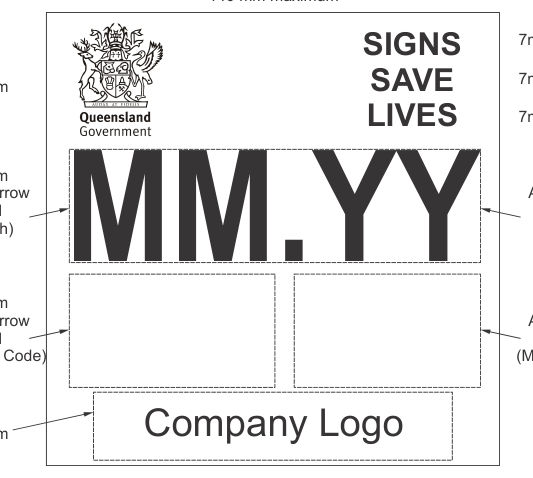
All signs shall have painted, imprinted or indelibly marked onto the substrate on the reverse side of the sign in the lower right hand corner, the following:
- a) The department’s corporate logo of size minimum 25 mm high in the format shown in Figure 13.4.10. The dimensions of the reference marking shall be a minimum of 100 mm x 100 mm and maximum of 140 mm x 140 mm. When a marker size greater than 100 mm x 100 mm is used, the size of all information, excluding the company logo shall remain as shown in Figure 13.4.10.
- b) The month and year of manufacture.
- c) The class and manufacturer's code of material used as background on the sign (codes - 3M, Ni, Ki, St, Re); or other approved system for identifying the manufacturer and sheeting supplier.
- d) The class of material used as background on the sign (400, 1100), and
- e) The legend 'Signs Save Lives'.
100 mm minimum · 140 mm maximum · SIGNS · SAVE · LIVES · MM.YY · 7mm Arial Bold · 25mm · Arial Narrow Bold (Month) · Arial Narrow Bold (Year) · Arial Narrow Bold (Company Code) · Arial Narrow Bold (Material Class) · Company Logo · 15mm
The markings detailed in above shall be black. The lettering in (b), (c) and (d) shall be 25 mm high and located so as to be visible after the sign is erected and not in a position likely to be obscured by stiffener rails or mounting posts. The legend described in (e) shall be located next to the corporate logo in a clear location and shall not exceed the height of the logo. Signs which are double-sided, e.g. fingerboards, shall have the same information detailed above painted, imprinted or indelibly marked onto one side of the sign in a location such that it is unobtrusive but not obscured after erection. The size of the reference marking for these signs shall be reduced to that required to fit, provided that the details are legible. The legend described in (e) above may be deleted.
13.4.11Packing#
Sign faces shall be suitably crated and/or packed to avoid damage during transport and handling. Each sign shall be separated from adjacent signs to prevent damage to the sign surface. If necessary, large signs shall have temporary stiffeners connected during transport.
13.4.12Warranty#
13.4.12.1General#
Where so stated in Clause 7.1 of Annexure MRTS14.1, a performance warranty statement from the sign panel manufacturer shall be included in the quality records. The warranty shall cover the complete sign panel, including all components thereon or attached, except for the sign face or sheeting, and shall guarantee the sign panel against any defects caused by failure of the components for a period of at least 20 years from the date of manufacture. Responsibility for failure shall be limited to the following:
- a) poor workmanship
- b) use of unapproved materials
- c) inappropriate use of approved materials
- d) incorrect construction including fastenings.
13.4.12.2Retro-reflective sheeting (screen printing and digital printing)#
A performance warranty statement from the retro-reflective sheeting manufacturer shall be included in the quality records. Retro-reflective materials must retain a photometric performance of at least the percentage shown above throughout the warranty period and, for non-reflective material, must retain integrity and effective colour and appearance. The warranty must include the full cost of sign replacement or repair, including all labour and materials involved. Any replaced or repaired signs must be covered by the remainder of this warranty period. Minimum warranty periods are contained in Table 13.4.12.2. The warranty shall include the requirement that, if a sign needs to be replaced due to defects in the retro-reflective sheeting, and the sign manufacturer is no longer in business, the manufacturer of the retro-reflective sheeting shall undertake the replacement or repair, including all labour and material involved at the time of replacement. The full replacement warranty period for Classes 400 and 1100 shall not be less than 10 years. The sign manufacturer shall provide certification confirming acceptance of this condition signed by an authorised corporate officer of the retro-reflective sheeting manufacturer.
| Sign Face Material | Sign Warranty Period (No of years, from date of manufacture) | Retro-reflective properties (% of new value retained) |
|---|---|---|
| Class 1100 | 10 | 80 |
| Class 1100 (white with EC overlay film) | 12 | 80 |
| Class 1100 screen printed | 10 | 80 |
| Class 1100 fluorescent reflective orange | 3 | 80 |
| Class 1100 fluorescent reflective yellow and yellow green | 10 | 80 |
| Class 400 | 12 | 80 |
| Class 400 (white with EC overlay film) | 12 | 80 |
| Class 400 screen printed | 10 | 80 |
| Class 400T sheeting for temporary roadwork signs | 3 | 80 |
13.4.12.3Limitations of warranties#
Warranties shall not apply to signs damaged by vandalism, the effect of improper maintenance and cleaning practices and accidental damage caused by vehicle accidents or other events.