1Scope and general#
1.3Terms and definitions#
1.3.13Shall#
Add the following note to the definition:
Where certain requirements in the design or application of the device are described with the 'shall' stipulation, it is mandatory that, when an installation is made, these requirements be met.
See Clause 1.9 b) for guidance on variations to 'shall' requirements.
| Added reference to Clause 1.9 a) for guidance on variations to 'should' recommendations. |
| See changes highlighted yellow following. |
1.3.14Should#
Add the following note to the definition:
Where the word 'should' is used, it is considered to be recommended use, but not mandatory. Any recommendation that is not applied must be based on sound traffic engineering judgement and documented.
See Clause 1.9 a) for guidance on variations to 'should' recommendations.
Added reference to Clause 1.3.14 and removed additional text.
See changes highlighted yellow following.
1.3.25Recommended / Recommendation#
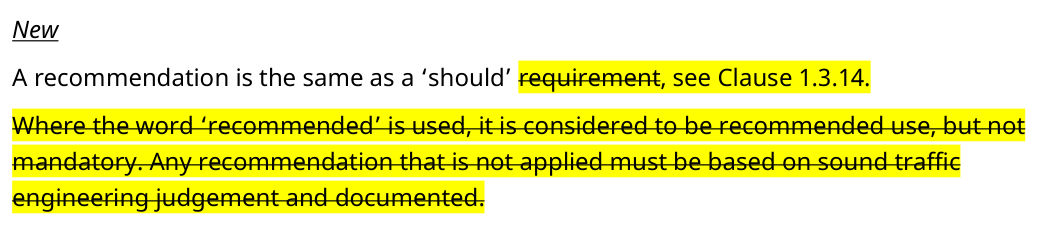
A recommendation is the same as a 'should' requirement, see Clause 1.3.14.
Where the word 'recommended' is used, it is considered to be recommended use, but not mandatory. Any recommendation that is not applied must be based on sound traffic engineering judgement and documented.
Added a new definition for a side road and included a reference to Clause 4.6.7 for the use of the ON SIDE ROAD message on TTM signs. See also changes to Clause 4.6.7.
1.3.26Side Road (use of ON SIDE ROAD message)#
A side road is any other road which intersects and departs from the road you are travelling on.
For the use of the ON SIDE ROAD message refer to Clause 4.6.7.
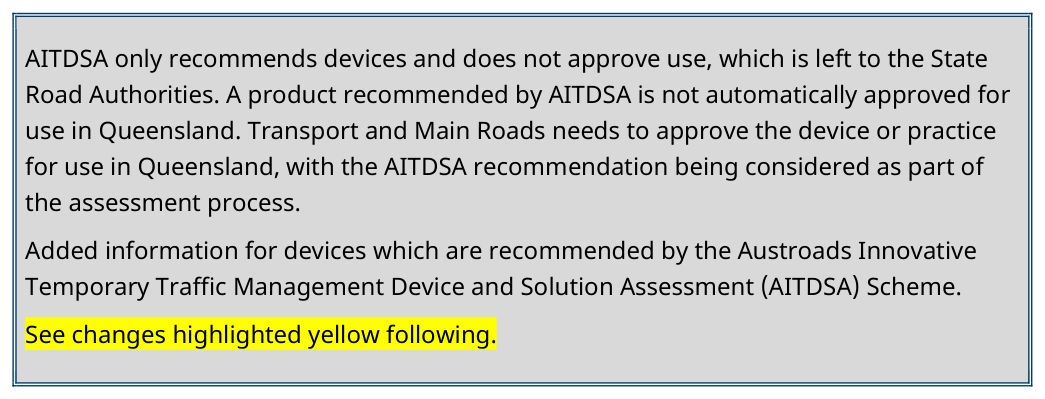
AITDSA only recommends devices and does not approve use, which is left to the State Road Authorities. A product recommended by AITDSA is not automatically approved for use in Queensland. Transport and Main Roads needs to approve the device or practice for use in Queensland, with the AITDSA recommendation being considered as part of the assessment process.
Added information for devices which are recommended by the Austroads Innovative Temporary Traffic Management Device and Solution Assessment (AITDSA) Scheme.
See changes highlighted yellow following.
1.5Innovation#
Innovative treatments that provide improved safety, efficiency and/or value for-money engineering outcomes are encouraged. Such treatments may include:
- a) planning for greater network impacts through reducing the level of service for the road user typically enables works to be undertaken in a more time- and cost-efficient manner
- b) innovative deployment of devices, and/or
- c) alternative device layouts using new and/or improved devices.
New or improved devices, treatments or practices require approval by the Department of Transport and Main Roads (see Clause 1.9 for guidance about variation to optimal treatments).
Devices which are recommended by the Austroads Innovative Temporary Traffic Management Device and Solution Assessment (AITDSA) Scheme also require the approval by the department prior to being used on roads in Queensland. The AITDSA recommendation would be considered and form part of the department’s approval process.
Clarified that an Event Traffic Marshal is a volunteer.
See changes highlighted yellow following.
1.7Prescribed training#
A person is only authorised to perform the role in Queensland if the person holds an authority card that is applicable to that role (that is, where such an authority is a mandatory regulatory requirement). To obtain an authority card in Queensland, a person must undertake the relevant prescribed training course and meet any additional requirements relevant to the appropriate authority card. Prescribed training courses shall be those developed by the Department of Transport and Main Roads and delivered by approved registered training organisations.
Prescribed training courses are outlined as follows:
- a) Working in proximity to traffic awareness Part 1: Required for persons who work on or adjacent to a road in accordance with the QGTTM Part 8 Table A7
- b) Working in proximity to traffic awareness Part 2: Required for persons who have completed Working in proximity to traffic awareness Part 1, and are required to select and implement work method practices as per the short term, low impact works provisions (with exceptions) in accordance with the QGTTM Part 8 Table A7
- c) Traffic management implementation (TMI): Required for persons implementing Traffic Management Plans (TMPs) and Traffic Guidance Schemes (TGSs) in accordance with the QGTTM Part 8 Table A5
- d) Traffic management design (TMD): Required for persons that design, develop, review and inspect TMPs and TGSs in accordance with the QGTTM Part 8 Table A3
- e) Traffic Controller: Required for person who holds an appointment to perform the functions of a Traffic Controller (see Clause 1.3.19) in accordance with the QGTTM Part 8 Table A4, and
- f) Event Traffic Marshal: Required for volunteers persons undertaking event traffic management in accordance with the QGTTM Part 8 Table A7.
In addition to the prescribed training courses identified above, temporary traffic management (TTM) workers listed below shall also act in accordance with the relevant QGTTM requirements:
- g) lookout person: For persons who have completed Working in proximity to traffic awareness Part 1 and Part 2 and are required to act in accordance with the QGTTM Part 8 Table A7
- h) roadworks pilot vehicle driver: For persons who act in accordance with the QGTTM Part 8 Table A7
- i) truck mounted attenuator (TMA) vehicle driver: For persons who have completed TMI and are required to act in accordance with the QGTTM Part 8 Table A7, and
- j) authorised person: For persons who act in accordance with the QGTTM Part 8 Table A7.
Clarified the risk assessment requirements and what needs to be demonstrated and documented through this process when mandatory requirements or recommendations cannot be adopted. Added the requirement to document sound judgement and reasoning through a risk assessment process to demonstrate the acceptability and safety of the varied approaches.
RPEQs do not specifically require TMD qualifications, as the need for TMD will be covered off in the “competent” part of complying with their RPEQ and the Engineers Act requirements. Removed the requirement for an RPEQ to also hold the TMD competency when signing off mandatory requirements that are not adopted or for innovative treatments.
RPEQ sign off is just for the elements where RPEQ justification and certification are required – not the whole design. Added the RPEQ is only required to certify that portion of the TMP and/or TGS design impacted by or related to departures from the mandatory requirements.
See changes highlighted yellow following.
1.9Variation to treatments and Registered Professional Engineer of Queensland certification#
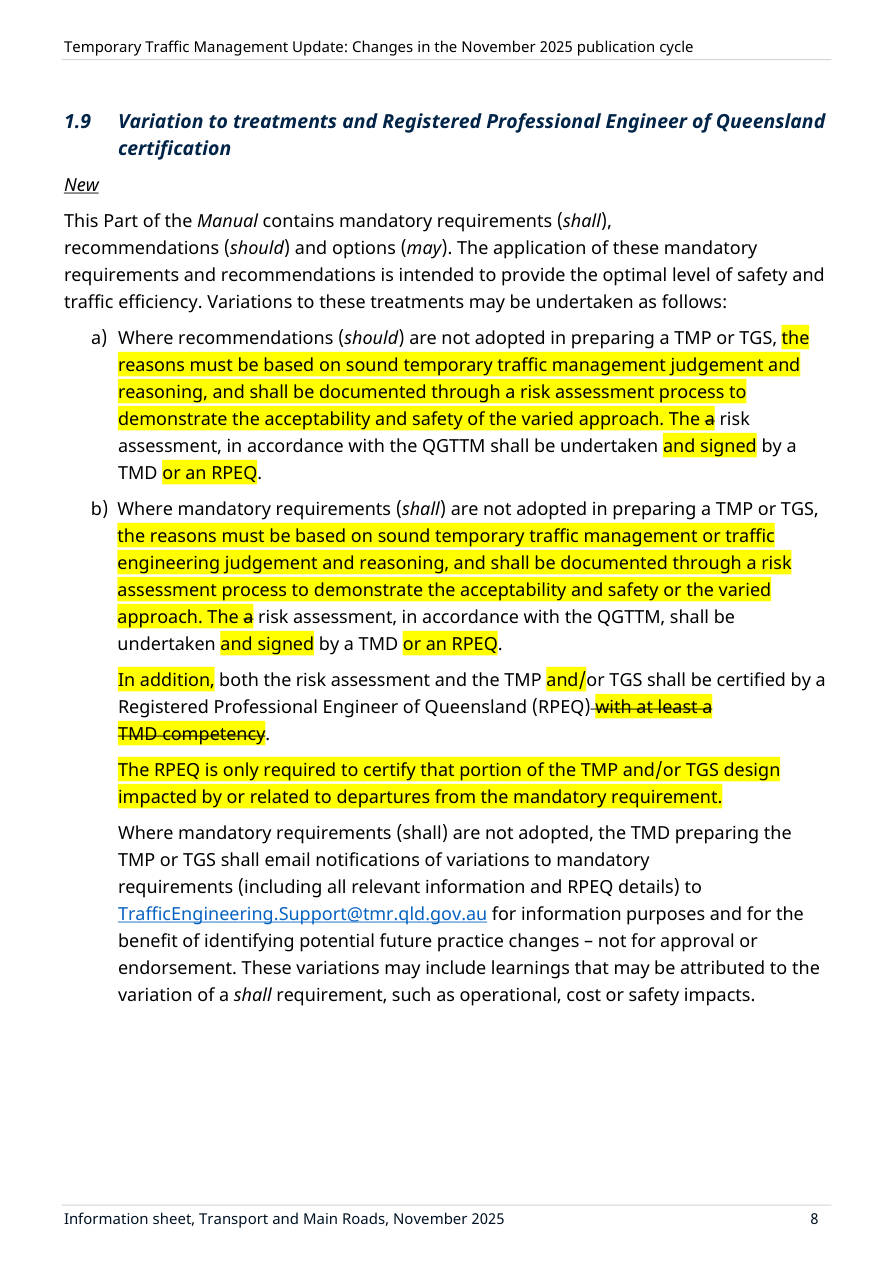
This Part of the Manual contains mandatory requirements (shall), recommendations (should) and options (may). The application of these mandatory requirements and recommendations is intended to provide the optimal level of safety and traffic efficiency. Variations to these treatments may be undertaken as follows:
Where recommendations (should) are not adopted in preparing a TMP or TGS, the reasons must be based on sound temporary traffic management judgement and reasoning, and shall be documented through a risk assessment process to demonstrate the acceptability and safety of the varied approach. The a assessment, in accordance with the QGTTM shall be undertaken and signed by a TMD or an RPEQ.
- b)Where mandatory requirements (shall) are not adopted in preparing a TMP or TGS, the reasons must be based on sound temporary traffic management or traffic engineering judgement and reasoning, and shall be documented through a risk assessment process to demonstrate the acceptability and safety or the varied approach. The a undertaken and signed.
In addition, both the risk assessment and the TMP and/or TGS shall be certified by a Registered Professional Engineer of Queensland (RPEQ) with at least a TMD competency.
The RPEQ is only required to certify that portion of the TMP and/or TGS design impacted by or related to departures from the mandatory requirement.
Where mandatory requirements (shall) are not adopted, the TMD preparing the TMP or TGS shall email notifications of variations to mandatory requirements (including all relevant information and RPEQ details) to TrafficEngineering.Support@tmr.qld.gov.au for information purposes and for the benefit of identifying potential future practice changes – not for approval or endorsement. These variations may include learnings that may be attributed to the variation of a shall requirement, such as operational, cost or safety impacts.
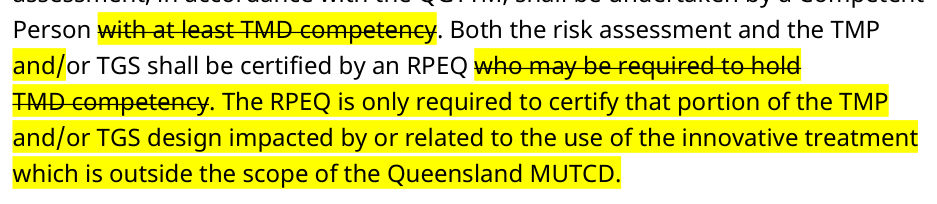
- c)Where innovative treatments (see Clause 1.5) that are outside the scope of the Queensland MUTCD are proposed to be adopted in a TMP or TGS, a risk assessment, in accordance with the QGTTM, shall be undertaken by a Competent Person with at least TMD competency. Both the risk assessment and the TMP and/or TGS shall be certified by an RPEQ who may be required to hold TMD competency. The RPEQ is only required to certify that portion of the TMP and/or TGS design impacted by or related to the use of the innovative treatment which is outside the scope of the Queensland MUTCD.
All proposed innovative treatments require approval by Transport and Main Roads prior to their use or adoption. Requests for approval of innovative treatments (including all relevant information) shall be emailed to TrafficEngineering.Support@tmr.qld.gov.au. As part of an approval to use or trial an innovative treatment, Transport and Main Roads may require that the applicant provides a detailed evaluation report on the performance and effectiveness of the treatment. Transport and Main Roads may use the results of the evaluation to identify potential future practice changes to this Part of the Manual.
- d)The use of options (may), when adopted in preparing a TMP or TGS, are not a variation to the optimal treatment and do not require certification by an RPEQ.
Very few roadworks sites should fall within scope of the RPEQ requirement in addition relation to subclauses (b) and (c). Examples include TMPs or TGSs which involve complex geometric changes that require the application of engineering design principles or complex diversions that might require detailed analysis (such as micro-simulation traffic modelling) to establish the network impacts.
Risk assessments for TTM activities shall be prepared in accordance with the requirements in QGTTM Part 10 Section 2 Risk Management for TTM.
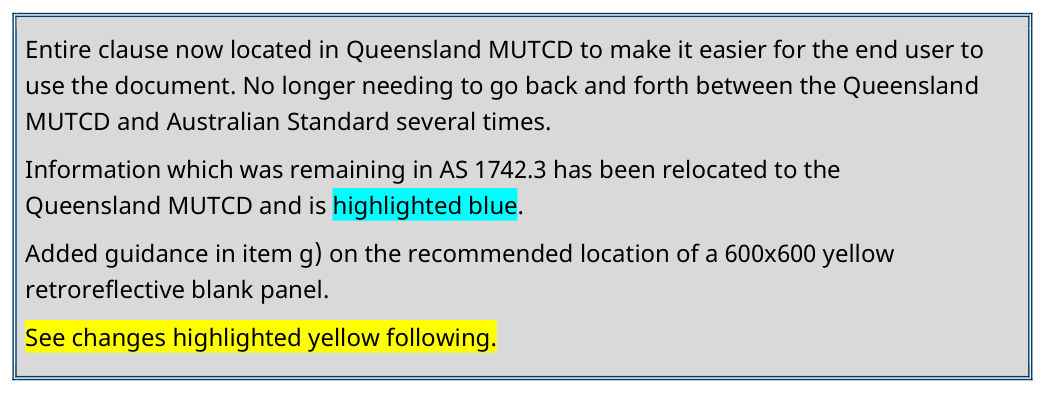
Entire clause now located in Queensland MUTCD to make it easier for the end user to use the document. No longer needing to go back and forth between the Queensland MUTCD and Australian Standard several times. Information which was remaining in AS 1742.3 has been relocated to the Queensland MUTCD and is highlighted blue. Added guidance in item g) on the recommended location of a 600x600 yellow retroreflective blank panel. See changes highlighted yellow following.