4Function, description and use of standard signs and devices#
4.2Selection and use#
4.2.2Multi-message signs#
Replace the entire Clause 4.2.2 with the following:
Multi-message signs offer an alternative sign display to that of standard signs in the Temporary (T Series), Regulatory (R Series), Warning (W Series) and Traffic Instruction (G Series) which are displayed singularly or sometimes as two signs with related messages. Multi-message signs, designated within the TM, RM, WM and GM Series, allow for the display of up to three logically related messages within a single uniform modular frame (see Clause 4.5.2).
Additional multi-message sign panels in common use for which there are no standard sign alternatives may be selected from Appendix A.
Further multi-message sign panels may be developed by state and territory authorities. Where this occurs, the sign specifications, conditions of use and permissible panel combinations should be consistently applied across all jurisdictions.
The conditions of use for multi-message signs are as follows, except when used to control pedestrians only:
- a)Multi-message sign shall have relevant messages consisting of a minimum of —
- i.two 600 mm × 600 mm panels; or
- ii.one 600 mm × 600 mm panel and one 1200 mm × 300 mm panel; or
- iii.one 1200 mm × 600 mm panel.
b) There shall be no more than one regulatory sign panel in the same multi-message sign frame displayed facing the direction of traffic. This excludes additional regulatory supplementary panels relating to and conditioning or otherwise the other regulatory sign panel(s) and which combine to form a single regulatory message.
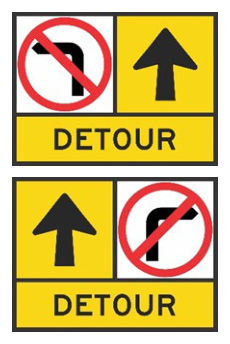
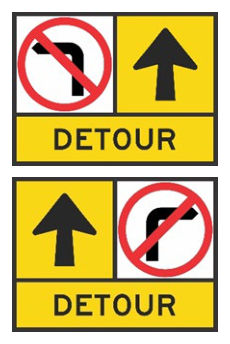
When used, regulatory sign panels shall be placed in the top position of the frame on the side closest to the traffic. This requirement does not apply to No Left (RM2 6A L) or No Right (RM2 6A R) Turn prohibition panels, these panels are installed on the side of the multi message assembly where the turn prohibition applies (see examples in Figure 4.2.2(a)).
d) For multi-message signs facing traffic, within one frame, there should be no more than two message panels consisting of words only. If the 1200 mm × 600 mm space is filled with two separate 600 mm × 600 mm message panels, at least one of the 600 mm × 600 mm panels should be symbolic or a blank retroreflective yellow panel.
These requirements for text only multi message panels do not apply to the following arrangements:
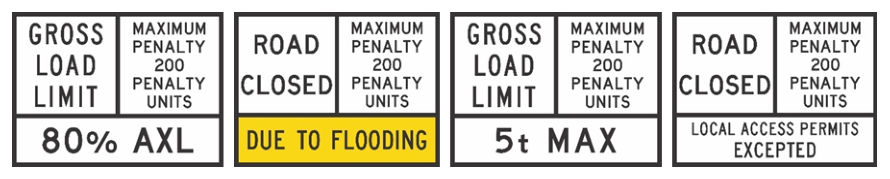
- i.multi message signs installed in accordance with section 46 of the Transport Infrastructure Act 1994 for restricted road use notices, where, in most cases, three panels containing words are required (see examples in Figure 4.2.2(b))
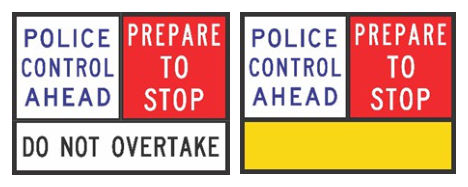
- ii.where police are performing traffic control duties and the 600 x 600 worded panels POLICE CONTROL AHEAD and PREPARE TO STOP are both required, see Figure 4.2.2(c) for examples, and
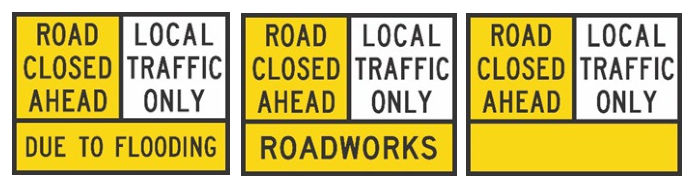
- iii.where the 600 x 600 worded panels ROAD CLOSED AHEAD and LOCAL TRAFFIC ONLY are required, see Figure 4.2.2(d) for examples.
e) A blank retroreflective yellow panel shall be placed within any unused module of the frame so that all panels in the frame are filled.
f) Multi-message sign panels (TM, RM, WM, GM Series) shall only be used in multimessage frames.
g) When a 600x600 blank retroreflective yellow panel is used, it should be located furthest from traffic, except where arrows or other direction related symbol panels are required in this location.
h) Where multi message signs are used and a sign is required at the same location for both directions of travel, the following options may be applied:
- i.use two separate multi message sign assemblies, placed back to back to face opposing directions of traffic, or
- ii.if orientation and sight lines to opposing directions of traffic can be achieved, the one multi message assembly may be used with the panels installed back to back on the one frame.
i) When used, the Speed Limit AHEAD and the END speed limit panels in MMS arrangements shall be placed in the top position of the frame on the side closest to the traffic.
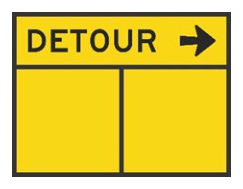
The requirements in a) and g) do not apply when using the 1200 x 300 multi-message panel (TM5 1B) DETOUR with a small arrow, or (TM5-1Q01) DETOUR with U-Turn symbol and there are no relevant messages that may be added to this assembly. In this case, a single TM5 1B or TM5-1-Q01 panel may be used as the top panel in a multi message frame with two blanks (see example in Figure 4.2.2(e)).
Further information regarding the multi-message signs and examples are provided in this Section, Appendices A and B, and the Austroads Guide to Temporary Traffic Management.
TRAFFIC LANE · TRAFFIC LANE
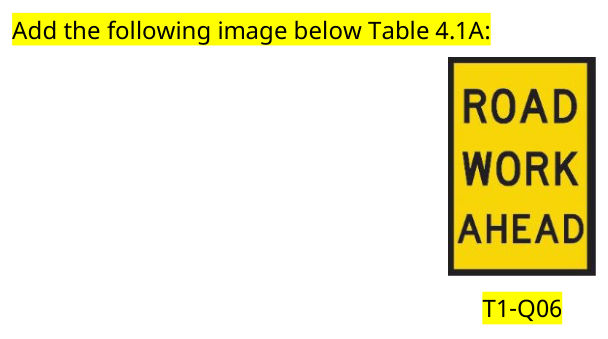
Added T1-Q06, a 600x900 version of the ROAD WORK AHEAD sign.
See changes highlighted yellow following.
4.6Signs and devices for work site approaches and departures#
4.6.2ROADWORK AHEAD (T1-1, TM1-1, T1-31, T1-Q06), ROADWORK X km AHEAD (T1-16)#
The ROAD WORK AHEAD T1-Q06 sign (600 x 900) sign may be used in Queensland, however T1-Q06 shall only be used on narrow medians and shoulders where the standard sign T1-1 or T1-31 would not fit and would be an obstruction to traffic.
Add the ROAD WORK AHEAD T1-Q06 sign (600 x 900) to Table 4.1A:
| Sign | Sign number | Size, mm |
|---|---|---|
| ROAD WORK AHEAD (Narrow format) | T1-Q06 | 600 x 900 |
Add the following image below Table 4.1A:
T1-Q06
Replace:
The ROADWORK X km AHEAD sign should be used X km in advance of a road work site, where additional advance warning is necessary.
with:
Where additional advance warning is necessary, the ROADWORK X km AHEAD sign should be used X km in advance of the Primary PREPARE TO STOP sign (if traffic control is used), or the first cone in a taper (if a taper is used), or the start of the safety buffer area, and be at least two sign spacings in advance on the ROADWORK AHEAD sign.
| Clarified requirements for using the ON SIDE ROAD message including the addition of a new Figure. |
| Modified text to align with ON SIDE ROAD message requirements. |
| Added ROAD PLANT ON SIDE ROAD sign. |
| See changes highlighted yellow following. |
4.6.7ROADWORK ON SIDE ROAD (T1-25, TM1-25), ROAD PLANT ON SIDE ROAD (T1-27, TM1-27)#
Replace:
The ROADWORK ON SIDE ROAD sign shall not be used on a side road to warn of relevant activities on the through road. The ROAD WORK AHEAD (TM1-1A) with a direction arrow (TM5-8A) should be used instead.
with:
arrow (TM5-8B) should be used instead.
| DWORK ON SIDE ROAD | and ROAD PLANT ON SIDE ROAD |
| a side road the terminating leg of a T intersection | to war |
| on the through road continuing leg of the T intersection TM1-1A or TM1-1C) or ROAD PLANT AHEAD (TM1-3-2C), w | through road continuing leg of the T intersection |
| or ROAD PLANT AHEAD (TM1-3-2C) | , w |
The standard MMS Lane Status panel TM10-1A may be used with or without the ON SIDE ROAD message to indicate a direction where the long arrow TM5-8B is not suitable.
The ROADWORK ON SIDE road sign shall not be used where there is an impact for traffic on the through road. Impacts on the through road may include but not be limited to any need for reduced speed zones, additional delineation, changes to alignment or surface condition, use of traffic control or traffic queueing which extends onto the through road. Where there are impacts on the through road, the ROADWORK AHEAD sign (see Clause 4.6.2) should be used.
The ON SIDE ROAD message may be used to provide warning of an activity on another road which intersects with the road you are travelling on (this includes cross intersections and roundabouts but excludes the through / straight direction even if this is another road). However, the ON SIDE ROAD message shall not be used when you are travelling on the terminating leg of a T intersection to provide warning of an activity on the continuing leg of the T intersection. See Figure 4.6.7 below.
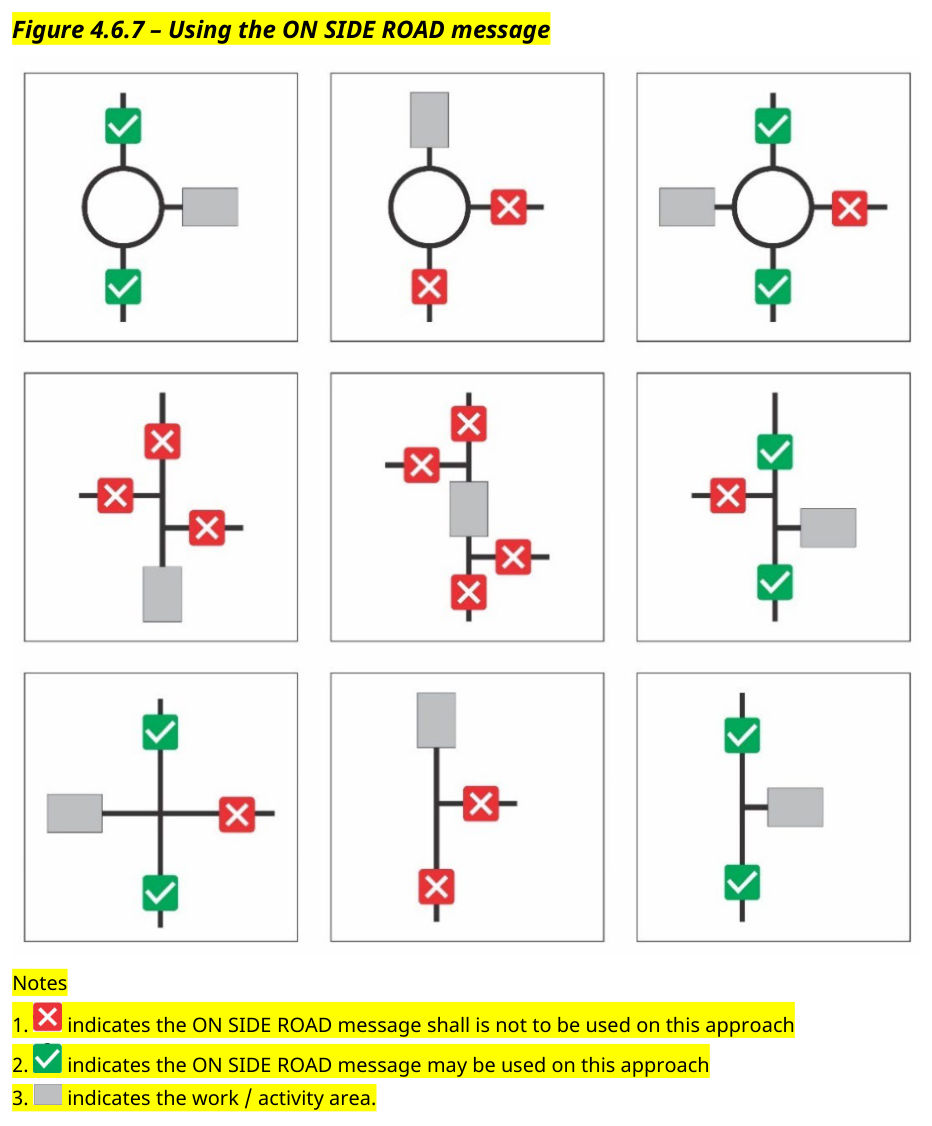
indicates the ON SIDE ROAD message shall is not to be used on this approach · indicates the ON SIDE ROAD message may be used on this approach · indicates the work / activity area.
| To ensure consistency in the use of the SIDE ROAD message. Added requirements for SIDE ROAD CLOSED message to align with the requirements for using ON SIDE ROAD in Clause 4.6.7 |
Table in words
- To ensure consistency in the use of the SIDE ROAD message.
- Added requirements for SIDE ROAD CLOSED message to align with the requirements for using ON SIDE ROAD in Clause 4.6.7.
4.6.9SIDE ROAD CLOSED (T1-32, TM1-32)#
Replace:
The SIDE ROAD CLOSED sign shall be used in advance of an intersection where the side road is closed to all traffic.
with:
The SIDE ROAD CLOSED sign shall be used in advance of an intersection where the intersecting road is closed to all traffic. The SIDE ROAD CLOSED sign shall not be used on the terminating leg of a T intersection to indicate a closure on the continuing leg of the T intersection. In this case the ROAD CLOSED AHEAD (TM1-43A or TM1-43C) sign with a direction arrow (TM5-8B) should be used instead.
| Adjusted terminology for default speed zones in Queensland to match other departmental documents (built-up area and not in a built-up area). |
| See changes highlighted yellow following. |
4.7Signs and devices for regulatory control of traffic#
4.7.3Sign control, single lane operation#
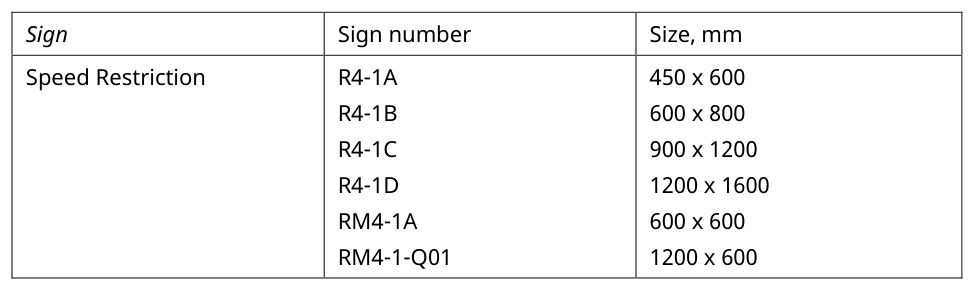
Replace the Speed Restriction row in Table 4.2(E):
| Sign | Sign number | Size, mm |
|---|---|---|
| Speed Restriction | R4-1A R4-1B R4-1C R4-1D RM4-1A | 450 x 600 600 x 800 900 x 1200 1200 x 1600 600 x 600 |
with:
| Sign | Sign number | Size, mm |
|---|---|---|
| Speed Restriction | R4-1A R4-1B R4-1C R4-1D RM4-1A RM4-1-Q01 | 450 x 600 600 x 800 900 x 1200 1200 x 1600 600 x 600 1200 x 600 |
(a)Speed Restriction (R4-1, RM4-1)#
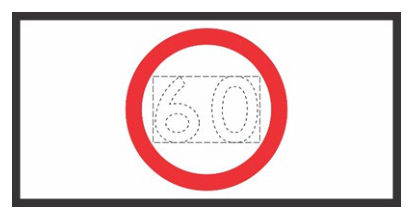
Add the following Speed Restriction sign option.
RM4-1-Q01#
(c)END Speed Limit (R4-12, RM4-12)#
In Queensland where an END Speed Limit is used, the speed limit which applies following this sign is the default speed limit applicable for that road environment of either an open rural road of 100 km/h or a built-up area of 50 km/h a built-up area of 50 km/h or for a road this is not in a built-up area of 100 km/h.
Clarified that the symbolic Detour U-turn (symbolic) MMS panel must only be used with the DETOUR message.
See changes highlighted yellow following.
4.8Detour signs#
4.8.3DETOUR (T5-1, TM5-1)#
Add the following rows to Table 4.3(C):
| Sign | Sign number | Size, mm |
|---|---|---|
| DETOUR (U-Turn) | TM5-1-Q01 | DETOUR (U-Turn) |
| Detour (U-Turn) Symbolic | TM5-1-Q02 | 600 x 600 |
| U-TURN FACILITY AHEAD | TM5-1-Q03 | 600 x 600 |
For detour routes that include a U-turn requirement, the DETOUR U-turn (TM5-1-Q01), Detour U-turn (symbolic) (TM5-1-Q02), or the U-TURN FACILITY AHEAD (TM5-1-Q03) signs may be used. The Detour U-turn (symbolic) (TM5-1-Q02) panel shall only be used with a DETOUR panel (TM5-7A or TM5-7B).
TM5-1-Q01#
TM5-1-Q02#
TM5-1-Q03#
Added recommended locations of the Detour marker (TM5-6A) arrow in an MMS arrangement, in response to questions regarding the placement of the detour arrow marker on MMS sign arrangements.
4.8.4Detour marker (T5-6, TM5-6A)#
When the Detour marker (TM5-6A) is used in a multi-message arrangement, the arrow panel should be located as follows:
- For an arrow pointing straight-ahead, locate the arrow closest to traffic, except where other direction related symbol panels (such as no right turn) are required in this location.
- For an arrow indicating a turn to the left or right, locate the arrow on the side of the multi-message arrangement the arrow is directing towards.
Other sizes for the truck symbolic sign exist in AS 1742.3 but not the C size MMS sign panel.
Added TM2-25-Q01C Trucks 1200x600 MMS sign panel.
4.20Other signs and devices#
4.20.1General#
Replace the Trucks (rectangle and square) row in Table 4.14:
| Sign | Sign number | Size, mm |
|---|---|---|
| Trucks (Rectangle and square) | T2-25 TM2-25A | 900 x 600 600 x 600 |
with:
| Sign | Sign number | Size, mm |
|---|---|---|
| Trucks (Rectangle and square) | T2-25 TM2-25A TM2-25-Q01C | 900 x 600 600 x 600 1200 x 600 |
Add the following Trucks (Rectangle and square) sign option to item a)
TM2-25-Q01C#
| Change |
|---|
| Added ROAD PLANT ON SIDE ROAD (TM1-48C) and additional notes referencing Clause 4.6.7 and noting that this panel is the same as TM1-27C. |
| Added SIDE ROAD CLOSED (TM2-43A) and additional notes referencing Clause 4.6.9. |
| Added WATER OVER ROAD (TM3-21A) and additional notes relating to the use of this MMS panel to ensure consistency of application of the requirements for use of the WATER OVER ROAD sign in AS1742.2. |
| Added notes to the use of the ON SIDE ROAD panel to align with the requirements of using the ON SIDE ROAD message in Clause 4.6.7 and corrected the 600 x 600 arrow sign reference number. |
| Added ON SIDE ROAD with arrow (TM5-10B) and additional notes to align with the requirements of using the ON SIDE ROAD message in Clause 4.6.7. |
| Added EVENT ON SIDE ROAD (TM9-4C-Q01) and additional notes to align with the requirements of using the ON SIDE ROAD message in Clause 4.6.7. |
| Added notes to the use of the event ON SIDE ROAD with arrow (TM9-5B) panel to align with the requirements of using the ON SIDE ROAD message in Clause 4.6.7. |
| See changes highlighted yellow following. |